Fewer than 20% of the companies that operated in Europe's crypto market before MiCA have secured a license so far. We look at whether the new rules could speed up consolidation among European exchanges, and who stands to lose from them.
On October 8, the European Securities and Markets Authority (ESMA) published an opinion stating that MiCA-licensed crypto companies must stop offering services for stablecoins that do not comply with the regulation. USDT and PYUSD are subject to the new restrictions.
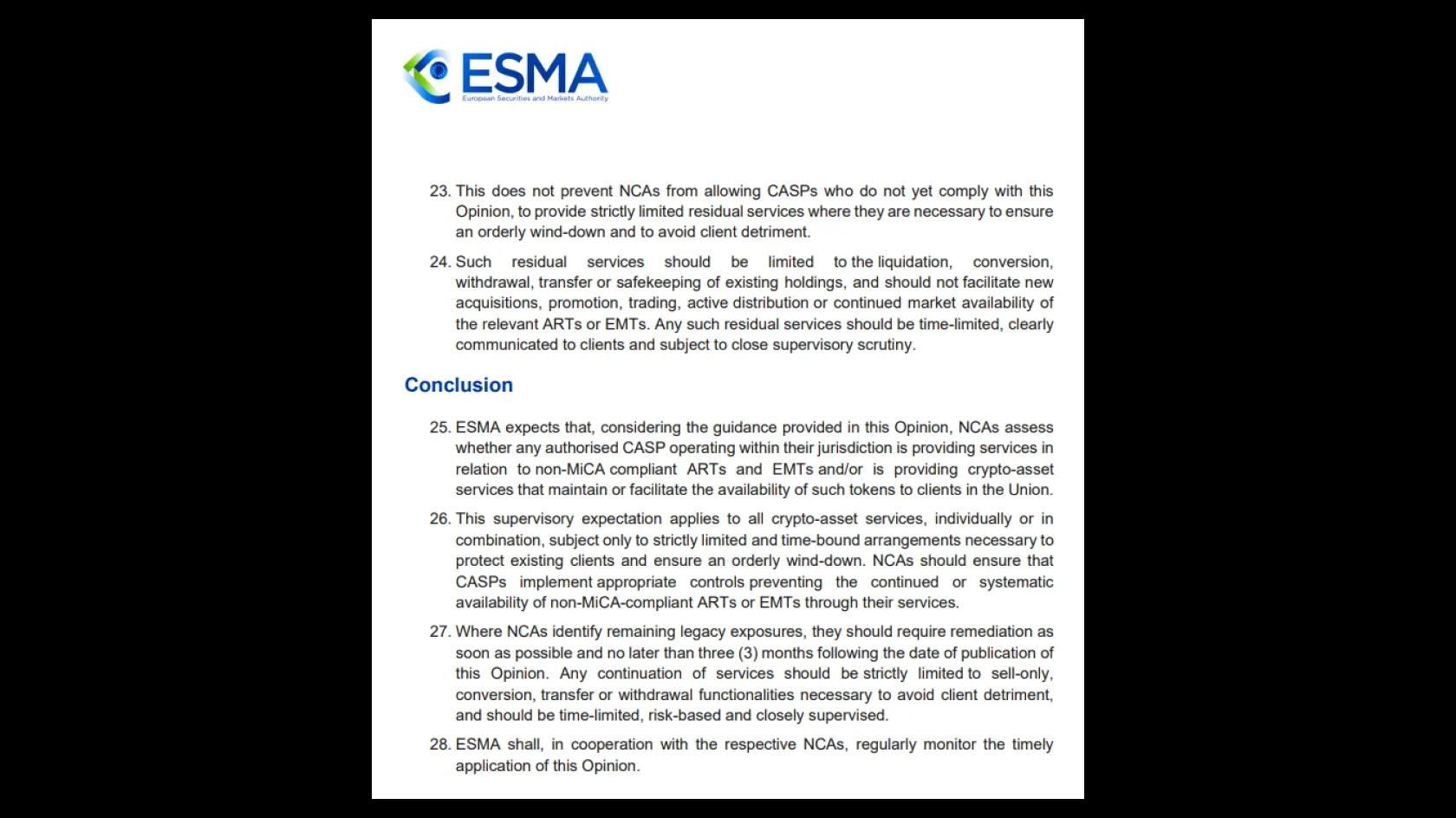
The regulator wants purchases of these stablecoins on licensed platforms to stop by January 8, 2027, while national authorities will set the exact timing within three months. Before the deadline, users will need to sell their remaining tokens, swap them, or withdraw them to personal wallets.
What the Document Says
ESMA’s press release puts the requirement this way: “crypto platforms must stop providing services tied to stablecoins that do not comply with MiCA.”
Text of the document. Source: ESMA
The regulator did not name specific coins, but the description fits Tether’s USDT and PayPal’s PYUSD. USDT remains the world’s largest stablecoin by market capitalization, and PYUSD is among the biggest players in the segment.
Once the transition period ends, the regulator requires platforms to stop offering all services tied to such tokens, including trading, custody, and crypto portfolio management. Exchanges must block purchases and prevent clients from increasing their positions.
Until the transition period ends, platforms may let clients sell these tokens, convert them into other assets, transfer them to external addresses, and withdraw them to personal wallets. Some exchanges may disable these functions ahead of the deadline.
The restrictions will hit hardest users who keep stablecoins on centralized exchanges and use them for day-to-day payments. USDT holders can still keep their tokens in their own wallets and swap them on decentralized exchanges.
ESMA Contradicts Its Earlier Guidance
The regulator’s new stance departs from its earlier guidance. In January 2025, ESMA stated that holding and transferring stablecoins remained permitted services, even if the token falls outside MiCA. In March 2025, the agency’s press office told Cointelegraph that MiCA does not ban such operations.
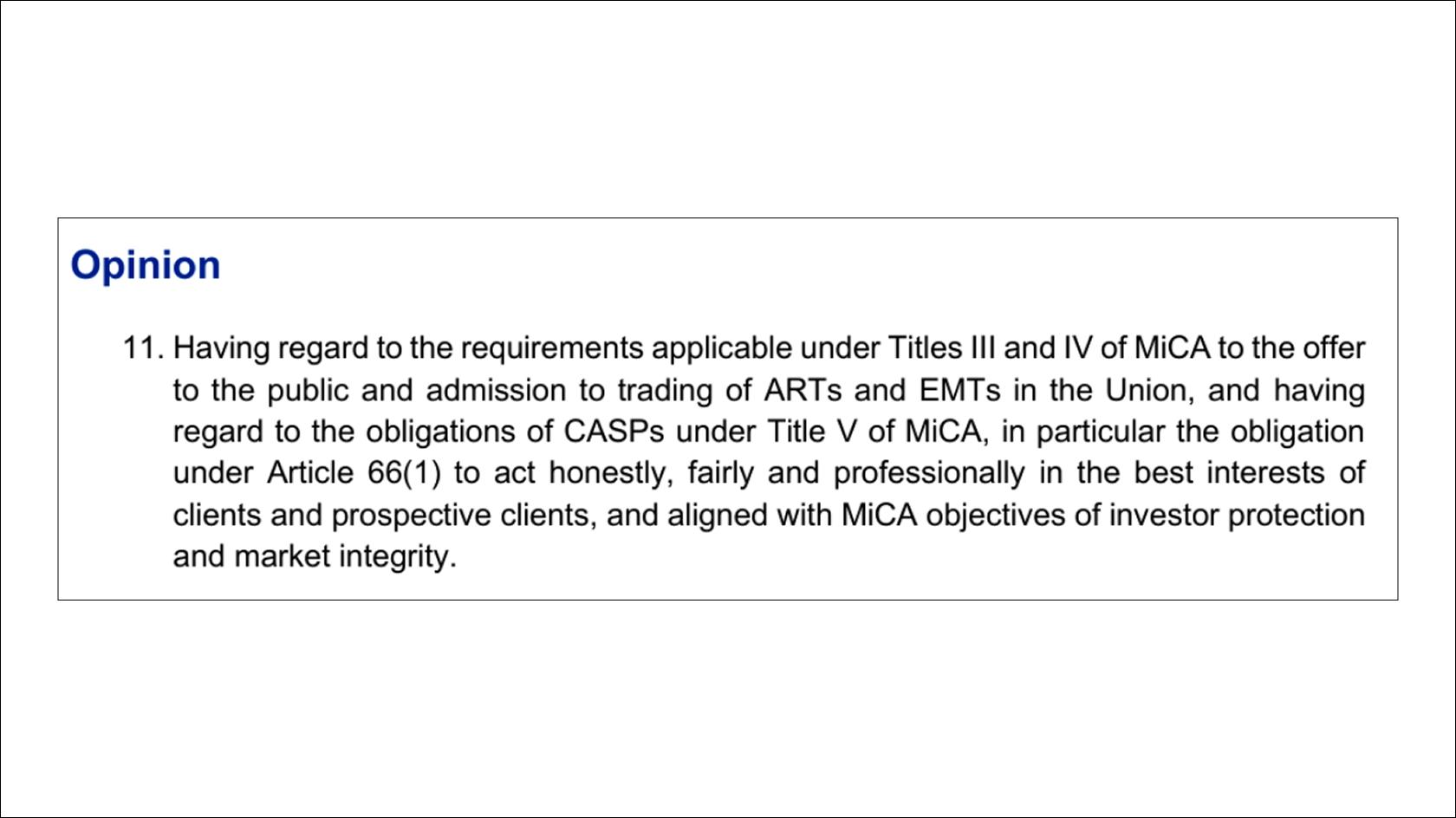
ESMA now cites Article 66(1) of MiCA, which requires crypto service providers to act in their clients’ interests. The regulator argues that providing services for stablecoins that do not meet EU rules conflicts with that obligation.
MiCA requires platforms to act in the client’s interest. Source: ESMA website
It’s worth noting that the opinion is not legally binding. The document is addressed to national supervisory authorities and sets out ESMA’s view on how existing rules should apply. On September 30, the agency asked the European Commission to enshrine the ban in MiCA. Until the legislation changes, regulators in different EU countries may interpret the existing provisions differently.
This creates legal uncertainty for crypto exchanges. They must factor in not only ESMA’s general stance but also the approach of the national supervisor that issued their license. As a result, the timing and process for disabling individual features may vary.
Where Circle and Tether Stand
Circle, the issuer of USDC, has already received authorization to operate in the EU under MiCA. It proposes that the EU treat stablecoin rules in other jurisdictions as equivalent to its own. According to Patrick Hansen, head of European regulatory affairs, this could serve as an alternative to having several issuers launch tokens jointly.
Global stablecoins can currently meet MiCA requirements through multi-issuance. If the EU begins recognizing foreign rules as equivalent to its own, foreign issuers would not have to use that scheme in every case.
In its comments on the proposed amendments to MiCA, Circle called for a review of the requirement to hold 30–60% of stablecoin reserves in bank deposits. At the same time, the company wants to keep multi-issuance.
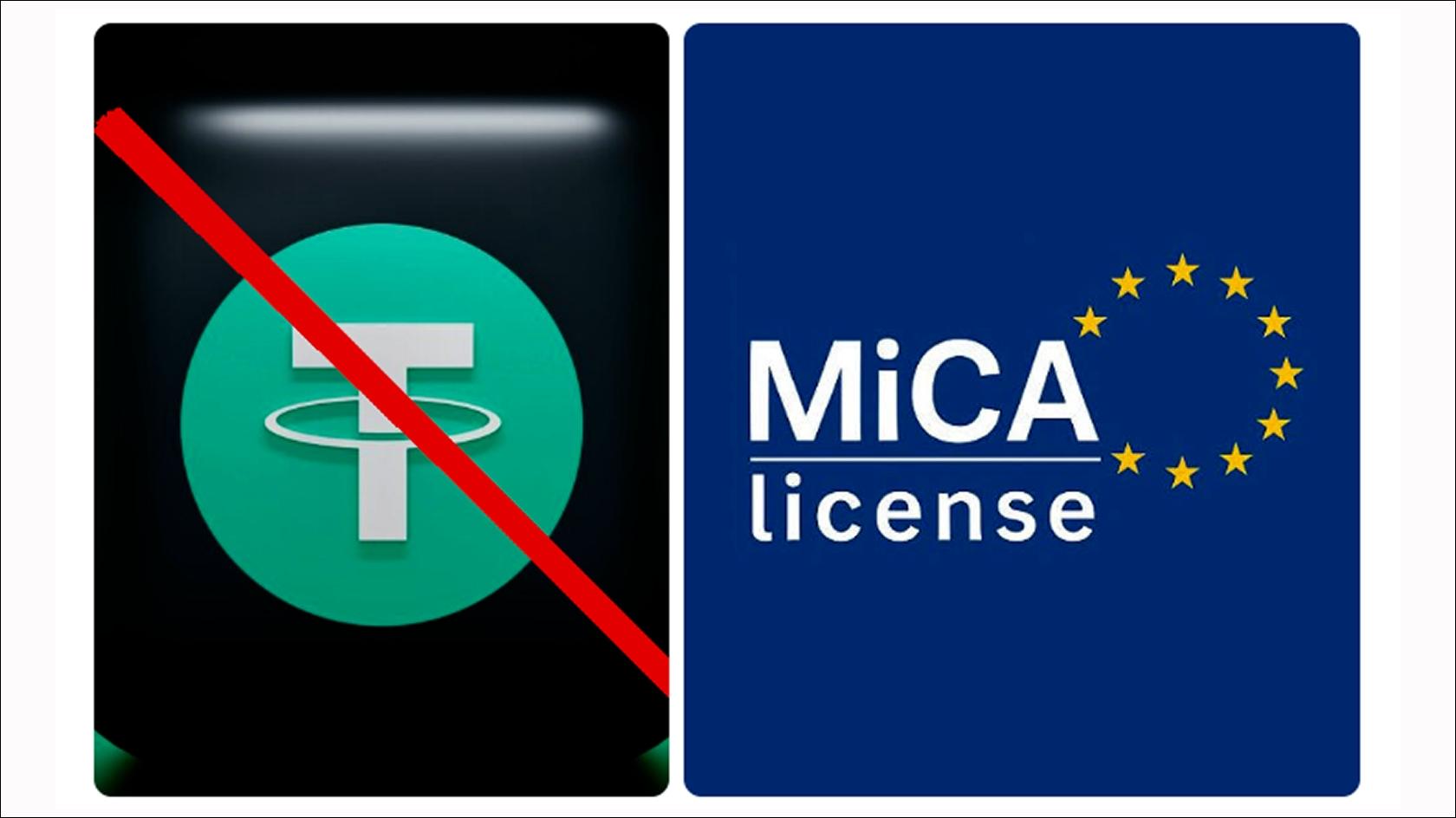
Tether loses access to the EU market. Source: X
Tether has not obtained a MiCA license and had not commented on the ESMA opinion at the time of publication. Its CEO, Paolo Ardoino, has criticized the requirement to keep part of the reserves in bank deposits. Tether keeps the bulk of its reserves in US Treasuries.
The ECB’s Stance: Deposits, Interest, and Multi-Issuance
The European Central Bank and the central banks of the 27 EU countries also oppose the requirement to hold part of stablecoin reserves in bank deposits. They argue that issuer deposits are less stable than retail deposits and that mass token redemptions would hit a bank’s funding. The central banks also propose keeping the ban on paying rewards to token holders and extending it to lending secured by stablecoins and to staking.
In addition, the ECB and national central banks want the power to ban the issuance of tokens pegged to non-EU currencies and to transfer supervision of crypto companies to ESMA. The aim is to strengthen centralized control over the EU crypto market.
How MiCA Is Reshaping Europe’s Crypto Market
The transition period for MiCA’s full rollout ended on July 1, 2026. By that date, crypto companies had to obtain authorization under the new rules or stop serving clients in the EU.
By May, according to ESMA, about 210 companies out of more than 1,200 previously registered at the national level had received licenses. That is less than a fifth of the market’s former participants. By the end of June, the number of authorizations had risen to roughly 230, but most of the old market remained unlicensed at the deadline.
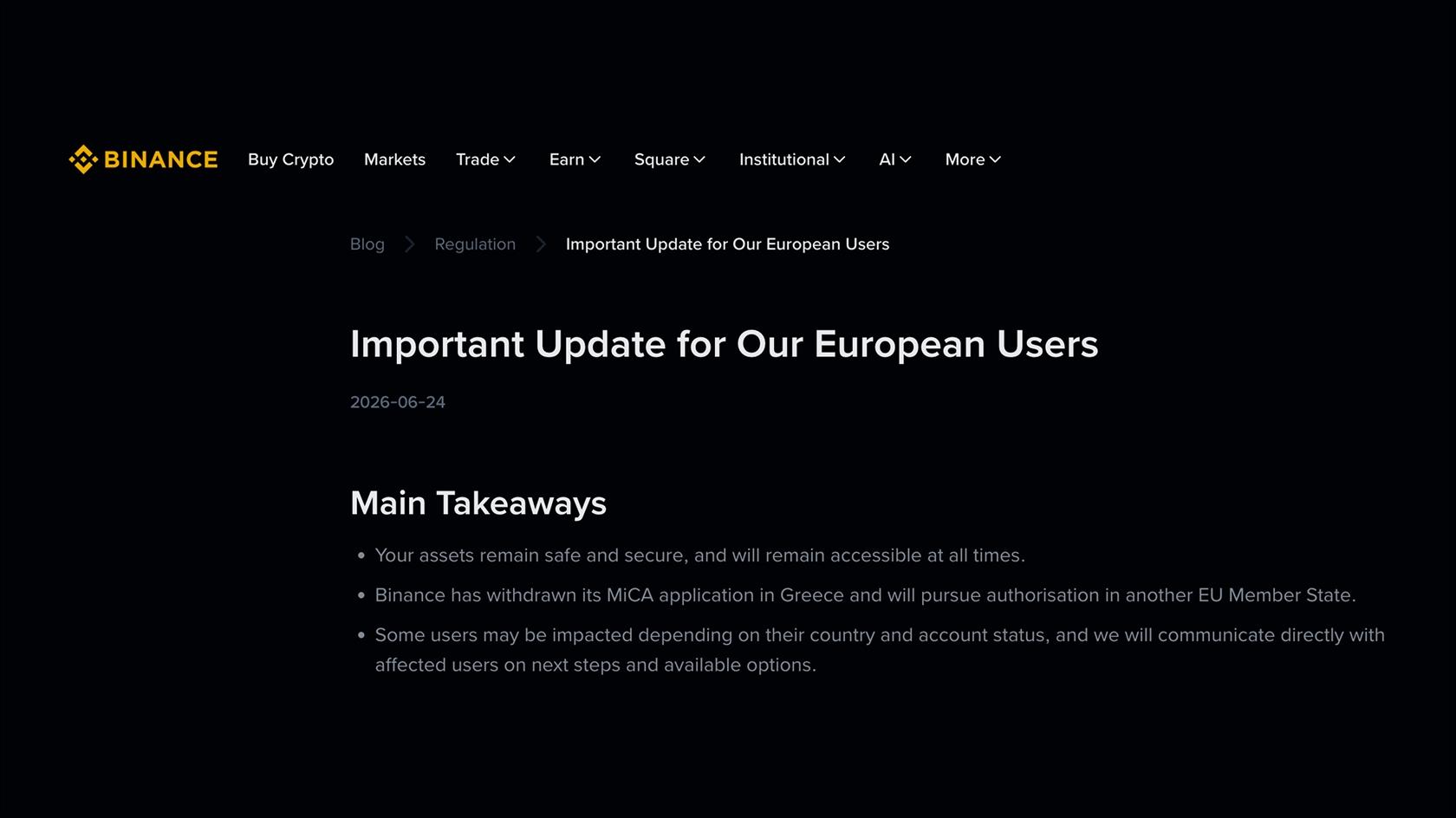
One of the most notable cases was Binance. The exchange had been seeking a license in Greece that would have let it serve clients across the entire European Union, but it withdrew its application on June 24. The company said it had been unable to obtain a formal decision on the Greek application and pulled it out of caution.
Binance statement. Source: the exchange’s official website
“Europe remains an important market for us. Our commitment to operating within the clear, fair, and harmonized MiCA framework has not changed. We are confident we will receive a license in the coming months,” Binance said.
Experts say the small number of licensed companies reflects the high cost of complying with the new requirements.
Roshan Dharia, CEO of Echo Base, an investment firm specializing in distressed assets, said MiCA compliance costs could be prohibitive for smaller crypto platforms.
“The low share of licensed companies suggests that much of the market has concluded that obtaining and maintaining a MiCA license is not economically viable under current business models,” he said.
Floortje Nagelkerke, a partner at the law firm Norton Rose Fulbright, believes some companies may stop serving clients directly and hand those functions over to licensed providers.
“We will see market consolidation and client transfers, because not all existing companies will manage to meet the requirements by the deadline,” she said.
Companies that have already received authorization include Coinbase in Luxembourg, Kraken in Ireland, and Revolut in Cyprus.
Miguel Zapatero, general counsel at Crossmint, believes the changes will lead to a smaller market where institutional players carry more weight.
“This is a sign of a maturing market,” he said.
Will USDT and PYUSD Return to Licensed Exchanges?
The European Commission must present a report on how MiCA is being applied by June 30, 2027, and, if necessary, propose amendments to the regulation. Reasons for a review include gaps in the regulation of foreign stablecoin issuers, divergence between EU and US rules, and the emergence of new tokenized financial instruments. In July, Euronews, citing EU diplomats, reported that a revisit of the legislation was seen as all but inevitable.
For USDT and PYUSD to return to licensed EU crypto exchanges, the current rules would have to change. Until that happens, users should check the terms for stablecoin services on their platforms and decide in advance where to keep their coins once the new rules take effect.
Our Take
MiCA requires a significant share of stablecoin reserves to be held in bank deposits. This adds risks related to banks’ stability and access to funds.
Tether’s refusal to go through MiCA authorization means licensed EU platforms cannot work with the world’s largest stablecoin. This shows how unpolished the system is and how easily it sacrifices user convenience to bureaucratic requirements.
The most surprising part is that Tether’s backing raises no questions. In other words, keeping USDT off authorized EU crypto exchanges is just legal red tape.
As a result, Circle has become one of the main beneficiaries, the favorite of the European system. While USDT sees its options narrow, USDC is winning in Europe in the undeclared war between stablecoin issuers.
This post is for informational purposes only and does not constitute advertising or investment advice. Please do your own research before making any decisions.