

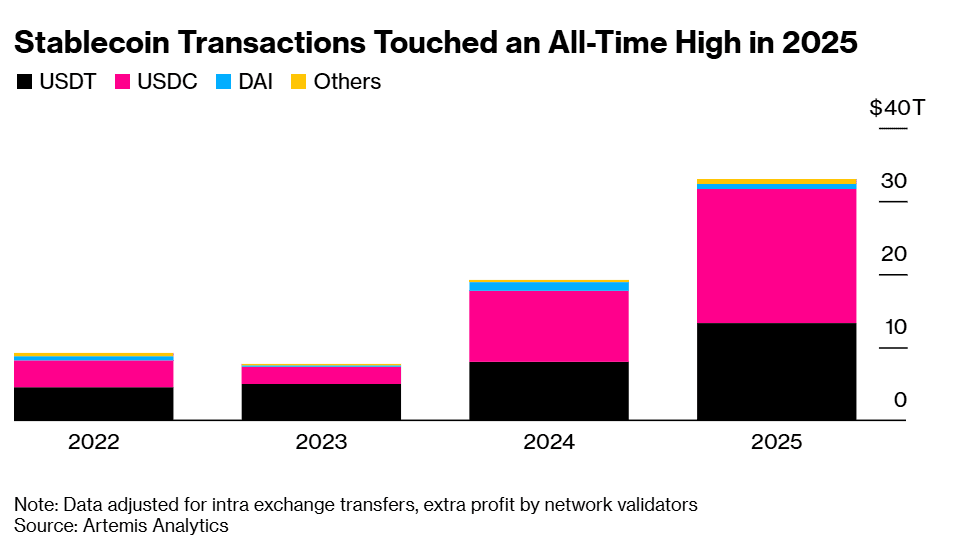
The total stablecoin transaction volume grew by over 72% to $33 trillion in 2025. In the next five years, it is reported to jump 3x. What’s even more interesting is that stablecoin comprises nearly 50-75% of all on-chain crypto transactions.
- markets
- ecosystems
- articles
- 23 Mar 26
Why Stablecoins Are Growing Faster in Emerging Markets
Stablecoins are becoming critical financial infrastructure in emerging markets. Here’s what’s driving adoption and where the risks lie.
0
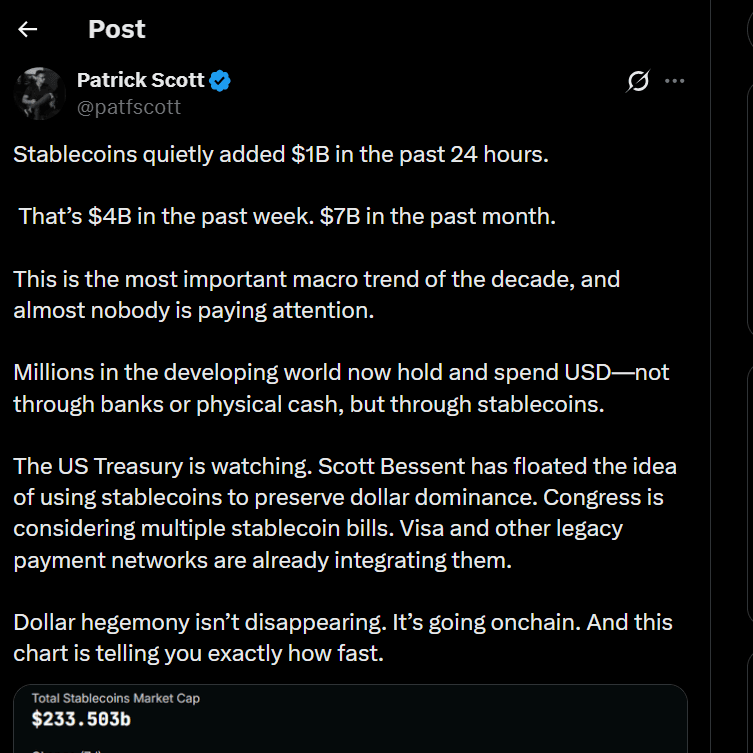
Stablecoins are more popular in the emerging markets. The people in these countries are not crypto enthusiasts. They are just ordinary people using stables in emerging markets as a simple act of financial survival. Countries such as Nigeria, Vietnam, the Philippines, and Bangladesh now trust these tokens even for savings.
In third-world countries, where currency devaluation is a real threat, these USD-pegged tokens act as a savings account, a payment option, and, very importantly, as an inflation hedge. This article discusses why stablecoins work on the ground and what the $1 trillion stablecoin opportunity is.
How Stablecoins Actually Work on the Ground?
Let’s start with an emerging economy like Nigeria to better understand the practical utility of stablecoins. Naira fell more than 71% in value between 2023 and 2025. The inflation numbers came as a huge shock. Nigerians began acquiring stables to hedge against the currency's decline. Nigeria now tops the list of countries adopting stablecoins, with 25.9 million users, representing 11.9% of the population.
Argentina is another nation with a large number of stablecoin users. With annual inflation exceeding 200% in 2023 and the peso having lost more than 90% of its value over the previous decade, 61.8% of all crypto transactions in the country involved stables.
Argentina is one of only two markets globally, alongside India, where USDC's usage share approaches parity with USDT. This is very important as USDC is associated with savings and treasury behaviour. Most likely in Argentina, people are not trading. They are rather saving wealth.
Also Read: Circle’s IPO: Can the Stablecoin Giant Survive Public Scrutiny
The Everyday Use Cases of Stablecoins:
Across these and other emerging economies, stablecoin use cases follow a few consistent patterns:
- Savings and wealth preservation: When a currency is losing value every day, holding USDC or USDT is only logical. It helps many investors in countries burdened by severe inflation, such as Venezuela and Nigeria.
Also Read: How CFOs Save $100K+ Monthly on Stablecoins (The European Trick)
- Peer-to-peer payments: In Bolivia, shops began listing prices in USDT as a more predictable reference than the boliviano, especially after foreign-exchange reserves fell to just $1.98 billion.
- SME and freelancer payments: Small businesses and freelancers in emerging markets are adopting stables to survive unpredictable FX environments and avoid the costly international transfers and cross-border payments.
Also Read: AI-Optimised Stablecoins: Smart Algorithms for Real-Time Peg Stability
The Use of Stablecoins in Remittances and Cross-Border Payments
In 2024 itself, migrants sent approximately $685 billion to developing countries. Those transfers often arrived late, got stuck, and were dependent on inferior banking models built for a different era.
Moreover, the average global remittance fee stood at 6.49% in 2025. In sub-Saharan Africa, it was even higher, reaching almost 8.8%. So, people sending money to their families collectively lose more than $50 billion a year to fees alone.
These USD-pegged tokens offer a much more cost-efficient alternative. Sending $200 from the US to Colombia costs less than $0.01, compared to almost $12.13 via traditional channels. Also, blockchain payments settle almost instantly, at any time of day, any day of the year.
Why Stablecoins Compete With Banks, Not Just Fintech Apps
It's not just stablecoins vs fintech apps now. They compete directly with the banking system. They eliminate intermediaries, reduce settlement risk, and reduce the cost quite significantly. Additionally, for B2B cross-border settlements, where margins are tighter and speed matters more, the difference almost changes the whole game.
Among payment companies tracked by Artemis Analytics, monthly stablecoin B2B payment volume grew from under $100 million at the start of 2023 to over $3 billion by early 2025.
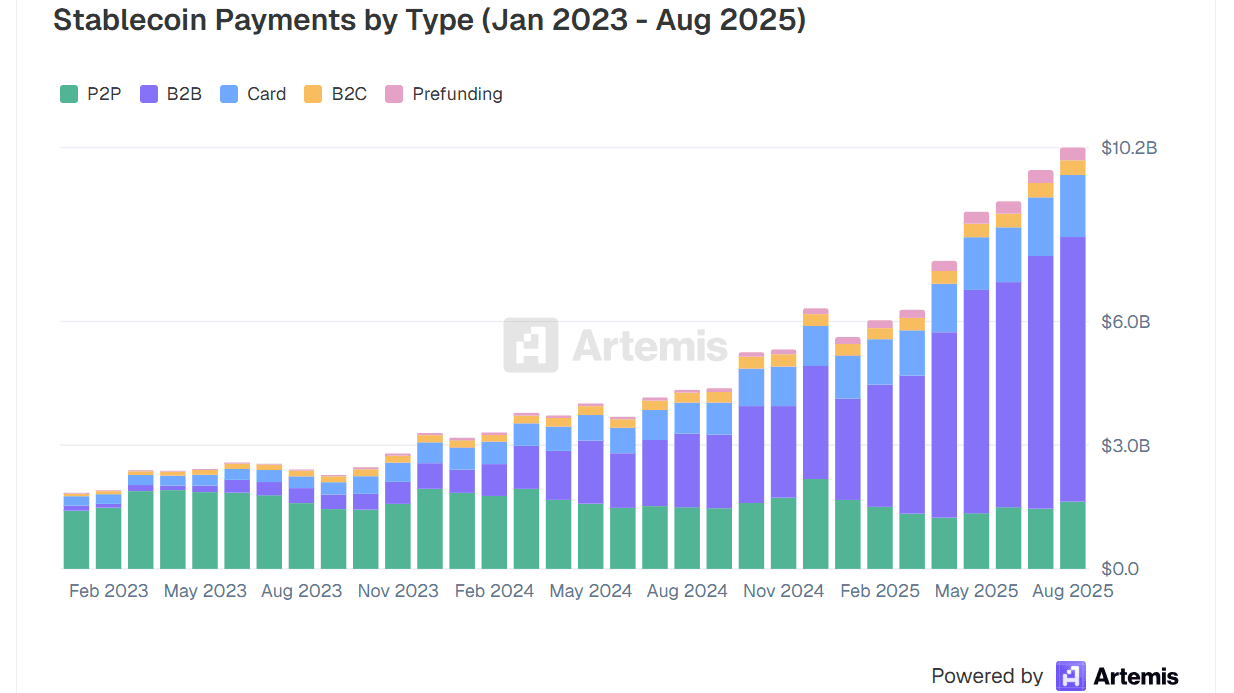
Over $136 billion in stablecoin payments have been recorded since January 2023 across 31 payment companies. So, essentially, the B2B players that now use these tokens have an edge in terms of savings in finance costs.
Stablecoins: Market Size and the Future
Standard Chartered analysts predict that stablecoin market capitalisation will reach $2 trillion by the end of 2028. That’s roughly 6.5x growth in just under three years. Also, the leading bank views this growth as driven by macroeconomic trends that persist even if Bitcoin and Ethereum trade sideways. That’s a pattern that is even seen in the current market conditions.
Here, the Treasury bill angle is equally important. Stablecoin growth could create $800 billion to $1 trillion in additional demand for US Treasury bills by 2028. This is because issuers accumulate short-term government debt as reserve assets.
For some context, USDT and USDC already collectively hold more US Treasuries than Saudi Arabia, according to the IMF's External Sector report.
On the payments side, Bloomberg Intelligence has already reported that stablecoin payment flows could reach $56 trillion by 2030. Moreover, Citi forecasts the market could reach $1.6 trillion by 2030, and some scenarios suggest as high as $3.7 trillion.
Have a look at this comprehensive table to get an understanding of stablecoin usage patterns across the globe:
| Country | Key Reason | Stablecoin Use | Key Stat |
|---|---|---|---|
Nigeria | Naira devaluation, remittances | Savings + B2B payments | 11.9% population adoption; $22B in transactions (Jul '23-Jun '24) |
Argentina | 200%+ inflation, peso collapse | USDC as savings vehicle | 61.8% of all crypto transactions are stablecoins |
Turkey | Massive lira devaluation since 2018 | USDT/TRY trading dominates | 4.3% of GDP in stablecoin purchases (2023-24) |
Venezuela | 170%+ inflation | P2P settlements | $44.6B in crypto volume (Jul '24-Jun '25) |
Vietnam | Remittances + gaming | Everyday infrastructure | 55% growth in on-chain value (12 months to June 2025) |
Pakistan | $35B remittance flows, unbanked | Mobile-first P2P | Fastest-growing region (South Asia, +80% in H1 2025) |
Bolivia | FX reserve collapse | USDT as unit of account | Shops pricing in USDT; banking sector integrating crypto |
India | Diaspora remittances + fintech | Mixed: ~47% USDC usage | $338B in on-chain inflows; #1 globally in adoption index |
What does the Regulatory Landscape Look Like for Stablecoins?
US and EU
In July 2025, the Trump administration brought the GENIUS Act. The law requires stablecoin issuers to maintain 1:1 reserves backed by fiat USD or short-duration Treasury instruments. They also need to publish monthly reserve reports and disclose redemption policies.

Issuers with a market cap above $50 billion must file audited financials annually. Now, that was a big moment in the stablecoin market and the crypto industry as a whole. Bringing a clear jurisdictional basis to an action means the US Government accepts crypto as a legitimate financial market.
Likewise, the EU's MiCA regulation takes a different approach. While it implements strict reserve, audit, and redemption rules, it simultaneously limits the volume of USD-denominated coins circulating in the euro area. This way, they are actively encouraging euro-denominated alternatives.
Emerging Market Approaches
The picture across emerging markets still is a work in progress. Nigeria brought virtual assets under the oversight of its SEC through the 2025 Investment and Securities Act. Brazil's 2022 Virtual Assets Law requires authorisation, with powers held by the Central Bank.
Similarly, Bolivia announced plans to integrate stablecoins into the national financial system, allowing banks to offer crypto-custody services.
Different laws in different countries obviously differ in detail, but the core principle remains the same. Stablecoins should be regulated like financial institutions. The era of regulatory arbitrage and loopholes is slowly coming to an end.
Entry Strategies for Builders and Institutions
Systems Around Distribution or Compliance
For those entering emerging markets, this is a genuine problem. The most successful operators like Bitso, Yellow Card, Coins.ph chose local fintech partnerships first. They became part of the existing ecosystems, worked with local regulators early, and built systems that can handle last-mile cash conversion.
In many emerging market cities, the final step is converting stablecoins into local currency, and it still relies on informal P2P markets. Building or partnering around this issue is often the most important factor in product viability.
USD Stablecoins vs Local-Currency Alternatives
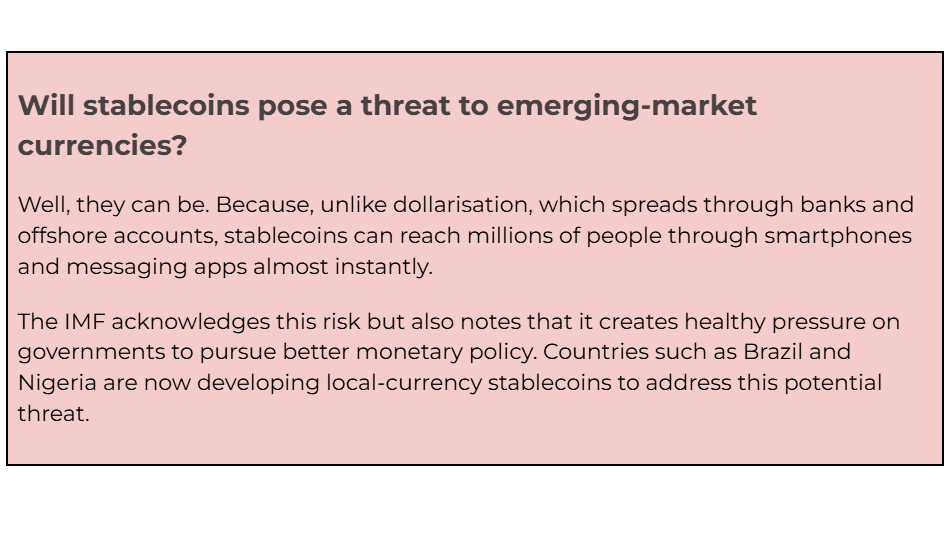
USD-pegged tokens hold high value because dollar demand is sort of predictable, and people often trust the USD more than their local currency. But interestingly enough, local currency stablecoins are still gaining popularity. This is because of regulatory advantage (like the EU) and, in certain cases, because of genuine utility.
As of 2025, almost all stablecoins, over 97%, are still connected to the US dollar.
Infrastructure That Actually Matters
Tron dominates low-cost stablecoin transfers in emerging markets due to its very low fees. Ethereum, Binance Smart Chain, and Polygon are also in line. In June 2025, Visa expanded its stablecoin settlement capabilities to Central and Eastern Europe, the Middle East, and Africa through a partnership with Yellow Card. They have already helped people settle over $225 million in stablecoin transactions.
Risks You Cannot Ignore
Here are some important risks that you must take note of:
- De-pegging risk: In March 2023, USDC traded 12% below dollar parity after the collapse of Silicon Valley Bank, where it held large deposits. In cases of defaults, the risks are directly transferred to the investors.
- Reserve opacity: USDT and USDC reserves are audited by Deloitte and held in more regulated structures.
- Liquidity fragmentation: Different people in different countries use different blockchains. It is hard and expensive to switch between these blockchains.
The $1 trillion Stablecoin Opportunity Isn’t Far Away
Stablecoin adoption is steeping, not because of the novelty factor or the hype they carry. Stablecoins are solving real-world problems and giving power back to users. They are the easiest way to settle across the border, while saving on high remittance charges and long delays due to correspondent banking channels.
They provide a hedge against local-currency inflation and access to financial services without a bank account. Leading payment networks like Visa and Mastercard now support stablecoin payments. The MiCA and GENIUS Act have legitimised stablecoins, and world governments are inclining towards the pegged tokens.
Also Read: How to Audit Stablecoins in 15 Minutes: A Practical Risk Check
Stablecoins define the new way of financial freedom, and the $1 trillion stablecoin opportunity is just a milestone before stablecoins become a way of life.
0
Comments
0
Write a comment.