With each passing year, the lopsidedness of crypto as a domain is reducing.
Due to the latest trends in crypto regulation 2026, the “wildness” has been tamed a lot. Policymakers now are heavily inclined towards investor disclosures, licensed exchanges, rules, standards, and overall accountability.
Doesn’t necessarily mean crypto’s become boring. I mean, the fun elements are actually leapfrogging.
Experts feel this year would probably be the turning point… when tokenisation, interoperability, and enterprise adoption would change the perception of blockchain tech. It ain’t a rich man's experiment anymore, but an expanding global financial infrastructure.
Which regulatory acts are shaping crypto right now?
Countless drafts, hearings, overrules, and mandates have been passed throughout history to legitimise the space. So much so that people thought such barricading would “kill” crypto.
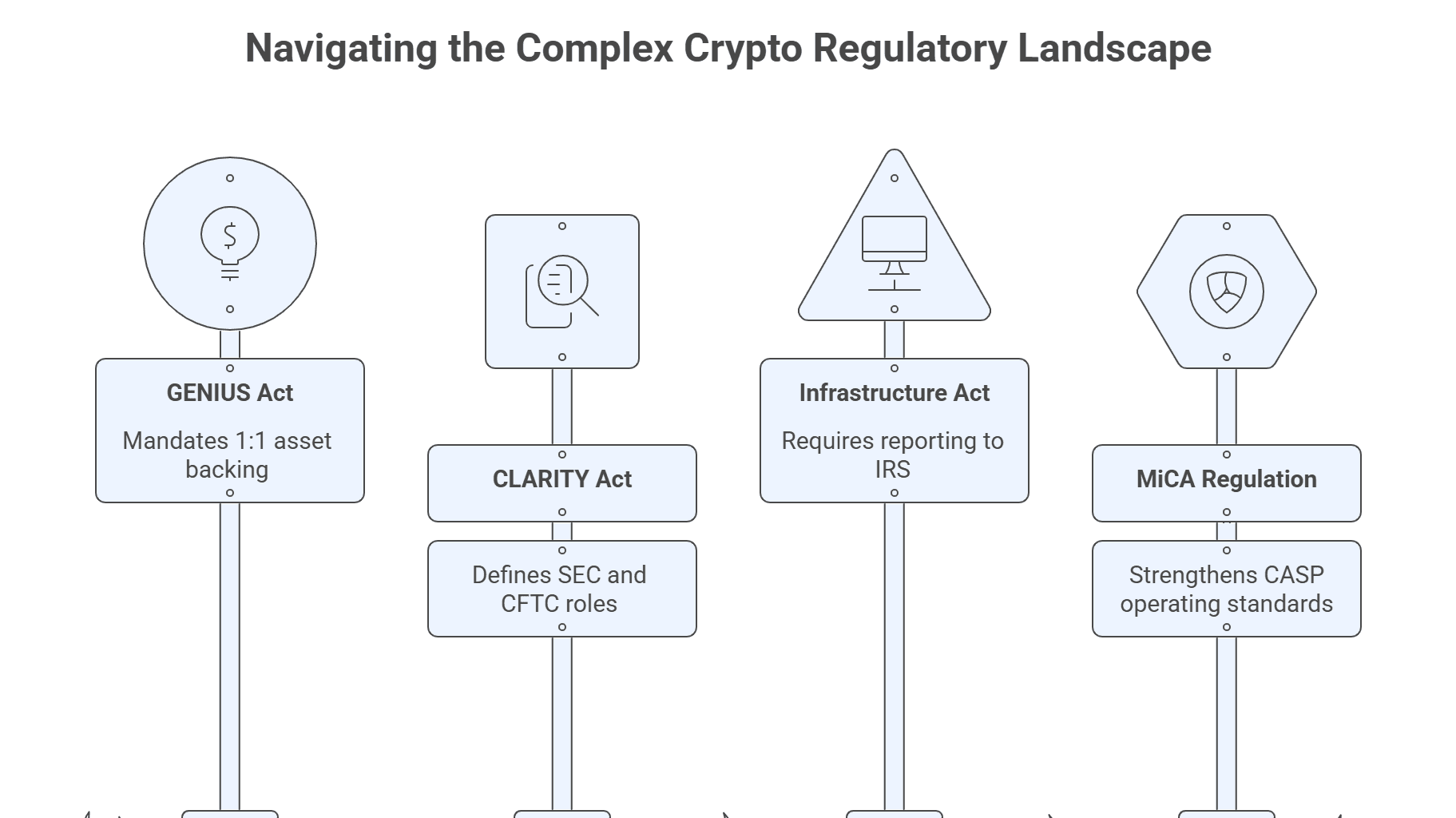
But then the collapses and hacks happened, and these shed light on the flaws of deregulation. Currently, four acts are shaping mass crypto perception:
- The GENIUS Act: Basically mandates 1:1 dollar or liquid asset backing for stablecoins.
- The CLARITY Act, yet to get a full-fledged go-ahead, defines specific roles for the SEC and the CFTC.
- 2021 Infrastructure Investment and Jobs Act (H.R. 3684): Requires exchanges to report client cost-basis information to the IRS.
- MiCA Regulation: Strengthens the operating standards for crypto asset service providers (CASPs) in the EU.
Also Read: The New Laws of US Crypto: GENIUS, CLARITY & Anti-CBDC Acts
Trust me, governments don’t wanna kill crypto. If they’d…they’ll miss the chance to levy even more taxes. The end goal has always been to balance market structure, consumer protection, and stablecoins so that you and I can trust the space and get in.
Top 5 global crypto regulation and compliance trends to watch out
1. Stablecoins are benefiting, thanks to the GENIUS Act
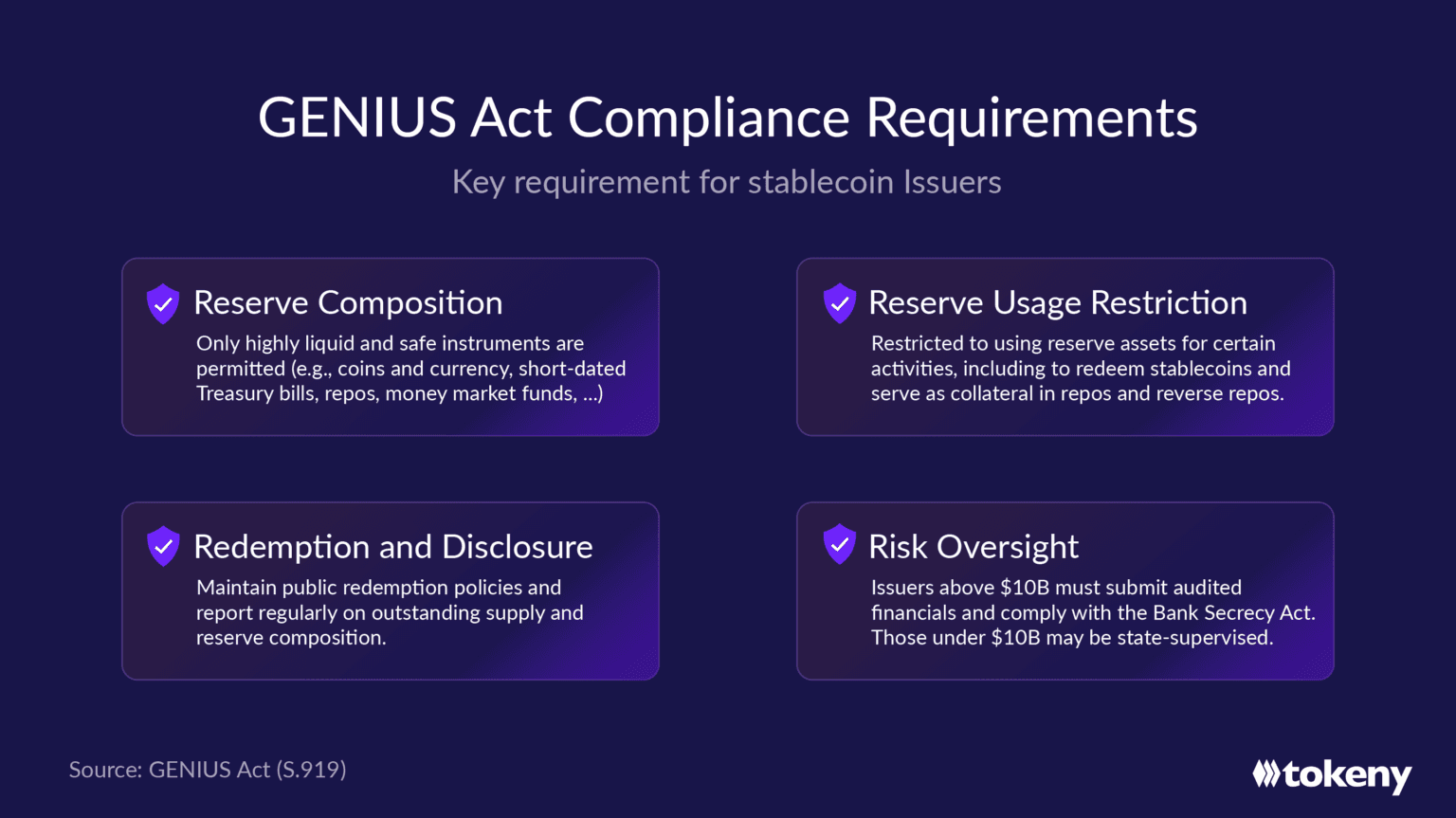
The passing of the US GENIUS Act changed the notion about stablecoins from being something speculative to a payment tool for nations.
Many stablecoins are now considered as payment or settlement-centric digital assets, which users can redeem for ~1:1 dollar value.
The reserve model has now taken a shift. Now issuers are required to hold liquid reserve assets and meet specific standards so that users can redeem as and when needed. The Act also now calls for CEO and CFO certification and mandates monthly reports, which places this rather unregulated structure close to traditional banking infra.
Issuance of payment stablecoins in the U.S. now has a limiter. No one apart from the issuer who's permitted can issue the stablecoins. If done…that’s against the law. Everything's now overseen and supervised to hold the right ones accountable.
2. The CLARITY Act now keeps crypto markets straightened
People've always had this confusion about crypto: when is a token a commodity, and when is it a security?
CLARITY Act creates a framework that tells from digital commodities, digital commodity exchanges, dealers, brokers, and those sorts. The Commodity Futures Trading Commission now plays a bigger role in overseeing market activity, while for certain security-linked areas, the SEC is still the final decision-maker.
Essentially, the road is split between the SEC and CFTC.
CFTC leads when digital commodity assets are in question…but when broker-dealers, alternative trading systems, or securities are involved, SEC takes charge. You can now trade, custodize (via broker-dealers), or deal with permitted stablecoins, but that has to be under SEC-defined rules within national exchanges and likewise trading systems.
CLARITY also indirectly impacts ETFs. Market integrity and surveillance govern the scene of spot ETFs and how much legal transparency there is regarding the asset. A CFTC-led framework can make it easier for regulators to monitor the market, potentially reducing future frictions for emerging ETF products.
3. Europe is now a solo license market cause of MiCAR 2026
MiCA's sole goal is to clear the regulatory mess that’s usually coupled to crypto systems and funds in the EU. Therefore, they created standardised market rules for every kind of assets which were previously not covered under financial services laws.
The core agenda is better authorisation, transparency, disclosure, and supervision cause customers shouldn't ever be barred from 100% of the information.
This sort of authorisation supports CASPs to function cross-border basis across the country's market. The passporting logic behind is that if a firm gets licensed under the EU framework, it can function in the wider market without having to start fresh for each country.
By the end of this year, the temporary MiCA list of ESMA would be tracking most of the asset-backed token issuers, whitepapers, and approved CASPs who are potentially breaking the rules. The list will keep on churning and refreshing, and by mid-year, all main governmental systems will have access to it.
Also, reporting would be painless, because ESMA is gonna bring in easy-to-read online records for trades and orders. iXBRL-formatted whitepapers would help the right regulators contrast disclosures and records, so that trading activities can continue without confusion.
4. Between trust and speed, the UK chooses the former
Unlike the US, the UK is planning more customer-first, using GENIUS and CLARITY.
The US would be the central hub of stablecoins and blockchain innovation. The CLARITY Act would also allow responsible digital commodity development in-country instead of such ideators moving to less-regulated lands and then building their products.
But considering the UK, as per FCA, companies in-country can directly start with authorisation from September 2026, and only after authorisation can they function within a sustainable, open, and competitive market, which laymen can trust.
The government is also optimistic towards in-country originated stablecoins for payment convenience and speed. Many ideas are still in the sandbox stage and are getting tested. It’s just that the notion of the UK being anti-crypto is being proved wrong. It’s rather crypto-centric, but with added protection.
5. CBDCs still exist, but private stablecoins are up in the buzz
Retail CBDCs are currently strictly a big no for the U.S. As per the CLARITY Act, the Anti-CBDC Surveillance State Act presents many hurdles for Federal Reserve banks to directly help individuals with such products or services.
Also, issuing a CBDC directly or using it for monetary policy would be complex now. This means the private money model will now shine.
Instead of retail digital dollars being the ornaments of the government, private issuers (obviously regulated) will find it easier to issue tokens following disclosure/enforcement mandates.
As per the GENIUS Act, interoperability standards have also been amended, which allows for better functioning of CBDCs across payment systems, platforms, and wallets.
6. AI compliance and tokenisation updates
The blend of legal accountability and technology is evolving and will evolve further in 2026.
Already, Smart Contract Governance allows lists and transfer restrictions, and is getting coded into ERC-3643 standards. Know Your Transaction (KYT) monitoring tools are also now coming live to flag mixes between sanctioned to-be-transacted and final transacted entities.
Zero-Knowledge Proofs have always been there, but they’re getting upgraded to not spill sensitive Personally Identifiable Information (PII). Tools like Bifrost can now monitor and maintain audit compliance logs. Also, location-based restrictions for users and assets are being researched and executed.
As Agentic AI development talks keep recurring in podcasts, blogs, and bylines, the need for acts like CLARITY becomes essential, as entities who’d ask regulators like the CFTC and SEC to study what kind of direction is needed for derivatives and tokenised products.
The Act also mandates blockchain payment fraud and transaction-related knowledge gathering for the Treasury.
All in all, without complete knowledge and a perfected demo, nothing can be a full-fledged system, especially considering crypto combined with AI.
Also Read: Approval of the GENIUS Act, CLARITY Act, and Anti-CBDC Surveillance Act triggers a rally across the digital asset sector
Key Takeaway: Discipline is not a dirty word
It's very simple. Nothing would exist anymore without a license. Everything needs to be by the laws, or at least, to sustain, should abide by the laws.
In the future, there wouldn’t be an FTX collapse or a Bybit takeover anymore. With the power of AI, multi-continental hacks can be spread, and wallets can be emptied in a matter of minutes.
But is the fundamental product at fault? NO.
Which is why…such guardrails are required to seed the faith of the commoners into blockchain products and payments as a whole. If everything is regulator-aligned, the entire blockchain digital economy will not only thrive, but it will allow many awesome ideators to conceptualise, build, and sustain.