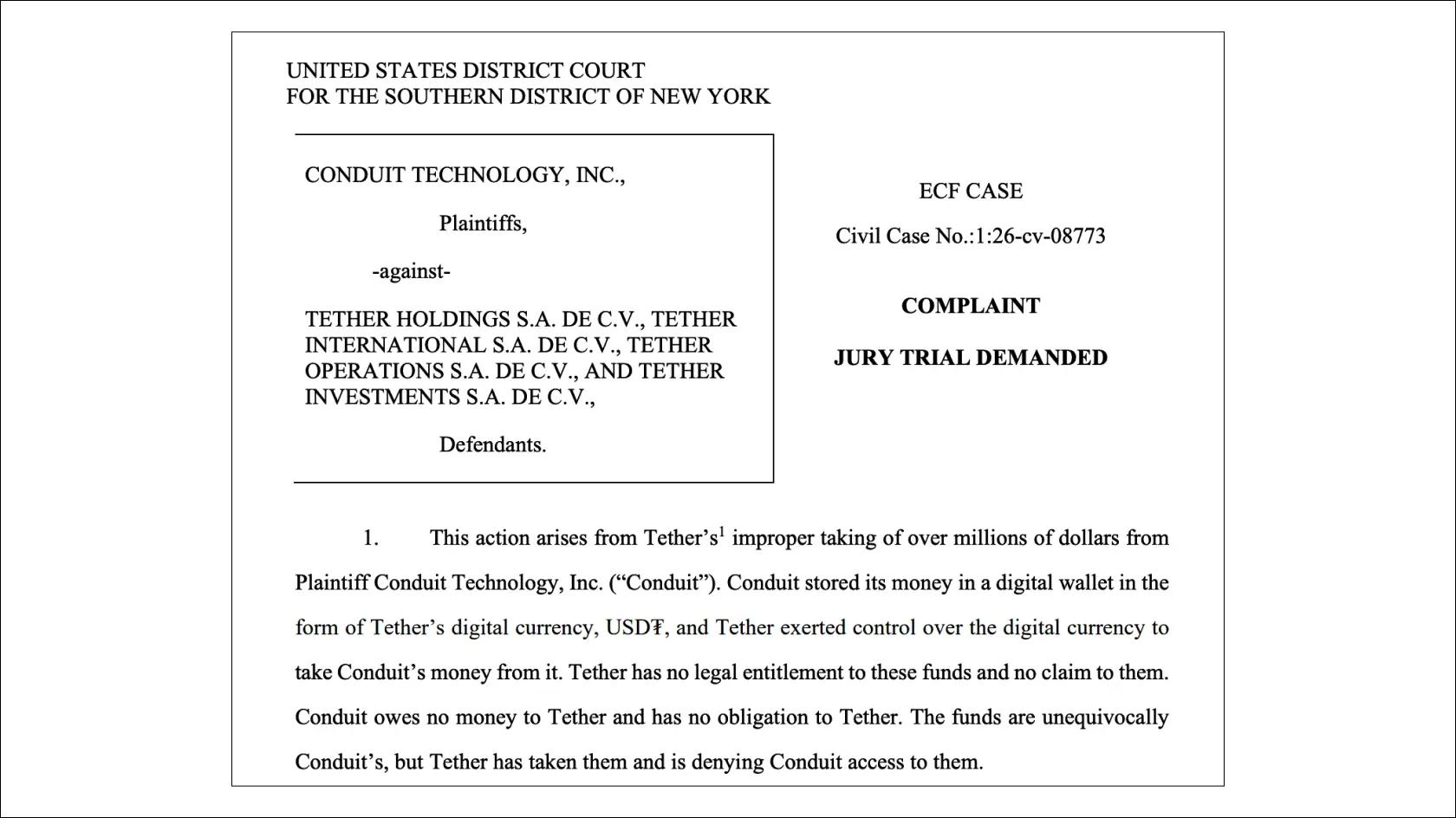
Conduit Technology, a U.S. fintech company that handles cross-border B2B payments, has sued Tether, accusing the USDT issuer of freezing $2.76M without adequate explanation. According to the lawsuit, Tether froze the wallet in September 2025 over its alleged link to a Brazilian police investigation into a former Conduit client. The funds have been out of reach for more than a year, and a court is now weighing how far Tether’s power to freeze funds extends.
The lawsuit says Conduit used the wallet to pre-fund client payments and called it the digital equivalent of an operating account. In the four months before the freeze, more than $1.1B moved through it in 4,427 transactions with 78 counterparties.
Conduit says losing access to the funds forced it to cut transaction volumes, lay off employees, and close offices. So it is seeking compensation not only for the frozen amount but also for the damage it says came from losing access to the money.
Case Details
Conduit filed the lawsuit in the U.S. District Court for the Southern District of New York on October 5. The company wants Tether to return about $2.76M in USDT, pay at least $2.76M in compensation, and turn over the income Tether allegedly earned from the reserves backing the frozen tokens.
Conduit’s complaint against Tether. Source: CourtListener
Conduit created the address for day-to-day settlements on May 20, 2025. On September 24, Tether froze the entire balance held there.
“These funds unquestionably belong to Conduit, but Tether took them and cut off our access,” the company says in its filing. “A company has no right to take money from a business just because that business chose to hold it in Tether’s currency.”
Conduit links the freeze to an investigation by Brazil’s Federal Police into Onix Intermediações, a former client of the platform. According to court documents, Onix’s last transaction through the service took place back in April, a month before the address was created. Conduit also says Onix’s funds were never held at this address.
The plaintiff’s key complaint is that Brazilian law enforcement never asked Tether to freeze this address and never named it in the investigation. According to Conduit, the USDT issuer made the call itself, linking the address to the case based on its own criteria.
Other USDT Freezes
In late August, two Thai citizens demanded that Tether return about $42.4M in USDT, saying it froze the funds after an informal request from a U.S. law enforcement official. The seizure warrant cited in their lawsuit came only four months after the freeze.
In April 2025, Tether froze about $44.7M in USDT across eight Riverstone Consultancy wallets after a request from a local police unit. At that point, no court had ordered the funds confiscated. In October, Riverstone filed a lawsuit, arguing that Tether failed to present documents proving the freeze was lawful and that Riverstone itself received no explanation from the police. The case was later withdrawn, so the court never ruled on whether the freeze was lawful.
Tether’s rules give the company broad powers to freeze tokens. The issuer can freeze USDT when the law requires it and in other cases it considers necessary, including when it suspects a violation of rules or laws. However, the freeze mechanism itself does not require a court order or include an appeals process.
As of October 7, Tether has not publicly responded to Conduit’s lawsuit. In the $42.4M freeze dispute, the company called the claims unfounded.
“This is a baseless attempt to interfere with law enforcement’s work to prevent the illegal use of USDT,” the company said.
Market Thoughts
The ability to freeze USDT is one of the stablecoin’s key features. If law enforcement believes an address is linked to a crime, Tether can halt token transactions at that address. Other cryptocurrencies, like Bitcoin, have no such centralized mechanism.
By May 2026, the T3 Financial Crime Unit, a joint project of Tether, TRON, and TRM Labs, had frozen more than $450M in USDT tied to illegal activity, working with law enforcement in 23 countries.
T3 Financial Crime Unit logo. Source: t3fcu.org
Ari Redbord, head of government policy at TRM Labs and a former U.S. Treasury Department official, sees this feature as a major advantage of stablecoins.
“Freezing and reissuing take illicit funds out of circulation entirely and make it possible to create clean value again,” he said.
Rebecca Rettig, chief operating officer and lawyer at Jito Labs, says financial oversight rules should clearly define who is responsible for screening transactions and meeting law enforcement requirements.
“For open blockchains, it is especially important not to shift such responsibilities onto every network participant without clear justification,” she stressed.
That creates a contradiction, and the Conduit case shows it clearly: the ability to freeze USDT is needed so law enforcement can stop money linked to crime, but the more widely the stablecoin is used, the costlier a mistaken freeze becomes.
In social media discussions of the Conduit case, one question comes up most often: how acceptable is it for companies that use stablecoins as working capital to have their funds frozen without a court order? If an issuer can freeze a corporate wallet this easily, holders effectively take on the risk of a closed-door process whose outcome they cannot verify or challenge on the blockchain on their own.
Tether’s supporters see the ability to freeze funds before a court gets involved as one of the main reasons USDT can be used within regulated financial infrastructure at all. They point to numerous cases where Tether helped authorities quickly stop the movement of funds linked to fraud, sanctions violations, and other crimes.
Our Take
These days, any suspicious transaction, dirty money, or funds of questionable origin automatically draw extra scrutiny, and in practice a presumption of guilt increasingly applies.
A private issuer can, in effect, run its own investigation, assess the level of risk, and freeze other people’s money on its own initiative.
The Conduit story shows once again how unsettled the rules remain across jurisdictions. Regulation seems to be getting stricter and more detailed, but uncertainty is growing along with it: where an issuer’s powers end, who is responsible for a mistaken freeze, and how an owner can protect their money.
This post is for informational purposes only and does not constitute advertising or investment advice. Please do your own research before making any decisions.