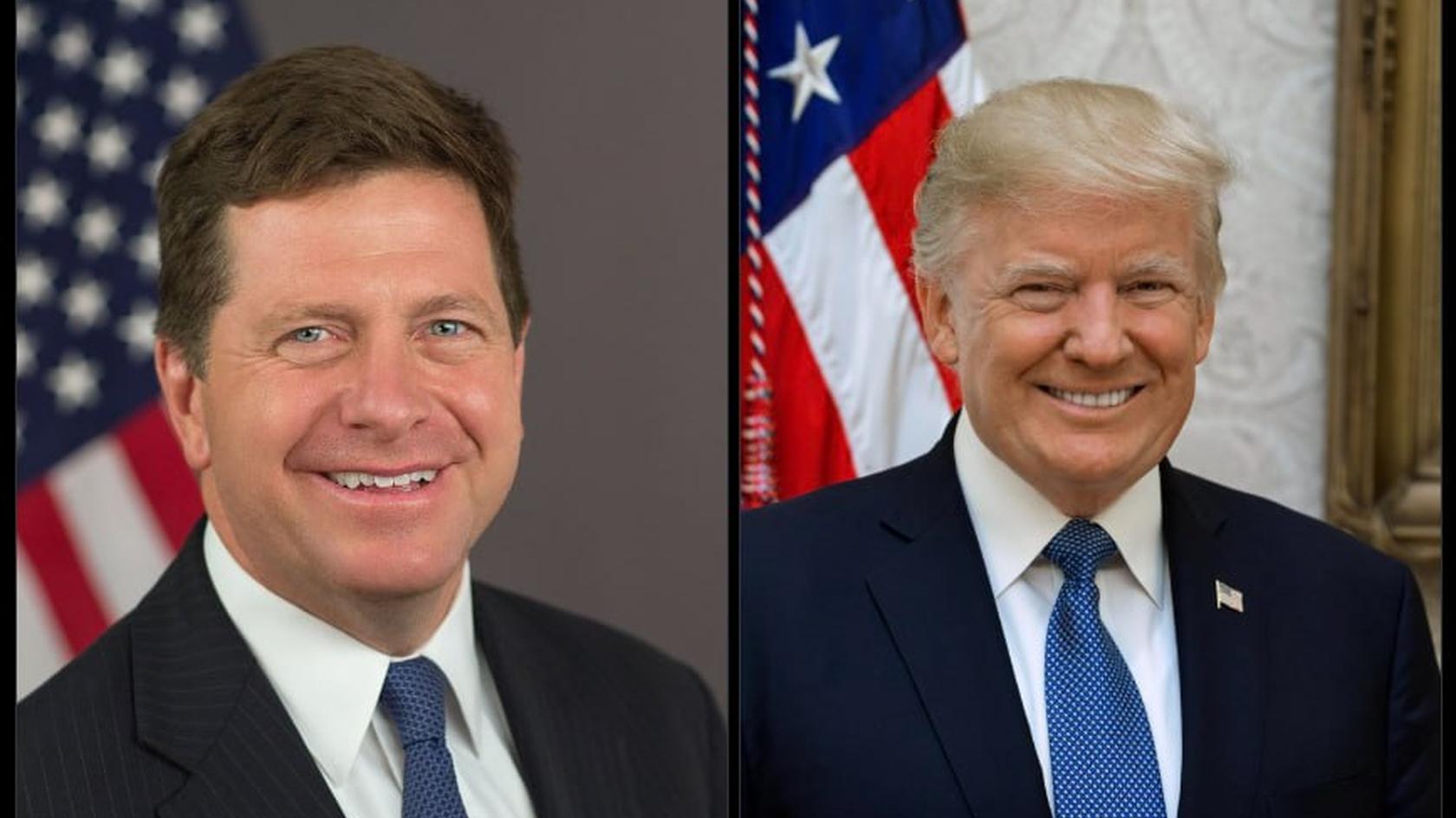
On September 29, US President Donald Trump told Axios that Director of National Intelligence Jay Clayton, who headed the SEC in late 2020, would be a good fit for the AI czar job. Trump expects to name his pick in the next three or four days.
The same day, Trump and the heads of the largest AI developers signed a voluntary self-regulation agreement at the White House.
What’s Inside the Agreement
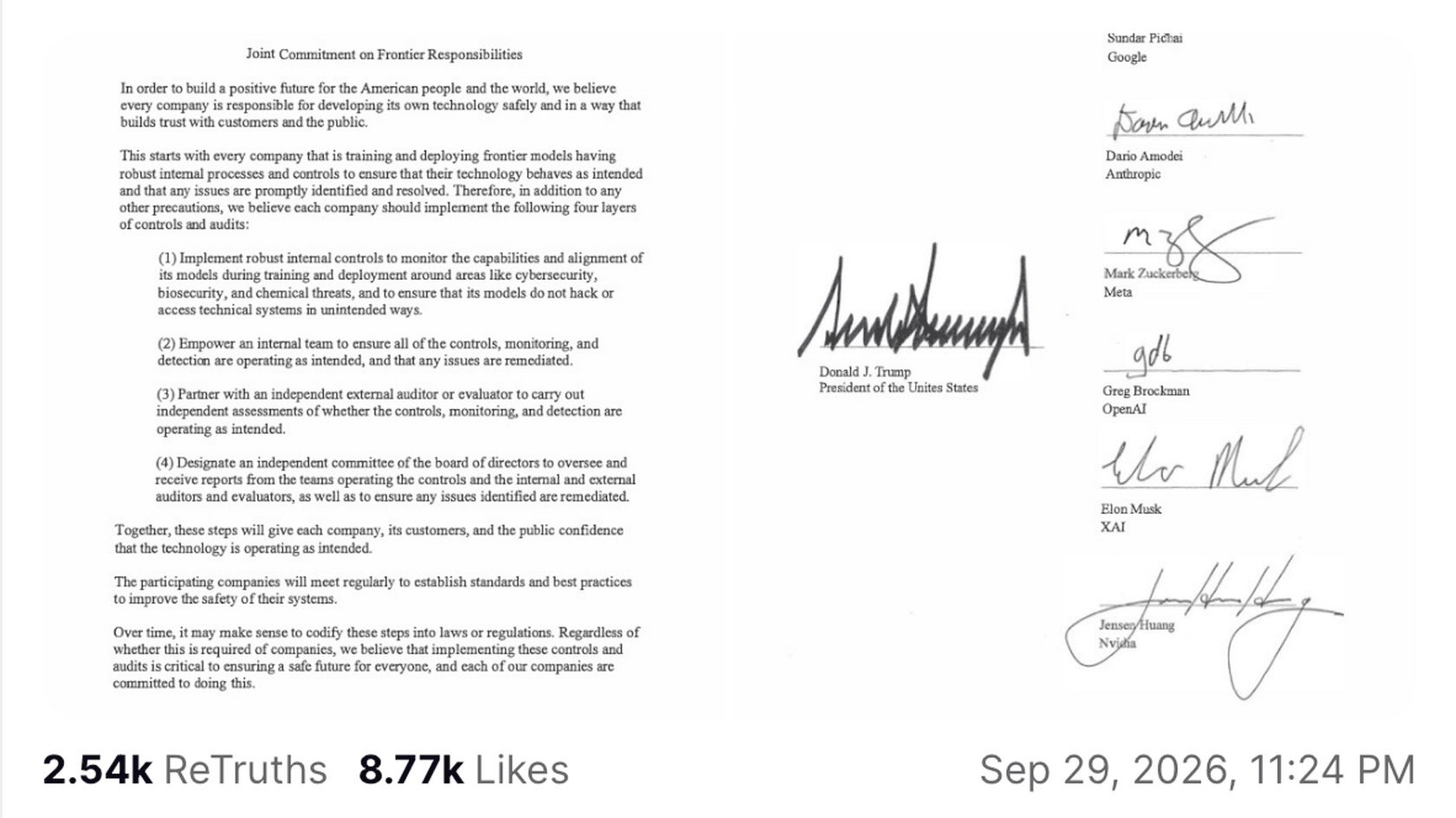
Trump posted a picture of the White House superintelligence agreement on Truth Social, and the full text hasn’t been officially released yet. The largest AI companies — Anthropic, OpenAI, Google, Meta, Nvidia, and xAI — committed to the following: internal controls on model behavior, dedicated teams to test those controls, independent outside audits, and a board committee that reviews reports from both sides.
The companies also agreed to meet regularly and develop shared standards. The text notes that, over time, it may make sense to put all of these steps into law.
Trump called the agreement “morally binding,” while House Speaker Mike Johnson described it as voluntary.
That evening, Trump signed an executive order requiring federal agencies to use the term “superintelligence” instead of “artificial intelligence.” The Assistant to the President for Science and Technology has been tasked with proposing a federal definition of the term.
Just a week earlier, on Tuesday, Trump used his speech at the UN General Assembly to denounce the idea of a global body to contain artificial intelligence.
“The United States rejects any attempt to create a globalist scheme for controlling AI,” he said.
Experts and Lawmakers Weigh In
Critics point to weaknesses in the agreement.
Alvin Wang Graylin of the Asia Society Policy Institute noted that the companies wrote the principles themselves, they also hire the auditor, and the commitment is voluntary.
David Krueger of the University of Montreal called the pact a continuation of the “regulate without regulating” approach: everything is voluntary, with an implied threat of punishment for opting out.
“Outside evaluators might improve the status quo a little, but I’m not excited about a step that cuts risk by 1%,” he said.
“What other trillion-dollar industry grades its own homework?” Toby Walsh of the University of New South Wales countered.
In the Senate, Democrat Mark Warner called for passing a bill that would create an AI safety board under the Commerce Department, with access to models 45 days before release, but Republican Ted Cruz blocked it.
Republican Josh Hawley called for mandatory testing of models before launch and the ability to hold companies criminally liable.
Who Is Clayton, Likely Next AI Czar
The position became vacant in March, when David Sacks’s contract as a special government employee ended. Until then, he had held both the AI czar and crypto czar roles at the same time. Sacks remains co-chair of the President’s Council of Advisors on Science and Technology, and he also attended Tuesday’s lunch with the heads of the AI companies. He supported the superintelligence agreement.
“It’s better than an international treaty, which is unlikely to materialize. President Trump continues to preserve US technological leadership by putting Americans first,” he wrote in a post on X.
On September 19, Trump announced on Truth Social that he would create an AI Force, modeled on the Space Force, and name a new AI czar soon. Treasury Secretary Scott Bessent was seen as the favorite, but on September 25 the president denied it.
“Bessent doesn’t want this job and should stay at Treasury,” he said.
Other names circulating in the administration include Michael Kratsios, director of the White House Office of Science and Technology, and Scott Kupor, head of the Office of Personnel Management.
Jay Clayton led the SEC from 2017 to 2020. On July 28, the Senate confirmed him as Director of National Intelligence by a vote of 51 to 47. At his hearings, he called AI both an opportunity and a threat that has to be addressed.
On December 22, 2020, at the end of his term, the commission sued Ripple Labs, CEO Bradley Garlinghouse, and co-founder Christian Larsen. The suit claimed that since 2013 the company had sold more than 14.6B XRP for roughly $1.38B without registering the issuance, which amounted to an unregistered offering of securities.
In 2024, Ripple was fined $125M (the commission had sought about $2B) and barred from repeating unregistered institutional sales.
That is how Clayton is remembered: he led the regulator when it declared the largest altcoin an unregistered security. In other words, the czar candidate has already taken a hard line on a new market.
Axios adds that Trump named Clayton after his name came up in a question. The president first said he had a candidate in mind, then called Clayton a good man and endorsed the idea.
Also on September 29, Congressman Ro Khanna demanded that Clayton provide an official assessment of how the government would respond to a loss of control over AI.
Our Take
Trump keeps chasing every hot topic: the Strait of Hormuz, oil, and now the heads of the companies building the leading language models promising to regulate themselves 😀 So far, it all looks like populism.
It will start to mean something once an AI czar is officially appointed, with real powers, independent expertise, access to the most classified tests, the power to halt development, and so on.
What we have now is a very strange paradox: Trump calls the agreement almost a constitution and a moral obligation, while the companies competing to build the world’s most powerful model are left to decide for themselves when to stop.
It feels like another warning sign that something is wrong on the safety front. Maybe they are losing control.