

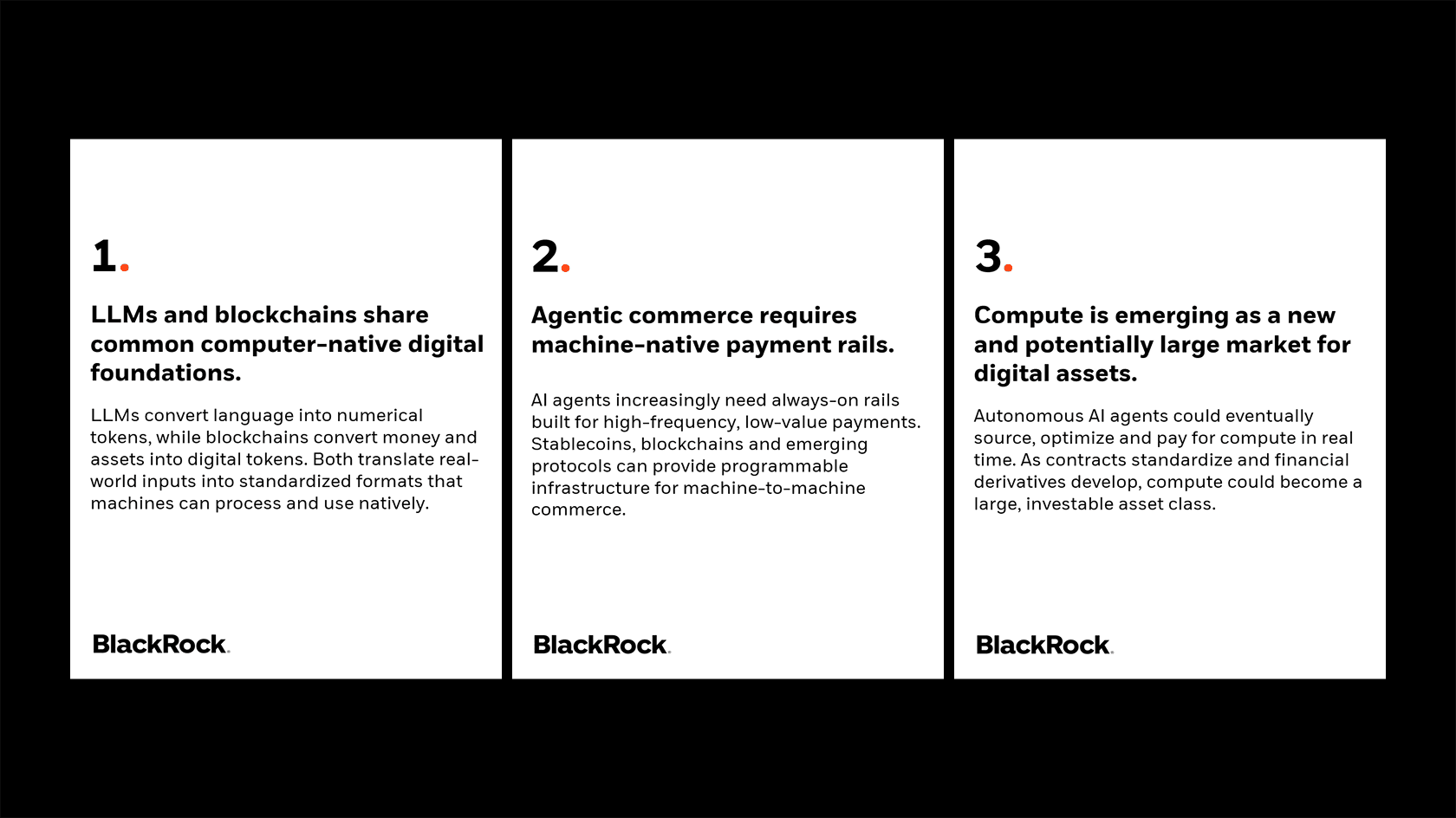
On September 22, the world’s largest asset manager, BlackRock, released a report titled The Machine Native Economy, linking new demand for digital assets to AI agents that can independently pay for data, services, and computing power.
- ai
- news
- 28 Sep 26
BlackRock Sees AI Agents as a New Driver of Stablecoin Demand
AI agents need stablecoins, wallets, and payment systems that work without human intervention. Here’s how BlackRock sees demand developing, while Coinbase is building the infrastructure for an economy where software can manage money on its own.
0
nft.eu
- rating +20
- subscribers 90
Coinbase CEO Brian Armstrong agreed with the findings of BlackRock’s research in a response to the report. He had already spoken about the company’s work in this area, saying that Coinbase is developing tools that allow AI agents to manage allocated funds and pay for digital services on their own.
While the crypto community is discussing these ideas as a case for stablecoins and blockchain infrastructure, Bill Gates warns that AI is “powerful enough to lead to events where a billion people could die.”
An Agent as a Separate Layer of Economic Activity
The authors of the BlackRock report describe an AI agent as a system that can independently complete an entire sequence of actions leading to a payment: buying access to data, using a paid service, obtaining the required amount of computing power, and completing the transaction.
To do this, an agent needs a wallet, a preset spending limit, a clear unit of account, and the ability to make payments. In this model, AI becomes a full participant in an economic transaction.
“The significance of this model is still underestimated by the market,” the analysts argue.
BlackRock believes that among digital assets, stablecoins will become the main means of payment between AI agents because machines need predictable payment values without exchange-rate swings, and the market is already large enough.
“In September 2026, more than $300B worth of stablecoins were in circulation, while the adjusted transaction volume for 2025 exceeded $11T. From 2020 to 2025, this figure grew by an average of about 80% a year,” the report says.
Coinbase’s Position
As early as July, Brian Armstrong pushed back against the idea that the crypto market should give way to AI.
“Cryptocurrency is a general-purpose technology. It is infrastructure, like electricity or the internet,” he wrote.
After BlackRock published its report, Armstrong backed the asset manager’s conclusions.
“The number of agents will grow. The number of agents that need to make payments will grow too. Crypto and stablecoins will become their primary payment method,” he said.
Coinbase is already developing infrastructure for this model, including the x402 protocol and Coinbase for Agents with spending limits. The company has also launched AI-agent payments through Coinbase Business and connected the system to Amazon’s Bedrock AgentCore Payments. According to the project team, more than 90% of agent-driven stablecoin volume was taking place on Base.
Read Also: Coinbase AgentKit: How AI Agents Got Wallets and Started Spending Money on Their Own
There is also an experimental test of this scenario. The Bitcoin Policy Institute gave 36 models 9,072 tasks related to money and payments. The researchers placed the models in simulated economic situations and studied their responses to see what logic AI follows when choosing a tool for a particular function.
For everyday payments, the agents chose stablecoins in 53.2% of cases, compared with 36% for bitcoin. When the models were asked to choose a tool for preserving value over the long term, bitcoin received 79.1%, while stablecoins received 6.7%.
Fiat money never became the main choice among any of the 36 systems tested.
▶️ Brian Armstrong explains how he uses AI agents
The "Old Way" of running a company is dead. 💀
— Jungle Inc | Markets & Future Systems (@jungleincxrp) January 24, 2026
Brian Armstrong just revealed how he’s using AI agents to run @Coinbase, and it’s a glimpse into the future of leadership.
1. Real-Time Monitoring 👁️
No more waiting for "quarterly reviews." Brian uses AI agents to synthesize… pic.twitter.com/fp5TTD16rZ
Are Computing Resources Becoming a Market of Their Own?
BlackRock sees computing power as another market resource. According to Goldman Sachs estimates cited in the report, capital spending on AI infrastructure could exceed $5T between 2025 and 2030.
According to Bloomberg analysts’ forecasts from late August 2026, the largest sellers of computing power — AWS, Microsoft’s cloud business, and Google Cloud — could generate around $1.1T in revenue by 2030. BlackRock uses this figure as a rough measure of the potential size of the computing market.
For an AI agent, buying computing power becomes a routine task. It can choose resources based on price, speed, location, and hardware type. BlackRock suggests that these resources could be standardized and packaged into contracts that an agent could purchase, transfer, or use as collateral on its own.
A similar trend can be seen in Stripe’s deal with OpenRouter, which media reports value at more than $7.5B.
“Tokens are the main currency for companies building on AI, and the economic impact depends on how they use scarce computing resources,” Stripe CEO Patrick Collison said in an interview with Reuters.
BlackRock sees the deal as part of the same shift: model routing, usage tracking, and programmable payments are coming together in a single system.
The More Freedom an Agent Has, the Higher the Cost of a Mistake
The economic model described by BlackRock assumes that AI agents will be given broader powers: they will need to manage money, access data, choose computing resources, and initiate payments. As their usefulness grows, so does the potential damage caused by an error or by someone gaining control of the system.
Read Also: Moltbot and the Rise of the Shadow Web: From Chat Agents to Autonomous Task Execution
Microsoft co-founder Bill Gates has warned about this.
“AI is powerful enough to lead to events where a billion people could die,” he said in an interview with NBC.
Gates believes the main risk of giving agents autonomy is that people with malicious intent could use them. According to him, small groups can already use AI to gain capabilities that were once available only to major states. Among the possible threats, he mentioned attacks on power grids, hospitals, and financial systems.
He considers self-regulation by technology companies insufficient and supports mandatory requirements for AI safety and monitoring.
“When you are trying to stop unacceptable behavior, you need information and records of what is happening. An emergency shutdown mechanism alone is not enough to prevent such tragedies,” Gates said.
For an economy built around AI agents, this means permissions, spending limits, and control rules need to be defined in advance. The more autonomy a program receives, the more important it becomes to record its actions and make clear who is responsible for the consequences.
Editorial View
AI agents are becoming a new layer of economic activity. To function, they need full financial infrastructure: wallets, stablecoins, and budgets. The same stack turns an agent from an advisor into an active participant in the economy: it can pay for services, buy credits and other resources, and act without human involvement.
It is reasonable to expect growing demand for reliable blockchains, bridges, and stablecoins. And if AI does create strong demand for crypto, stablecoins are likely to be at the center because volatility remains one of the biggest obstacles to using crypto in finance.
BlackRock’s idea that computing resources themselves, rather than tokens, could become a new asset deserves attention. It points to the emergence of a full-fledge computing market.
As for Gates’ forecast, it is unlikely to play out as a Terminator-style scenario, because even with maximum AI capabilities, there is no basis for assuming that AI would want to eliminate one-eighth of humanity, and the human factor will remain important in any case.
The real risk lies elsewhere. If control over an agent falls into the wrong hands, for example through hacking or a social engineering attack — and such incidents are becoming more common — the resulting chain of actions could cause very real damage.
This creates a paradox. For agents to become useful to the economy, they need financial infrastructure and a certain degree of freedom. But once they have that freedom, an agent becomes a full participant in the market. It needs to be controlled and restricted with spending limits, and someone must ultimately be responsible for what it does.
The broader the permissions, the greater the agent’s access to sensitive data. If someone learns how to control it or trick it into acting against its internal limits, the consequences could be devastating.
Still, T-800 is unlikely to be cleaning its gun just yet, and the liquid Terminator is not preparing to wipe out humanity because of crypto either 😃

This post is for informational purposes only and does not constitute advertising or investment advice. Please do your own research before making any decisions.
0
Comments
0
Write a comment.