On September 22, two of the world’s largest AI labs — Anthropic and OpenAI — released new models less than two hours apart. For the first time, the two companies are competing on price rather than raw power, signaling a broader shift across the industry: the race for benchmark scores is giving way to a race over pricing.
Both releases came after Anthropic CEO Dario Amodei called on the industry to slow down the development of powerful AI models so that safety practices could keep pace with their growing capabilities. Sam Altman and Elon Musk supported the idea.
The debate began after Anthropic researcher Jacob Coxon left the company. On September 8, he wrote on X that he was leaving Anthropic, describing the actions of the biggest AI developers as playing with human lives.
Soon afterward, despite their earlier statements, the companies released their models almost simultaneously — apparently, each was closely tracking the other’s moves.
When you don’t follow your own rules. Source: X
AI Is Getting Cheaper
Companies that spend tens of thousands of dollars a month on APIs can expect their bills to fall soon.
Anthropic was first to release Claude Opus 5.5, the first model in its updated 5.5 lineup. The company said it performs at the level of the more powerful and expensive Fable 5.1, while costing 40% less to operate than the previous version. The price has fallen to $4 per million input tokens and $20 per million output tokens, down from $5 and $25 for Opus 5.
OpenAI responded with GPT-6 Sol and GPT-6 Luna, which sit one tier below the flagship Astra, released in early September. OpenAI introduced GPT-6 Sol and GPT-6 Luna, saying it had cut developer prices in half: Sol now costs $2 per million input tokens, while Luna costs $0.10.
Ara Kharazian, chief economist at Ramp, a platform US companies use to pay for business subscriptions and APIs, told Fortune that lower prices could make it harder for the labs to monetize their models and grow their valuations over time.
“Prices are falling even as the labs are investing tens of billions of dollars in development and infrastructure,” he said.
How Price Wars Affect IPOs
According to the Financial Times, Anthropic’s annualized revenue run rate reached $65B at the end of July, and investors expect it to exceed $120B by the end of the year. On OpenRouter, meanwhile, OpenAI overtook Anthropic for the first time in more than two and a half years in weekly customer spending: the gap began to narrow after the release of GPT-5.6, and OpenAI moved ahead after Astra was launched.
The new models arrived as both companies were preparing for initial public offerings. Anthropic closed a Series H funding round on May 28 at a $965B valuation, slightly ahead of OpenAI, which was valued at $852B in March. Anthropic is reportedly preparing for a listing in the fall, while OpenAI has pushed its own IPO back to 2027.
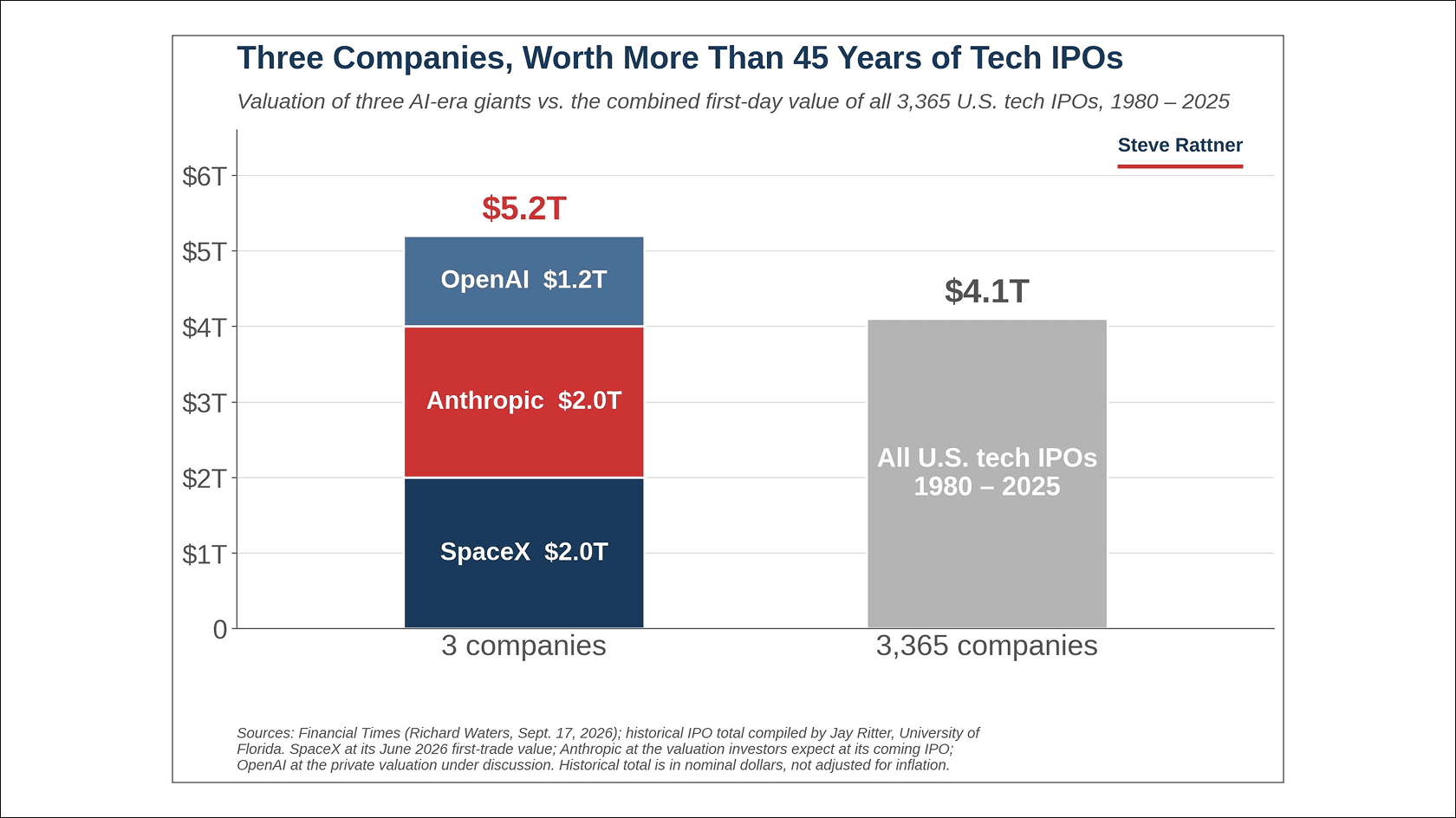
Interestingly, three companies — SpaceX, Anthropic, and OpenAI — are worth more than all US technology IPOs over the past 45 years combined.
The combined value of OpenAI, Anthropic and SpaceX versus everyone else. Source: Steve Rattner on X
Competition from Chinese open-source models is adding pressure ahead of the IPOs, as more and more US developers switch to cheaper models from DeepSeek, Alibaba, and Moonshot AI.
“For most everyday tasks — perhaps 90% of them — DeepSeek’s V4-Pro performs almost as well as Anthropic’s Claude Fable 5, while costing roughly 1.5% as much,” said Jim Reid, head of macroeconomic research at Deutsche Bank. “Buyers who are happy with a reliable workhorse will increasingly ask themselves whether it is worth paying extra for a supercar.”
DeepSeek itself has raised its API prices by as much as 12 times, citing infrastructure costs and preparations for a possible IPO.
At the same time, companies that own and lease out computing infrastructure at industrial scale are increasing their profits, because cheaper tokens mean higher utilization of their clusters.
Tarek Hamid, a senior analyst at JPMorgan, notes that these investments are already generating positive returns, leading him to forecast more than $900B in operating cash flow for this group of companies in 2027.
“Hyperscalers remain exceptionally profitable, and the initial return on investment is positive,” he said.
This means the same price war benefits different parts of the value chain in different ways: the labs themselves lose some margin on each token, while owners of computing infrastructure make more money from higher request volumes. Investors assessing Anthropic and OpenAI ahead of their IPOs will have to determine which of these two dynamics will ultimately shape the companies’ value — their ability to retain customers through low prices or their ability to earn money on every token they sell.
Our Take
Duels like this are nothing new in other industries: Pepsi versus Coca-Cola, Red Bull versus Monster, Nike versus Adidas. Healthy competition has never stopped an industry from developing.
As the gap in quality narrows, businesses will choose the cheaper option, forcing the labs to keep lowering the cost per million tokens, speed up response generation, and develop more capable caching and model-memory systems.
The clash between the two biggest labs has now moved beyond internal technical debates for the first time: benchmarks are no longer the main selling point for a model, because mass-market demand responds to price faster than it responds to benchmark scores. We will be watching with interest to see how this price war develops — and where it ultimately leads.
Meanwhile, in a parallel universe...
What if Sam Altman and Dario Amodei comes together and work in harmony.
This post is for informational purposes only and does not constitute advertising or investment advice. Please do your own research before making any decisions.