

On October 4, OKXICE, a joint venture between OKX and NYSE owner Intercontinental Exchange, notified the SEC that it plans to launch a 24/7 trading platform for tokenized shares of U.S. companies. Initially, it will offer more than 60 securities under the SEC's temporary five-year Innovation Exemption, adopted on September 17.
- markets
- regulation
- news
- 05 Oct 26
Tokenized Stocks Make It to Wall Street
OKXICE plans to launch 24/7 trading of tokenized U.S. stocks under the SEC's new framework, and the market will put the model to a real-world test.
0
nft.eu
- rating +20
- subscribers 90
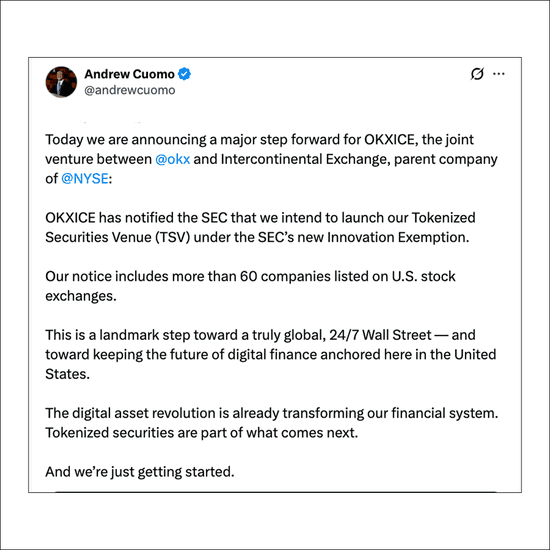
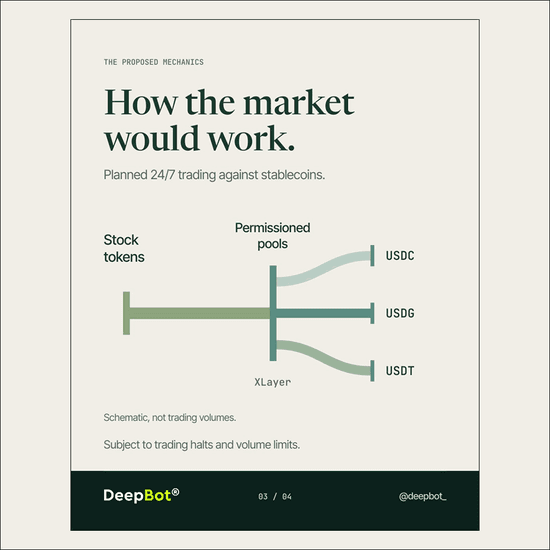
The list includes Nvidia, Tesla, Apple, Microsoft, Coinbase, Robinhood, JPMorgan, and other major public companies. Each tokenized stock will be paired with one of three stablecoins: USDC, USDG, or USDT.
Issuers have 30 days to object to tokenization. The new framework will test not only investor demand but also whether public companies themselves are ready to move their shares onto a blockchain, and the first objection has already come in.
What Is the Innovation Exemption?
The Innovation Exemption is a five-year SEC program that lets tokenized stocks trade on blockchain platforms without registering as a stock exchange.
A platform must admit only approved participants, disclose trading data, and stay within limits on the number of securities and on trading volume. A token must give its holder the same rights as a regular share, including dividends and voting. The issuing company can ban trading in its own tokenized shares.
The SEC created the program to adapt existing securities market rules to blockchain platforms, where tokenized stocks may trade through automated liquidity pools instead of a traditional order book. The regulator has temporarily exempted such platforms from exchange and dealer regulations, so it can test the new model in real-world conditions and gather data for future permanent rules.
The SEC's authorization process lets issuers block their shares from being listed on third-party tokenized platforms. For OKXICE, this will be the first practical test of the new rule: it will show how many companies agree to tokenization and how many exercise their right to refuse.
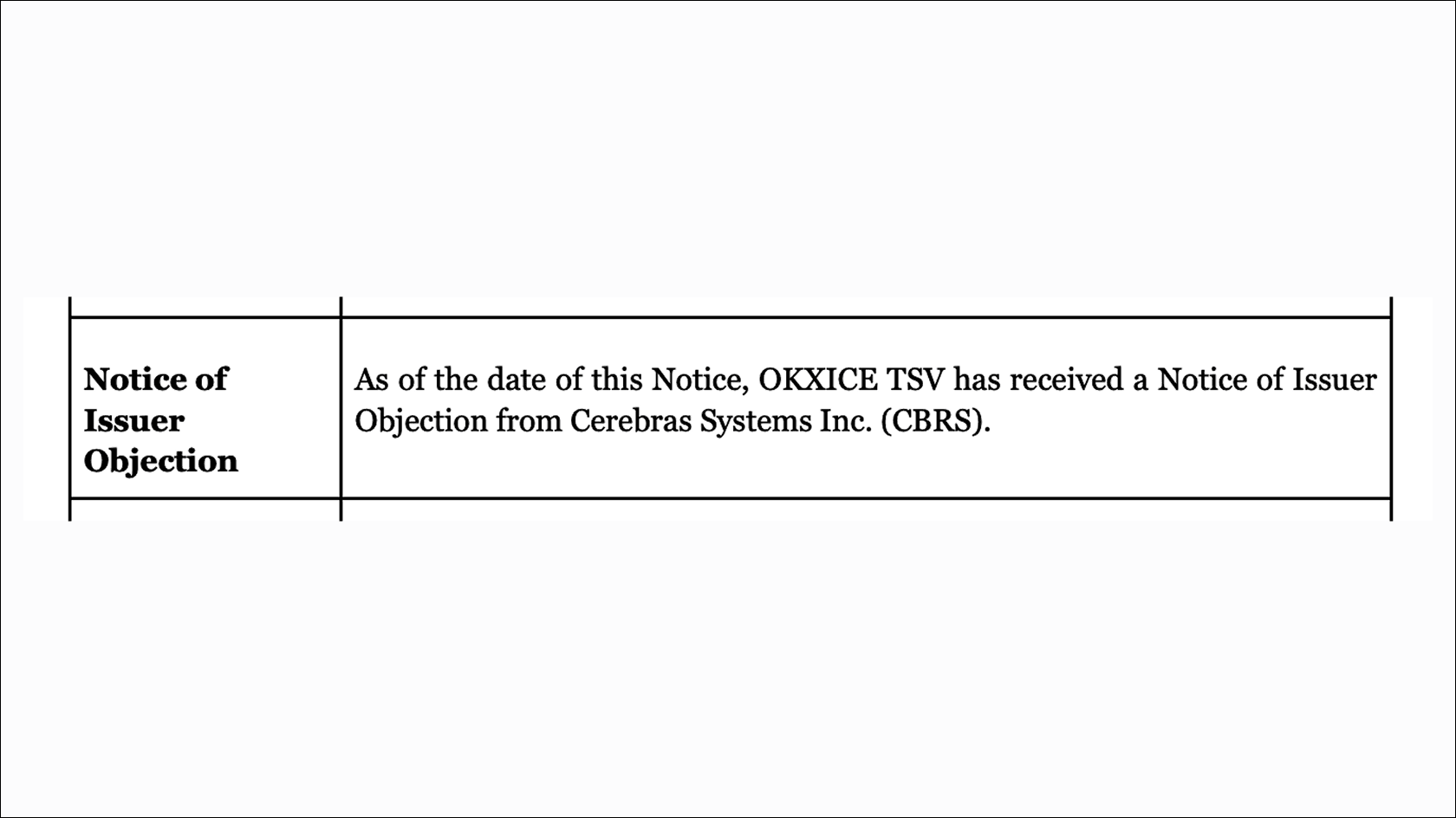
Cerebras Systems has already filed an objection, using the 30-day window the SEC provides.
Market Size
According to the analytics platform RWA.xyz, the distributed value of tokenized stocks on blockchains stands at $3.20B, up 10% from 30 days ago. Another $25M comes from tokens that are recorded on a blockchain but don't circulate outside the issuer's platform. Over the same period, the number of holders rose 53%, to 4.26M. The entire U.S. stock market, meanwhile, is valued at roughly $76–77T.
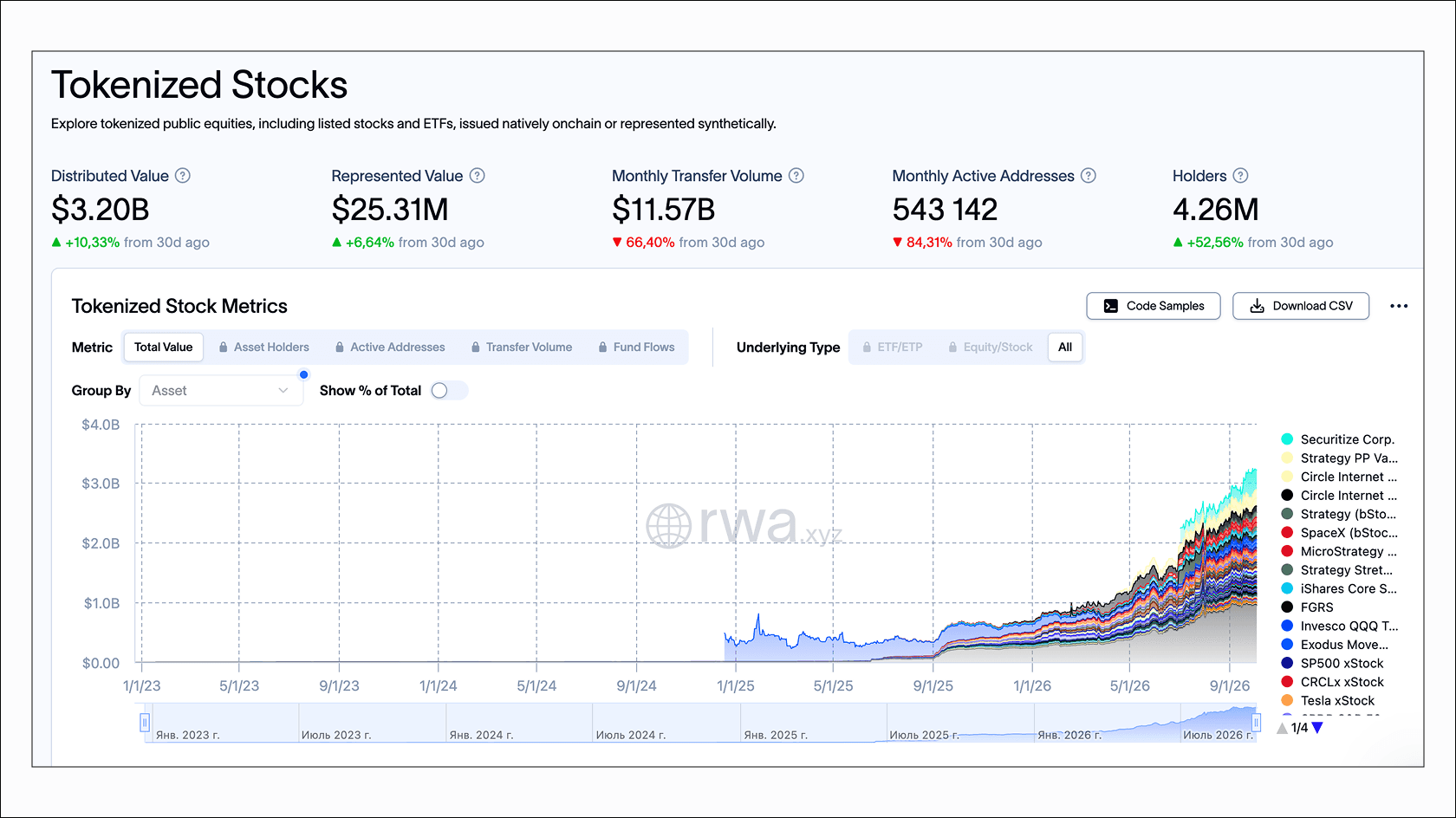
Capital and audience are growing at different speeds. Securitize, a company that specializes in tokenizing securities, drove most of the increase in value, while retail-focused products from Robinhood and other platforms attract far more holders. For now, the market is expanding mainly through user growth rather than capital.
CFTC Chairman Michael Selig believes regulators need to prepare now for widespread tokenization of financial assets.
“The next decade will likely bring more change to financial markets than the past several decades combined,” he said at a U.S. Treasury Department conference.
24/7 Trading Is Put to the Test
OKXICE plans to run 24/7, but nonstop trading comes with limits. The platform must halt trading if the primary exchange suspends trading in the underlying stock, if a volatility-limit mechanism is triggered, or if the SEC-approved volume limit is reached. A repeat breach of the limit can halt trading in that security for three months.
The main question is liquidity. SEC Commissioner Mark Uyeda warned that extending trading hours could spread liquidity more evenly, but could also spread it too thin, worsening price discovery and trade execution.
The SEC has already held a roundtable on the move to 24/7 trading, with exchanges, brokers, clearinghouses, and large asset managers taking part.
Hyperliquid co-founder Jeffrey Yan believes that 24/7 trading by itself won't be the main advantage of onchain finance.
“Self-custody of assets and transparency of operations matter more,” he emphasized.
For now, the new market won't be able to draw a significant share of liquidity away from traditional exchanges. The SEC has capped trading in tokenized securities at 0.25% of average monthly volume for Category 1 stocks and 2.5% for Category 2.
At the same time, the race for 24/7 trading isn't limited to crypto platforms. Brokers and stock exchanges are also widening their trading hours: Robinhood already offers around-the-clock trading on weekdays and, for some stocks, on weekends too, while Nasdaq is extending its session to nearly 23 hours a day.
Our Take
What stands out most about the OKXICE launch isn't the ability to tokenize stocks itself, but how the traditional market reacts to it. Issuers have 30 days to object, and the first objection has already been filed. If most companies don't exercise this right, the market will get its first signal that large corporations are ready to let their shares onto blockchain infrastructure.
Technically, the model is already built: trading will run through approved Uniswap v4 pools, and tokenized stocks must retain the rights of regular shareholders, including dividends and voting. The question now is whether corporate and legal infrastructure is ready for a system in which stock trading becomes more transparent and runs around the clock.
Liquidity will be especially telling. The crypto market runs around the clock, while the underlying stocks trade only at set times, so overnight and on weekends a token's price can stray further from the price of the stock. The SEC has already capped the volume of such trading, and OKXICE itself warns of the risk of reduced liquidity. That's why the framework must prove not only that investors want it, but also that it can work sustainably alongside the traditional stock market.
This post is for informational purposes only and does not constitute advertising or investment advice. Please do your own research before making any decisions.
0
Comments
0
Write a comment.