
On September 17, the U.S. Securities and Exchange Commission (SEC) published a five-year Innovation Exemption order allowing pre-approved platforms to trade tokenized stocks on-chain — digital tokens representing shares already trading on major U.S. exchanges. SEC Chair Paul Atkins attributed the order to the fact that the Senate had once again failed to advance the CLARITY Act this week.
- regulation
- news
- 18 Sep 26
DeFi hits Wall Street? SEC greenlights the tokenized stock market, sidestepping Congress
After the CLARITY Act failed in the Senate, the regulator began moving forward with its previously announced plan to set crypto market rules without a standalone law.
0
nft.eu
- rating +20
- subscribers 90
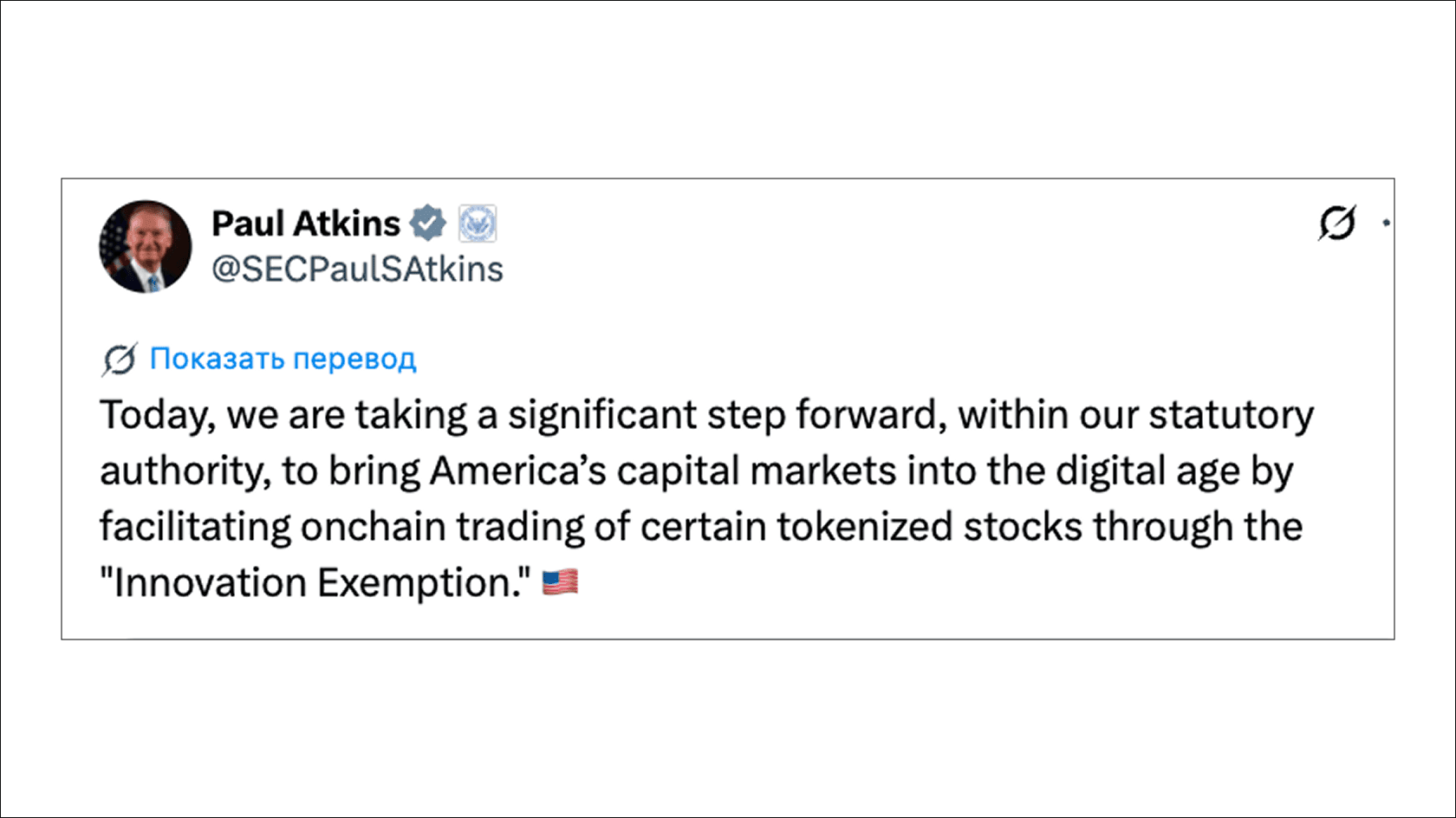
The regulator chose to act on its own, using powers it already holds — a first step toward fulfilling its joint promise with the CFTC to deliver crypto market rules even without Congress.
Earlier:
- SEC Promises to Build a Legal Framework for Cryptocurrencies
- CFTC Chair Says Crypto Market Will Be Regulated Even If CLARITY Act Fails
Details of the Order
The exemption under Section 36(a)(1) of the Securities Exchange Act of 1934 relieves a pre-approved tokenized securities platform of the obligation to register as a stock exchange. Such platforms match buyers and sellers through a market-maker program within a pool of pre-deposited assets.
Another benefit under the Innovation Exemption applies to firms that fund this pool with their own money and tokens. This kind of activity normally requires dealer status — a license held by professional market participants. The Innovation Exemption temporarily waives this requirement for them.
The commission isn't declaring the current setup a permanent standard: the order sets a time frame within which the market operates while the regulator observes how on-chain trading lines up with conventional trading.
What Automated Market Makers Must Meet
The platform must be a U.S. entity and comply with the sanctions regimes of the U.S. Treasury's Office of Foreign Assets Control (OFAC), admitting only pre-approved participants into the pool.
Smart contracts must remain public, auditable, and deployed on an open ledger without prior authorization. The platform halts trading in a token the moment the underlying security is halted on its primary listing exchange. Both the number of tickers and trading volumes are capped, tied to the tiers of the price limit-up/limit-down mechanism.
Commissioner Mark Uyeda added a disclosure requirement to these conditions. According to him, platforms must publicly disclose dollar-denominated data on the price, size, and time of every trade, as well as the pool's address, its end-of-day size, and daily volume.
“We get to see how the market behaves in practice, and can then use that to write permanent rules,” Uyeda said, comparing the current step to early exemptions that eventually gave rise to money market funds, index funds, and exchange-traded funds.
Rights Equivalent to a Security in a Brokerage Account
A token in this scheme isn't simply a price proxy. The order only permits a tokenized share of a national market system stock, issued by the issuer itself, on its behalf, or by an independent third party. The holder receives the same rights and privileges as the owner of a regular share of the same class, including dividends and voting rights.
Synthetic instruments that provide price exposure through a derivative contract and carry no shareholder rights are explicitly barred by a separate provision in the document.
The issuer has the right to object. Before admitting a third-party token, the platform sends the company written notice and gives it time to block trading. Here, the regime diverges from the model used abroad: according to the Financial Times, Robinhood and Kraken's parent company, Payward, don't request issuer permission outside the U.S. and don't give holders a direct vote, so they'll have to rebuild their products to meet U.S. requirements.
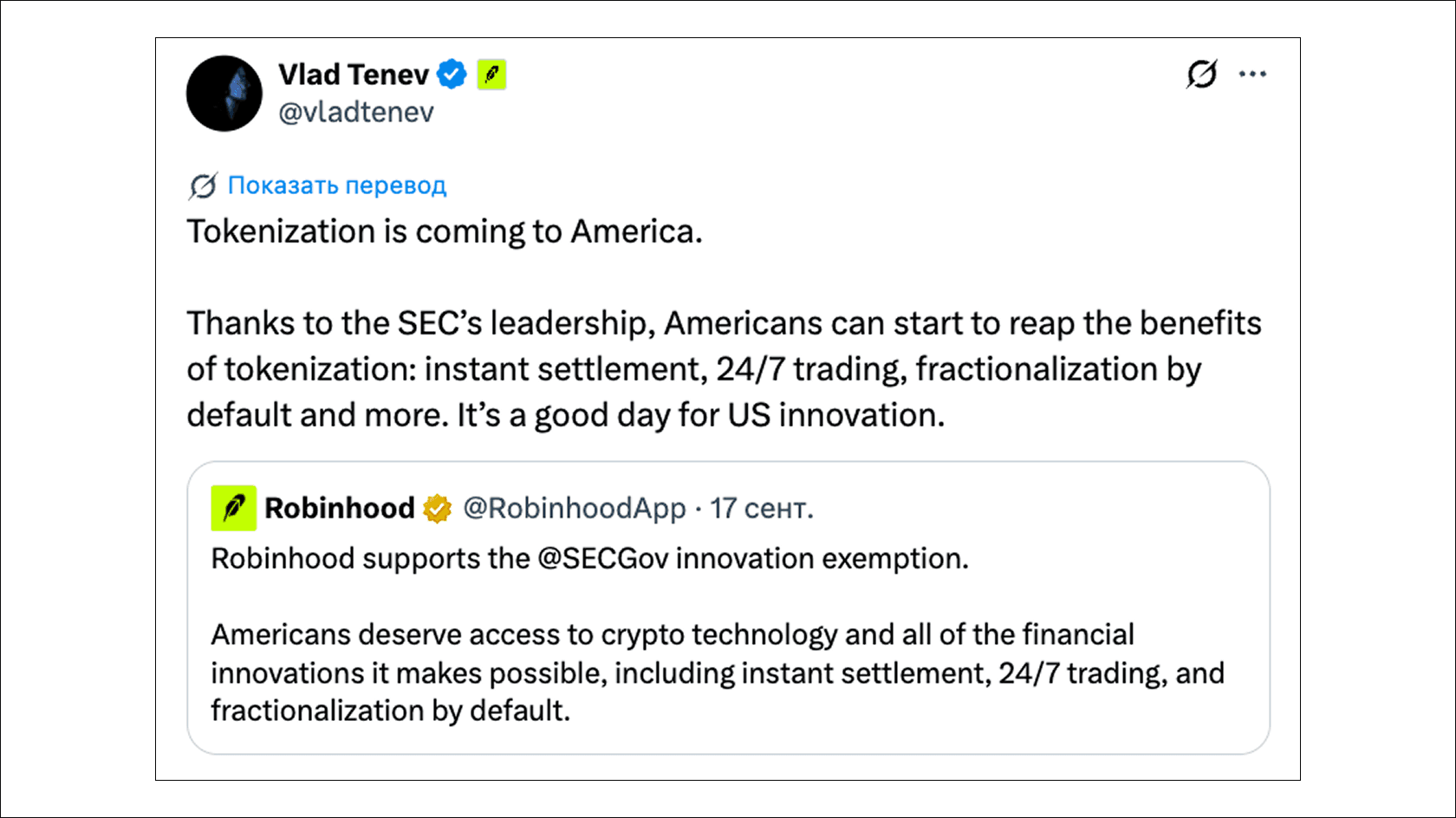
Robinhood chief executive Vlad Tenev called the decision a good day for American innovation and listed instant settlement, around-the-clock trading and share fractionalization. The company’s offshore tokens do not meet those conditions: they do not carry direct voting rights or issuer consent.
Why the Exemption Matters — and Where It Falls Short of a Law
Commissioner Hester Peirce backed the Innovation Exemption but was careful to narrow its scope.
“Platforms' and liquidity providers' participation in this mechanism doesn't in itself make them exchanges or dealers in the commission's eyes,” she explained. “First we need to see who actually joins it and how trading develops.”
Peirce frames the order's purpose as market observation: the regulator wants to understand how tokenized stocks are used on-chain and how this activity intersects with the conventional stock market. An issuer that doesn't need this kind of trading has the right to opt out of the regime.
Trade publication American Banker, which specializes in banking and financial regulation, cites market participants pointing to a downside of this approach: SEC and Commodity Futures Trading Commission (CFTC) rules don't carry the same weight as a law passed by Congress — the next administration or a court could overturn them faster than a full statute.
Atkins didn't dispute this, calling the current measure a stopgap.
“Permanent rulemaking must follow this temporary step,” he reiterated.
Who Is Already Building Similar Markets
The Innovation Exemption isn't the only channel for stock tokenization in the U.S. In March, the SEC already approved a similar application from Nasdaq, which received the right to conduct trades in tokenized stocks through the Depository Trust Company, the organization responsible for settlement in the U.S. stock market.
On September 10, Nasdaq invested $100M in Payward, the parent company of major crypto exchange Kraken. Together, the two companies are developing the Nasdaq Equity Tokens project — Nasdaq's own stock tokens, set to launch in the second quarter of 2027. Shareholder rights, including dividends and voting, will carry over to these tokens.
The Depository Trust & Clearing Corporation (DTCC), the main settlement center for the U.S. stock market, launched a similar pilot with JPMorgan, Goldman Sachs, BlackRock, Vanguard, and the NYSE.
In other words, the SEC's regime for tokenized securities platforms slots into a process that's already underway rather than creating a market from scratch — the same instrument is being built in parallel by both major exchanges and traditional financial institutions.
What Awaits the Tokenized Stock Market in the Coming Year
The first applications will come from platforms already registered in the U.S., with client verification and an onboarding process already in place. Trading volumes will remain limited for now by ticker and turnover caps.
Large companies will most likely move to block third-party tokens tracking their shares or require that such tokens be issued under their own name. Foreign wrapper tokens without dividends or voting rights won't fall under the regime, though they'll continue to exist outside the U.S.
The scenario on a one-year horizon: a platform notifies the issuer, which gets time to object, after which a token appears carrying dividends and proxy voting rights, with trade data made public. Trading in the token stops the moment the underlying stock is halted on its exchange.
If corporate actions — stock splits, spin-offs, votes — go through without token holders losing their rights, the SEC will have grounds for permanent rules. If problems arise with tracking ownership, issuers will block token issuance en masse or challenge Section 36 in court, and the regime risks staying niche.
Editorial Comment
At first glance, the SEC's decision looks like DeFi's arrival on Wall Street. In reality, the opposite is happening: the traditional market is building itself a sandbox where it can examine this kind of trading almost under a microscope. The requirements for the securities themselves remain unchanged — full disclosure, open trade data, just as with ordinary securities.
The very existence of this regime signals that adoption is already underway: new instruments are merging with traditional finance, and the process is a controlled one. The question is where it leads.
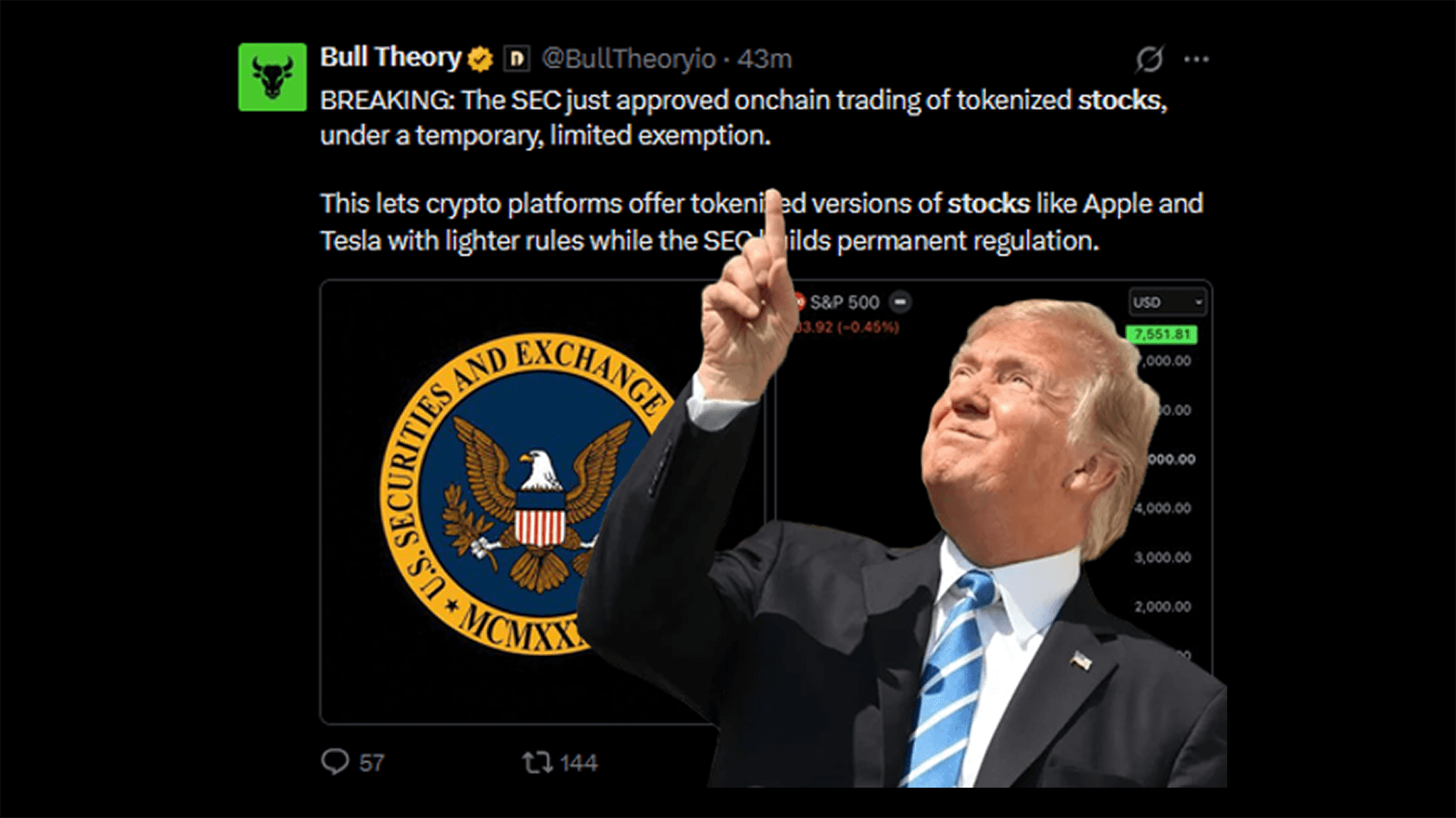
What's worth watching isn't whether tokenized stock gets integrated, but whether it actually functions like a stock: whether shareholder rights are preserved and whether the system can track compliance with the terms of the temporary authorization. In essence, this is groundwork for the stock market's move toward full but managed tokenization, where the token carries not just a digital likeness of a security but real rights — including dividends.
If the scenario plays out, the era of synthetic wrappers loosely tied to the real market and functioning like tokens in a game will come to an end. Such wrappers put assets on-chain using an approach the market has talked about for years without ever finding one that actually works. Inside this sandbox, that scheme may finally emerge.
This post is for informational purposes only and does not constitute advertising or investment advice. Please do your own research before making any decisions.
0
Comments
0
Write a comment.