Yes, it's true that AI website agents nowadays can find flights, check baggage rules, book for you, and do lots of tasks while you simply watch that Simpsons episode. But just one JS blocking the fare or no date field label can return a null fetch.
Whether a website is ready to get cited by AI is now making SEO teams work overtime, because even if it's poorly optimised for search engines these days, getting retrieved by AI and cited as a reference is equally important. And plain old SEO can't do that.
For that, you need to structure your JS a little. Tags like <div> should fit the AI's call to retrieve. And most of all, your page shouldn't block the AI crawlers.
Traditional search has come a long way since its initial days. Now it's not just about keyword stuffing or labelling the H1 and H2s. But today, there have to be two different objectives for a page that’s live:
- Whoever's reading it should find the interface polished.
- Its structure, bounded actions, and direct snippets need to be retrievable for the machines.
It's not okay just to be findable. Optimising properly for (AEO), or Answer Engine Optimisation and (GEO), or Generative Engine Optimisation… the former meaning writing for AI, while the latter helps LLMs to retrieve and cite.
Simply explained, these help crawler bots/agents skim through the information, scrape out the right facts, and then act as per the context and intent for which the page was originally curated.
How AI agents interpret a page in 2026?
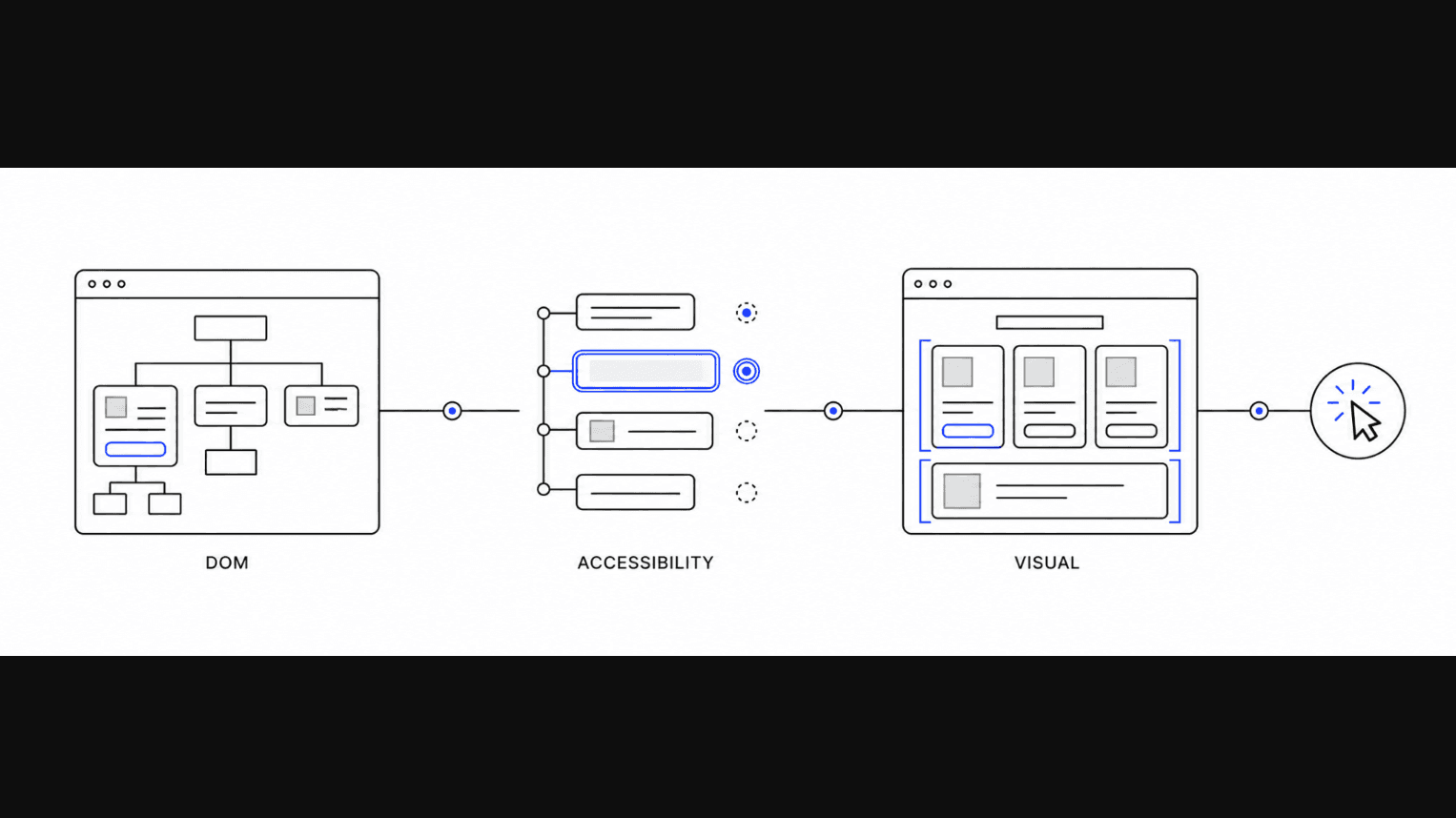
Earlier… writing for AI simply meant cutting out the fluff and writing crisply so that almost all of the information could get featured in Google snippets. Not the case now, though. As per Google's agent-friendly website guidance, browser agents commonly need three core representations.
1. The DOM structure
Document Object Model (DOM) explains the overall page's hierarchy and attributes. For agents to act. DOM helps insert CTAs like Buy Now within a product card, unlike a generic < div>- styled button
2. Purpose and state are represented by the accessibility tree
Nodes get distilled by agenting browsers into names, roles and states. A controllable instruction means “return date, text box, required” rather than a bulky clickable button. WAI-ARIA helps fill in HTML native styling elements within custom widgets.
And it's not just about fixing interaction designs. More nuanced control would still require managing your focus, keyboard behaviour, and all. That means native <button>, <a>, <nav>, <label> and form elements still have their place.
3. Visual grouping categorisation requires structured screenshots
Working agentic web design depends on the visual layout, DOM and accessibility tree trifecta. Browsers these days also use multi-modal LLMs. These models can infer proper grouping and structure if the backend code is ambiguous (obviously eats more tokens and time). If these are animations or GIFs, they can often be misinterpreted, but hyper-precise web designs and examples always keep the visual, accessibility, and DOM elements coherent.
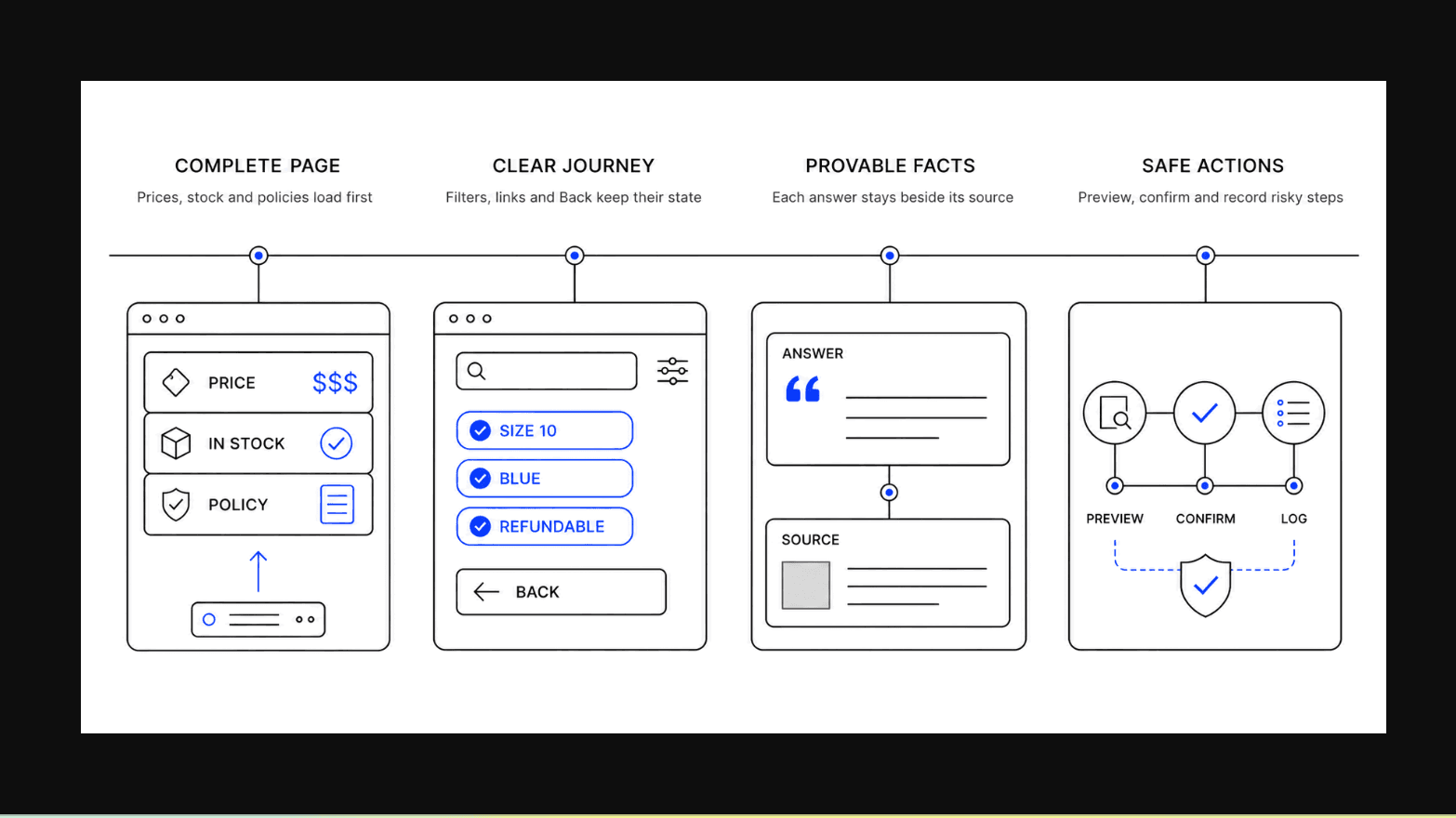
The 4 pillars of agentic page building
1st pillar: AI-readable website needs complete source content
Focus more on server-side rendering than client-side rendering because the latter confines responses only to the root and scripts. Also, Google recommends hydration or static rendering of JS, as not all crawler bots can execute it otherwise.
In layman's terms, use static generation for prices, titles, availability, the primary links and added policies. Interactions can be hydrated later on the HTML, and APIs can be fed from the same PIM or DIM headless so that catalogue values can't drift even if they're changing
How much access you want to provide should depend on your purpose. Regardless of the crawler, be it OpenAI, Anthropic or Perplexity, the search index retrieval/training patterns for each are different. There's no specific Google agent token. Google-Extended and Googlebot work differently from the previous three.
Your robots.txt, rate limits, and logs should stay aligned. Your IP's best if it's a static residential one (can even be rotational) but needs to be verified to decrease the scope of malicious bot flagging.
Also, just so you know, llms.txt isn't necessary for an agent-ready site was proposed by Jeremy Howard. Initially, it helped crawler agents find out the markdowns and important link references. Only 8.7% of the Tranco top 1,000 sites published it, as of recent research, and even Google publicly updated that it holds no value in terms of visibility or ranking.
2nd pillar: Stable, stateful, and semantic navigation is the way
Guesswork shouldn't be something that an agent has to do (cause they're pretty bad at it). HTML tag linkage, proper naming for icon-only buttons, and aria-relevant tags should be properly used to match the interface.
Next up, make sure primary action locations are consistent. Images and ad words should have reserved spaces. Overall, a layout shift score of <0.1 should be your target.
Then comes pagination, variants, and filters - each of them requires specific URL parameters. For example, say you run an e-commerce apparel site. The "size 10 blue refundable" is selected. The same should be agreeable in terms of the DOM and accessibility tree. A reversal simply should mean back.
3rd pillar: Facts need to be quoted by the agents
One answer, blocked caveat, or evidence directly under the H2 or H3 shouldn't be split between tooltip, hero, or PDF. AI-readable landing pages should be scrapable and SVO (subject-verb-object) formatted.
The JSON-LD labels within the page code should direct towards the fact that they can link towards the article, publisher, or product to its respective SKU, brand name, currency, and attached offers. sameAs and main domain links should be curated properly to help crawler agents understand the similarities and differences. This doesn’t mean something would get 100% cited, but the chances of hallucination and wrong matches decrease.
Canonical articles should be segmented into multiple answer-sized sections. Dates and authorship updates in JSON-LD should be regular. All in all, the API, the HTML feed, and the downloadable markdown - everything should be coherent so that the entire page becomes attributable
4th pillar: Governance is mandatory to ensure predictability and safety
If there are no direct-to-be agents, usually start using comms. Hence, always have nearby error codes and HTML tags properly set so that if something's wrong, the agent doesn't go to the next step. This kind of spam check is necessary to block risky requests and automation flow.
If any decision is high risk, don't ever, ever publish pages that give full access to agentic activity. Make a plan, preview it, and only then commit if everything's OK. A short-lived permission and item potency key (start or unique retry ID) is good to chip away at the duplicates.
For payments and deletions, always have human confirmation or a human-in-the-loop system. Validate everything on the server, and then make sure to log everything before you approve.
Many emerging protocols are trying to help the cause:
- The WebMCP protocol contributes to addToCart call options via typed JS tool exposure
- Jan 2026, Google’s Universal Commerce Protocol (UCP) came out as a combined support for APIs (Shopify’s UCP), A2A (Salesforce Agentforce), and MCP (any software connector), while also being AP2 compatible. This connects the agent with shopping, payment, and tools to perform the actions successfully.
- Apart from that, Web bot authentication from Cloudflare also checks all the requests coming from the agent site.
Needless to say…never, ever try to perform something malicious, such as prompt injection. Keep codes, keys, and critical payment information away from AI.
A similar example can also be seen in crypto, where AgentKits are used to keep the reasoning and signing elements separate. In this read, have a look at how checkout assumptions are changed by automated payments.
An easy 5-pass agent readiness audit guide
- Check sources versus rendered content: Disable JS and compare raw responses against the rendered DOM. After that, check the page's title, stock price policies, and all the other primary links.
- Check the machine interface: For that, use the Chrome DevTools Accessibility pane. If you see any stale ARIA blockers or anonymous controls, stay away and complete tasks from names, roles, and states alone.
- Entities need to be validated: In the schema.org markup validator, first check the JSON-LD. Then check eligibility via Google’s Rich Results Test and cross-reference between extracted and visible values.
- Further audit the governance rules: It's time to check robots.txt, rate limits, WAF decisions, and the logs to understand which bot's trying to access the page. Monitoring this is as necessary as creating the page to prevent any hiccups.
- Time to sandbox test: In an isolated browser environment, try to call a live browser agent. For example, Perplexity Comet to compare select submit. This'll help with testing bad data, expired database elements, and potential duplications. Record the bot's flow for possible interventions and side effects.
Remember the bottom line: SEO still is the fundamental
Despite whatever the LinkedIn and Reddit gurus feed you regarding GEO and AEO, the basics of SEO still rule the game before trying to make your website agent-ready.
Try to fit your user intent. HTML has to be semantic, layouts stable, and canonical content should have server-side validation.
If incoming organic traffic, or simply put, people viewing your site feel that it's navigation-worthy, chances are most of the crawler bots would also feel the same.