From Prompts to Orchestration: 8 Levels of Business AI Adoption in 2026
Read an expert review of corporate artificial intelligence integration levels based on current technical parameters, governance protocols, and financial metrics.
From Prompts to Orchestration: 8 Levels of Business AI Adoption in 2026
So, you're a founder who now runs a tech company of all Gen Z squad with 10+ AI tools for sales, operations, customer outreach, accounting, and everything.
Great, great. But then you find Jack from accounts prompt on work GPT “Book three Spider-Man tickets for me for Ma and Zoey. Make no mistake.”
What'd your reaction be?
To separate access between personal and operational control without having any major screwups in between, AI adoption levels for companies are mandatory. And it's not just me suggesting so. In a latest McKinsey global survey, about 1,993 respondents from 105 countries reported 88% regular AI use for work, but about among them, only 1/3 mentioned a proper enterprise-level AI setup.
And there are levels to this SOP or hierarchy, whatever you call it, namely eight. Don't think of it as some official law, but rather a guideline. The weak links that it tackles usually are three: data, integration, and control/adoption.
Let's look at what these levels essentially measure.
Measurement criterion based on the eight levels
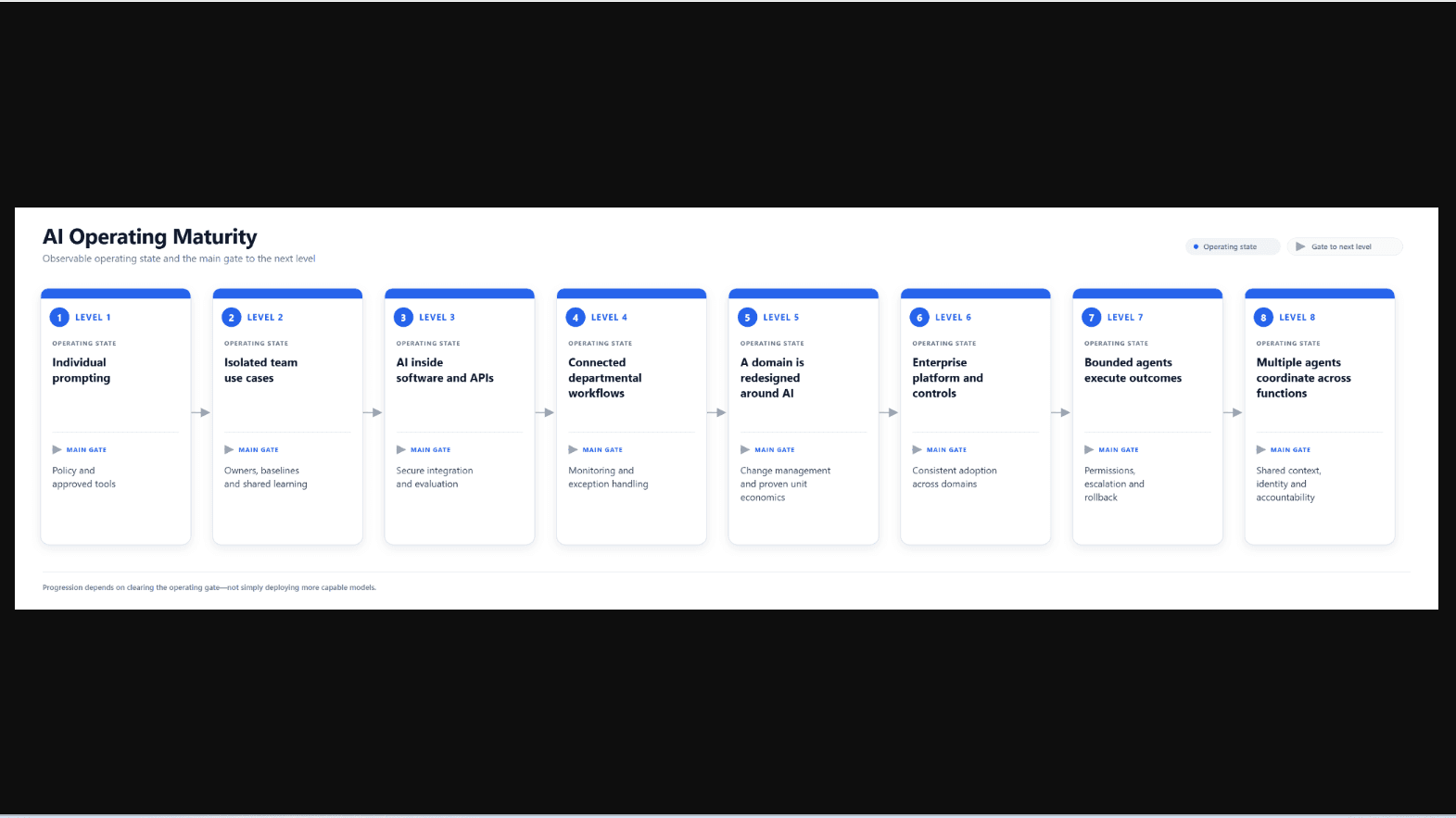
Reach, system integration, allowed autonomy, allowed control, and net value - you could say these are the dimensions that decide the chances of AI adoption levels. I've prepared the pillow table for you to understand the gates of entry and control for someone to succeed at each level.
Different levels of AI operating Maturity
Eight levels (of readiness) of corporate AI adoption
Level 1: Personal use case and prompting
Someone who's personally AI proficient doesn't mean they're enterprise-ready. Imagine some staff using generative AI for summaries, basic research, code, and drafts.
But do they know the difference between discrete corporate and personal stuff? I bet they don't. Instances of data leakage, shadow AI, and mixed-up memory context basis quality hazards are literally everywhere. And I mean everywhere. And people don't even have an idea about it.
The acceptable gate for someone to pass this level is via SOPs, enterprise accounts, proper AI literacy, and manual review of generated task outputs.
Level 2: Not shared around usage, but shared baseline memory
A friend of mine who works in a digital marketing agency told me how there's a separate content team, graphics team, a separate team of C-suits, and then a team of sales and accounts. But his company uses only two ChatGPT accounts and one Perplexity account, and each is shared haphazardly across team members.
You know what the problem is here? Distorted memories, jumbled up contexts.
Someone can access some other chat, edit it, delete it, move it to different projects and folders. Someone can get access to some information that they shouldn't have access to, and everything that you can imagine. The cure to this is having separate, isolated use case environments, while the baseline workflow and metrics between overall team objectives need to be shared across different teams.
Level 3: AI not as software or a browser window, but an API/MCP now
Yep, at this level, AI tools and LLMs are built into software. Or people can summon both open-source/gated models directly through VS Code or, for that matter, any CLI.
So, what happens here? Usage becomes very consistent. A little boring and repetitive.
Adding more steps in the same workflow isn't going to work well for the business. Operational and security checks need to be divided here. Governance regarding access controls, isolated browsers, test data, latency, token costs, and what can be done and what can be reduced is required, given the recent spikes seen in NVIDIA's data centre results. The capacity of final AI proficiency should depend on cost per successful output, not the dozens of AI/API used.
Level 4: End-to-end AI workflow needs to be governed
This isn't for small-scale brands or companies, but if you were a founder, your vision would definitely not be to remain small.
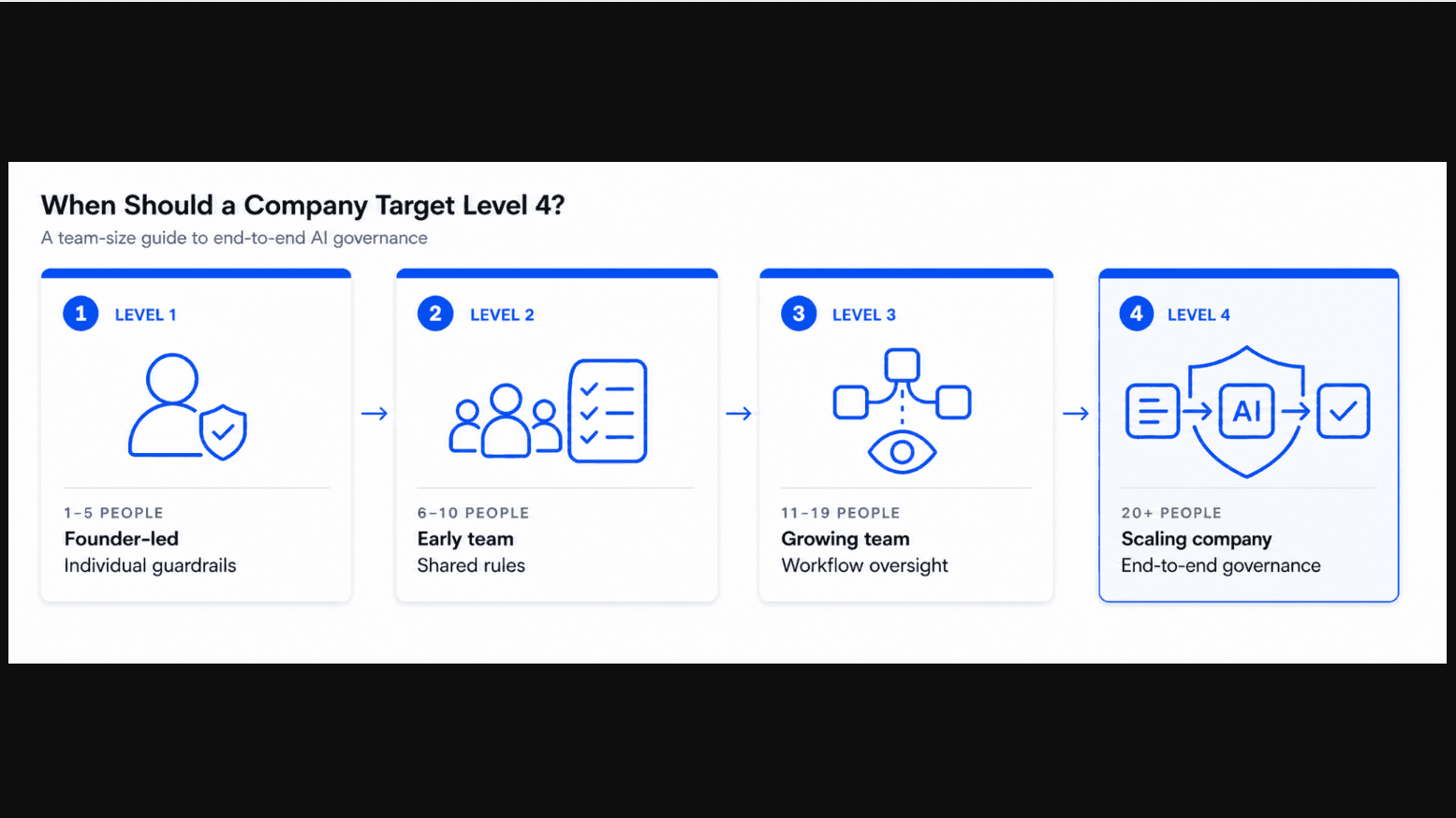
When should a company target Level 4
Once you grow your team to 20-plus, it's better to have a department that checks the steps of every task, every AI subscription, from team leader to executives, workflow, transition, etc. Basically, end-to-end from the initial request to final system output generated by every AI that's being used needs to be overseen given the rising token costs.
Tracking moving data from one AI to another, one person to another is obviously very complex. But given that has an aligned pathway, it becomes easier from a founder level to get hold of errors and minimise them or restart any failed task later on.
It also speaks volumes about how you define your leadership. For example, McKinsey found that in spaces like media, tech, and telecommunications, agentic use is the most, while the workflow remains scattered. Investing in the maturity of such a scattered environment from start to end becomes necessary in these domains.
Level 5: Build business processes to have AI in the loop
Yep, this needs to be done, but at the same time, there needs to be a human in the loop in this AI process. Companies tend to restructure their roles, responsibilities, and customer journeys. In 2026, it's high time those are turned to AI-led to match the previously discussed levels of AI adoption. If you remove AI from your process just because you don't like it or you think it might create slop, you'll lag.
Across Y Combinator and McKinsey reads posted publicly, it's been seen that those who redesign their workflows around a human-in-the-loop AI service tend to benefit more than those who strictly rely on either AI or human workflows. You get the idea.
Level 6: Standardise your tools and data access usage
I'm talking about creating a central platform or maybe a Center of Excellence where anyone can go to for tracked data access so that it can later help in evaluation of the models being used, auditing, and responding to any broken incidents proactively. It pulls some elements from the previous levels, but think of this from a continuous AI lifecycle management process, as per what the NIST AI risk management framework says.
Another piece of evidence of this, as per an IBM survey done with 2,000 tech executives, is that more than 75% say AI adoption for sure is faster than governance. Also a reason readiness for large-scale agentic deployment is something businesses need to work on.
Level 7: Outcomes need to be automated via agents, but controlled
A couple of years back, generating one answer, essay, or email using AI meant so much. Nowadays, performing multi-step tasks, where different kinds of inputs are needed at different stages of the prompting, even sub-stages added regarding prompt refinement, is basic.
Such has been the growth of AI-led workflows. Think jobs like handling customer tickets, resolving routine requests, searching for info within scattered records, and then helping people out. Can now be done in a matter of seconds thanks to, obviously, AI agents. They run autonomously and don't require you to oversee every part of their thinking protocol. But the executive who's handling the workflow should be skilled and experienced enough that you can check the step-wise thinking protocol and the output that is being generated.
A good example would be early-stage agentic wallet architecture whitepapers: authority has to be enforced through systematic design and step-by-step procedures rather than just ticking off documentation. There have to be overrides. There have to be limits set and rollbacks when needed.
Level 8: Agents governing AI workflows across departments
This is the last step, or level I'd say. Specialized agents can coordinate across different functions while controlling access via shared identity layers. They can delegate, they can solve any conflict they come across, and orchestrate the entire process for other agents to follow through.
There are still barriers, and one of the major barriers here is the learning curve and execution. But such isn't yet common across worldwide enterprises, as companies that are scaling using agentic AI still have certain functions within their process where they completely rely on humans. There’s still fear of leaving everything to complete autonomy.
Another barrier to this is the rising costs, poor control, and no absolute final value, as Gartner predicts that almost 40% of agentic projects will see closure by 2027.
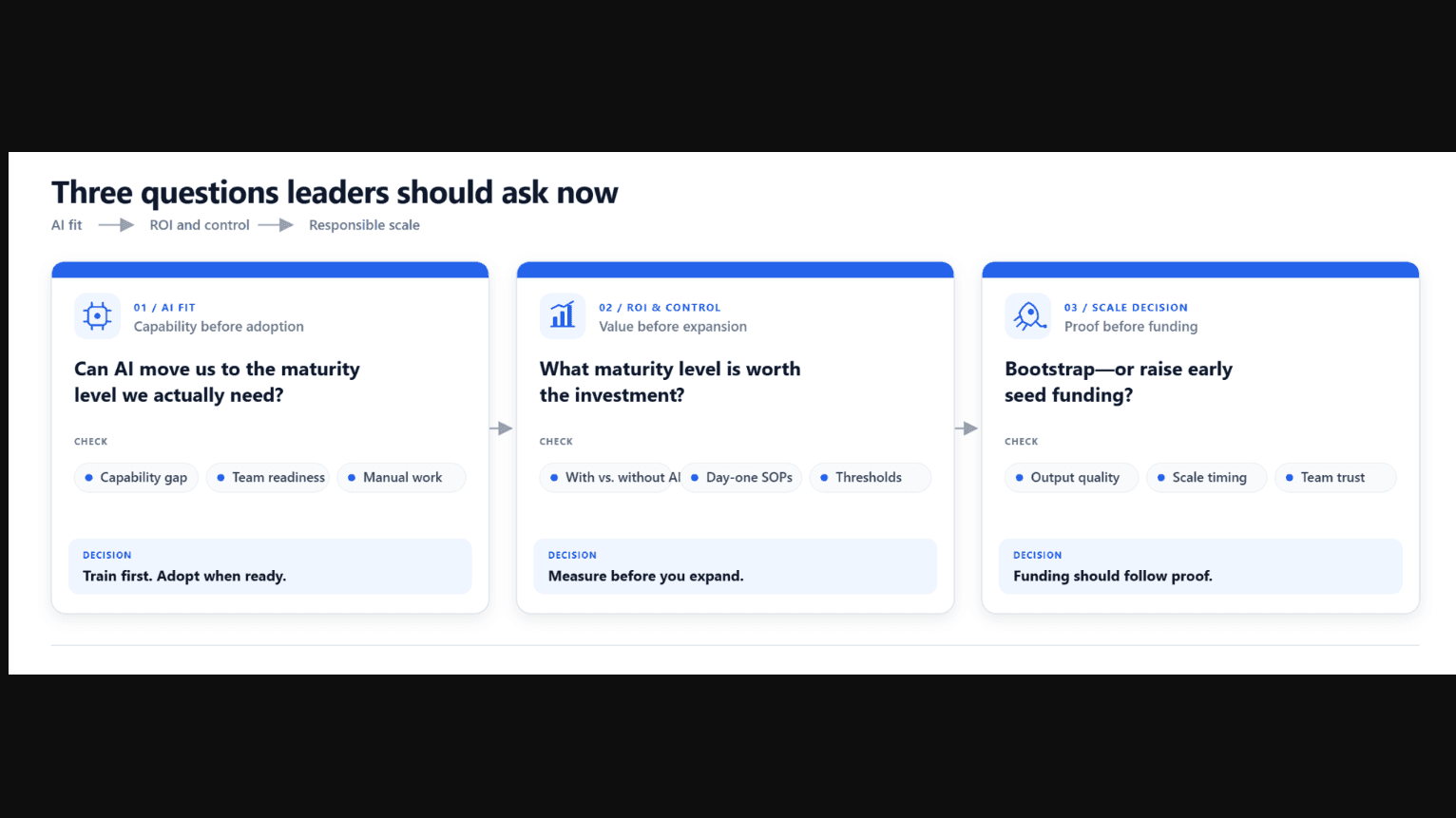
Three questions leaders should ask right now
Ask yourself if your AI can help you attain the final level of maturity.
Ask yourself if, as per your potential, AI can help you attain the final level of maturity. If not, it's still early to jump onto the AI ship. Keep adding a skilled workforce to your team and keep on training them on how to implement AI to cut out manual execution from their day-to-day tasks.
The next question would be deciding the AI adoption maturity levels your business needs versus the actual investment that you need to put through. Be clear on the fact what'd happen with and without AI, and which thing benefits you at whatever stage you're in. Try to generate SOPs for your team from day one and try to measure their outputs and threshold levels.
Lastly, ask yourself: is bootstrapping better or getting early seed funds better for scaling your business? Because if the output isn't right, you might have to let go of your team, which can show you in a bad light in your functioning space.
Always better to stay alert than automate what you can't yet control.