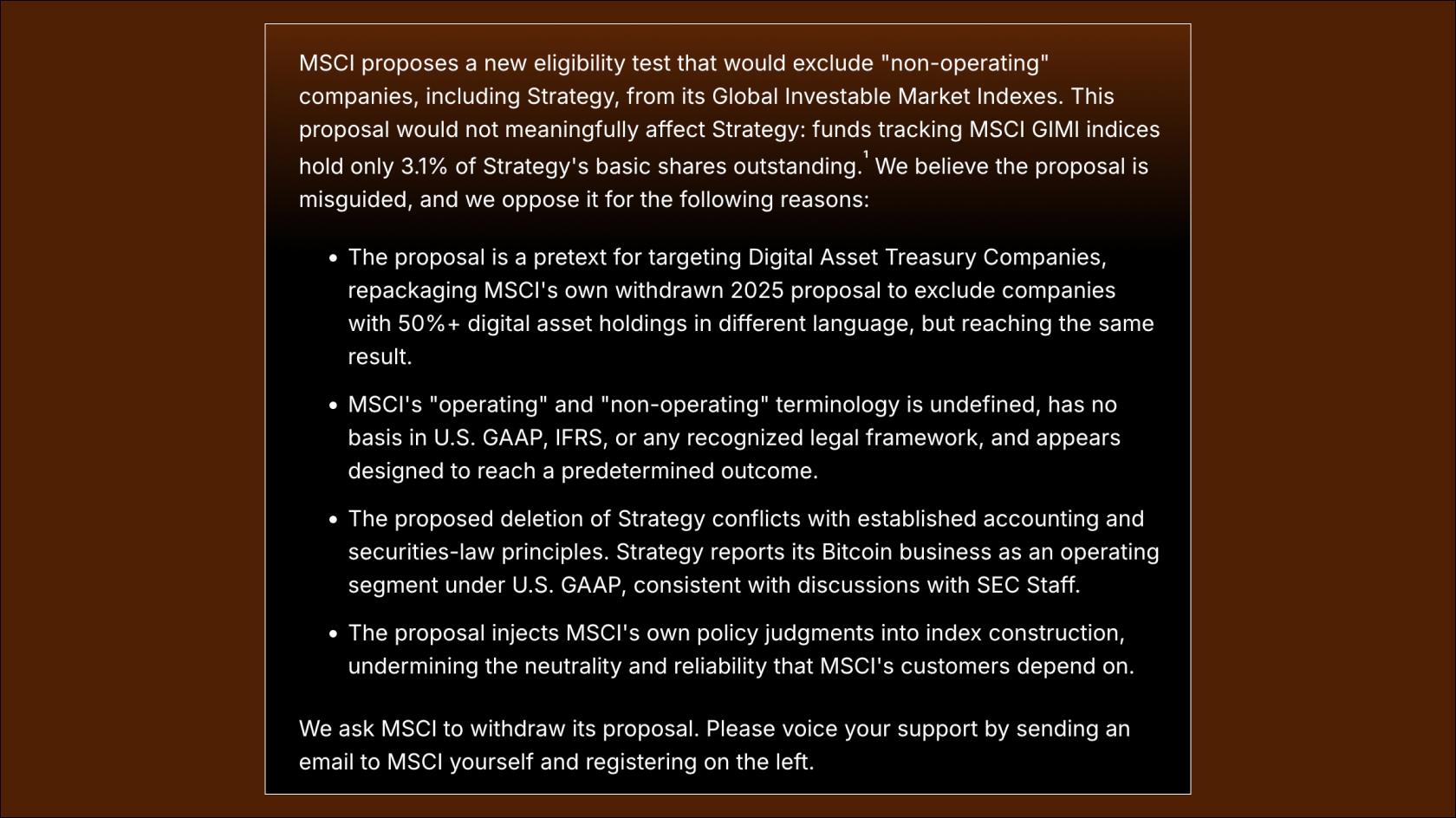
On November 11, index provider MSCI confirmed that Strategy and Metaplanet will be dropped from its indexes effective December 1. Strategy’s stock fell 2.5% in after-hours trading. Funds that track MSCI indexes will have to sell shares of both companies.
Why MSCI Is Dropping Them
In October, MSCI updated the rules it uses to select companies for its indexes. The provider now checks whether a business resembles an investment fund, assessing its operating assets and financial metrics. Companies that fail the check are removed from the indexes.
Strategy landed on the list because of its bitcoin accumulation model. The company issues common and preferred shares, borrows money, and puts the capital it raises into BTC. By the end of October, its holdings had reached roughly 850,000 BTC.
Strategy disagrees with MSCI’s decision. The company says it still develops software and accounts for its bitcoin activity as a separate line of business.
“We believe the decision is unjustified and discriminatory,” the company said.
Strategy’s Potential Losses
Strategy doesn’t expect serious consequences. The company estimates that funds tracking MSCI indexes hold about 13 million of its shares, or 3.1% of the total. Even selling the entire stake wouldn’t exceed the stock’s average daily trading volume.
But JPMorgan analysts warn of a much more serious scenario. If other index providers also drop Strategy, outflows from its stock could reach $8.8B. That would make it harder for the company to raise new money to buy bitcoin.
Our Take
Saylor has taken a gut punch, and it landed on the very mechanism that let him buy bitcoin with other people’s money.
Saylor turned bitcoin into a full-fledged financial product. Strategy’s whole model rests on raising capital through shares and other securities, then using it to buy BTC. That creates a curious paradox: the company made bitcoin the foundation of its business, yet its future now depends not only on bitcoin’s price but also on whether index providers see Strategy as a real company.
You can debate whether bitcoin is independent of Wall Street. But one thing is certain: a business built on accumulating it very much depends on the decisions of traditional financial institutions.
The main danger isn’t that Strategy will start selling bitcoin. It’s that Strategy will stop buying it. That’s a far more interesting risk than the usual scare stories about an immediate sell-off of its holdings. If demand for the stock drops and raising capital gets more expensive, Strategy will find it harder to fund new purchases. The market could lose a major buyer before that buyer ever turns into a seller.
MSCI has questioned the very idea of corporate crypto treasuries as a standalone business. If a company mostly holds investment assets, why should it be valued like an ordinary operating business? What’s more, the new rules aren’t limited to crypto: even Yellow Cake, which invests in uranium, is being dropped.
For now, panic over a possible bitcoin sell-off is unfounded. MSCI’s decision doesn’t require Strategy to sell its holdings: index funds will sell the company’s shares, not the BTC it owns. That said, Strategy’s SEC filings do say it could sell cryptocurrency to cover its financial obligations.
Here’s how a potentially dangerous chain reaction could play out: a falling stock price makes it harder to raise capital, Strategy buys less bitcoin, and that puts extra pressure on its business model. And if liquidity problems begin, the company could even end up selling its holdings.
Ultimately, Saylor has run into a fairly obvious problem. Wall Street has started asking an uncomfortable question: why buy shares of a company that buys bitcoin when you can simply buy bitcoin?