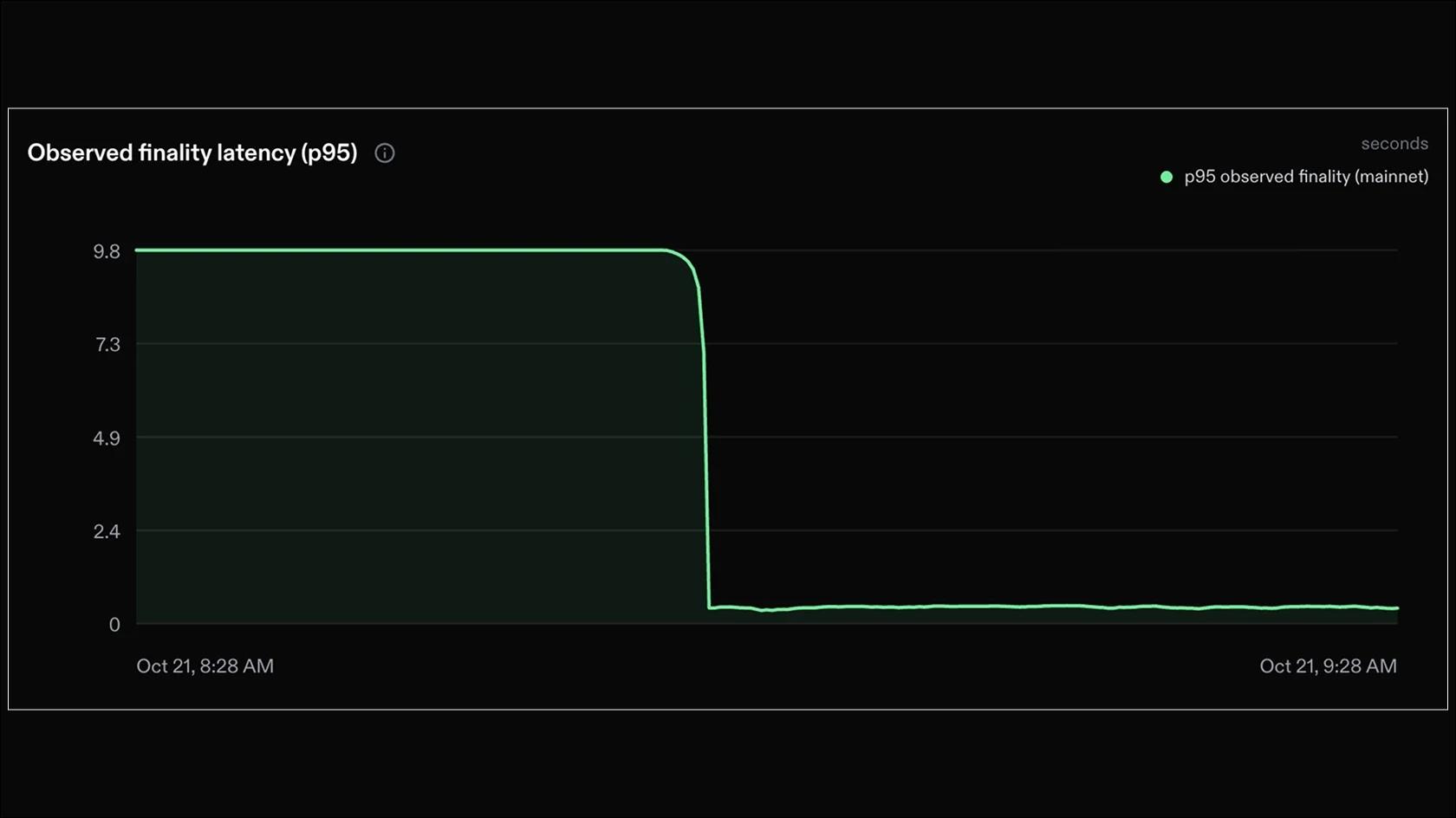
On October 21, Solana launched Alpenglow, the biggest overhaul of its consensus mechanism to date. According to the developers, the upgrade cuts transaction finality time to 150 milliseconds and reduces costs for validators. We examine whether these technical improvements could strengthen Solana’s position and attract more activity to the network.
What Changes for Transactions
With Alpenglow, Solana has switched to a new consensus mechanism designed to reduce transaction finality time from around six seconds to just 150 milliseconds — a 40-fold improvement. The upgrade speeds up the process by which validators agree on blocks, rather than the execution of transactions themselves.
Exchanges and payment services that need to wait for transactions to reach finality are likely to benefit the most. They could settle transactions and credit deposits faster, provided their infrastructure supports it.
“For professional traders, faster finality is useful, but it has never been the main bottleneck. What matters far more is being close to where blocks are produced,” explained Robin Nordnes, head of Raiku, a company developing infrastructure for faster trade execution on Solana.
Even after the upgrade, traders who can get their orders to validators ahead of competitors will retain an advantage.
Will the Upgrade Affect SOL?
The biggest economic changes will affect network operators. According to Galaxy’s estimates, Alpenglow reduces validator voting costs by roughly 60%. The savings come as the number of validators has fallen by around 30% over the past year, reaching 659 by the end of September, according to a Bitwise report.
Lower costs could make it easier for smaller operators to continue running validators and help slow the decline in their numbers. However, that does not guarantee an increase in the validator count.
For SOL holders, there is no immediate financial benefit. The upgrade does not automatically increase staking yields, and faster transaction finality does not, by itself, create additional demand for the token.
The long-term impact will depend on whether these improvements attract new payment and financial services. More user activity could generate higher fee revenue for the network, though whether that happens remains to be seen.
There is another point worth noting for investors tracking Solana’s activity. Following Alpenglow, the total transaction count could fall significantly even if trading activity remains unchanged. That is because validator votes are no longer recorded as separate on-chain transactions. As a result, user transactions will be a more useful measure of actual network activity.
Will Solana Become More Reliable?
Alpenglow changes not only Solana’s speed but also its resilience to outages. The new mechanism is designed to keep the network running under certain combinations of technical failures and malicious validator behavior.
There is a trade-off, however. The previous mechanism could tolerate malicious stake accounting for less than one-third of the total. Under the new system, that threshold falls to less than 20%. In return, the network gains greater resilience when honest validators go offline. According to Galaxy’s assessment, developers revised these trade-offs with Solana’s history of technical outages in mind.
For investors, the key question is whether the network can keep operating during periods of heavy demand. Solana’s previous outages have shown how critical network availability is for traders, who cannot execute transactions when technical problems disrupt the blockchain.
A successful Alpenglow launch does not yet prove that the new mechanism is reliable. While traders continue trading memecoins much as they did before, Solana still needs to demonstrate that faster block consensus comes with stable network performance. Its performance under sustained use and heavy network loads will offer a clearer picture.