The AI impact on junior software developer jobs 2026 is not just a forecast about what might happen to the tech career ladder anymore. The entry point is rapidly shrinking, as companies have less and less incentive to hire graduates. They can - and many do - simply turn to AI for work that graduates used to do. The new state of things effectively eliminates the standard entry-level pathways for junior developers.
SignalFire’s 2026 State of Tech Talent Report (based on LinkedIn-scale data that covers over 650 million professionals) found that new-grad and entry-level hiring have dropped roughly 65% at 12 major technology companies compared to 2019. The figures are also down around 76% at early-stage startups. The report claims that 2025 CS graduates are 45% less likely to land a "Tech Major" role than prior cohorts - and twice as likely to describe themselves as founders, compared with the 2022 graduating class.
What this means is that corporate America has stopped paying the ‘Training Tax.’ It doesn’t want to pay someone to learn and waste the time of senior engineers on reviewing and monitoring the newcomers.
Especially when an experienced engineer with an AI agent at their side can now handle a much bigger volume of routine implementation work that once required a larger team.
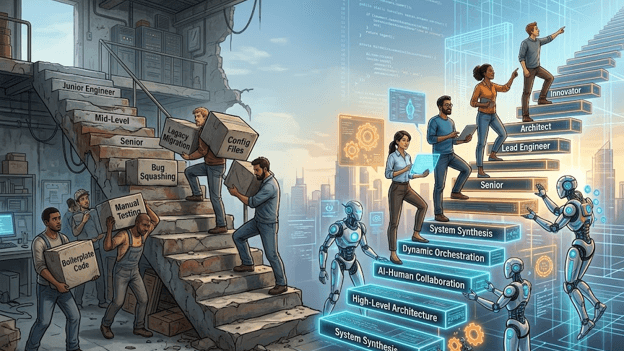
How AI Agents Are Rebuilding the Engineering Career Ladder
Illustration generated with AI
While companies want senior developers, they refuse to invest 1-2 years in turning juniors into seniors due to fear of immediate job-hopping. It is more profitable and less risky to just use AI to handle junior-level work. That is the real AI impact on junior developer roles.
Entry-level software work was built around the tasks that are still important, but are not as risky. This provides a perfect environment for juniors to “learn the ropes,” so to speak. A junior developer could create CRUD endpoints or fix some simple and straightforward bugs. They could adjust a UI component or write tests, and do similar tasks.
Assignments such as these gave new engineers some much-needed practical experience, but if they made mistakes, the consequences would be minimal. The problem is that AI coding agents are now capable of handling such work in a fraction of the time and they don’t make mistakes often. The developer still needs to review the results, but the act of producing code is no longer considered a valuable entry-level skill. This is why many are concerned about AI replacement of junior developer jobs in 2026.
From Typing Code to Auditing Systems
With AI taking over junior developers’ former tasks, companies’ needs for engineers have changed as well. If generating a working function now only takes seconds, there is no advantage in knowing how to type it faster than AI, nor is it possible. The harder problem is trying to determine whether the function belongs there at all, or whether it introduces some sort of problem with security or performance.
This is why a human developer is still needed, as they can provide contextual problem-solving. A developer who understands the architecture can identify hidden problems and recognize when a solution created by an AI agent is technically valid, but for some reason doesn’t work well for the product. Simply put, AI still needs oversight, but the same can be said for junior developers.
Fewer Low-Risk Tasks to Delegate
Companies are cutting junior hiring because AI now handles the routine work juniors used to do, and training a junior is a cost with no guarantee they will stay. Over time this robs them of experienced engineers.
The recent hiring data further confirms that this change is truly happening. In software development, senior-level positions accounted for 69.3% of listings in Q1 2026, compared with only 4.5% of entry-level roles. The senior share has gone up 9 percentage points since 2019, while the mid-level share has fallen 7.7 points over the same period.
The problem for junior hiring is not just that AI can replace a junior developer - it is that the traditional progression depends on having enough low-risk work for juniors to have something to do. If AI can handle the majority of such workload, senior engineers have fewer simple tasks for juniors. This means that the career ladder now has to start higher, and new developers are expected to arrive with the ability to understand, audit, and direct systems instead of just contributing some code to it. In other words, they need to arrive with experience, but they don’t have an opportunity to earn it.
Why Young Developers Choose Independent Product Creation
With many concerned about junior developer jobs disappearing due to AI in 2026, young developers are trying to build something themselves. Trying something new often looks more productive than just facing hundreds of rejected applications and choosing to submit their resume once again. This is also a good way for them to demonstrate what they can actually do.
The economics make this option more and more accessible, as services like Vercel and Supabase remove a lot of the work regarding the infrastructure. Launching a project once required dedicated servers and operations expertise, but these services eliminate such needs.
LLM APIs also provide capabilities that previously needed entire development teams to build them from scratch. For developers, this is good news, as they can now create a product on their own, without needing a job or a large investment.
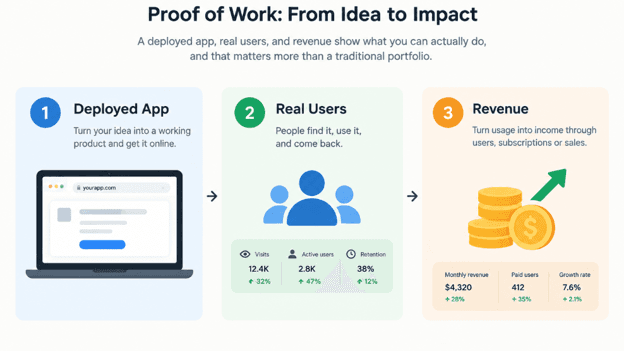
Ownership Is The New Portfolio
With a product in their hands, juniors can see their mistakes and improve upon them. Getting better is impossible if your only reference is a rejection letter, but a product that works or doesn’t work gives the developer more information about their own skill, and they can potentially even monetize it.
Illustration generated with AI
Even if the product fails, the developer can dissect it to see what went wrong. More than that, even a failed product can be a demonstration of the developer’s thought process and technical judgment.
Traditional junior path
Solo-builder path
How you learn
Work on smaller tasks under senior engineers and learn through feedback and reviews
Learn by building, testing, breaking, and fixing on your own
Typical work
Bug fixes, routine features, tests, UI changes, and similar low-risk tasks
Complete products
AI’s role
Helps developers handle more routine work
Acts as a coding and development partner
Feedback
Senior developers review the code and provide guidance
The product provides feedback through success/failure and user response
Main advantage
Builds strong fundamentals and exposes developers to established practices
Allows the builder to own the product and gain practical experience, plus it lets them show what they can build independently
Main risk
Fewer entry-level opportunities, since companies are now automating routine work
Developers can move quickly, but they miss the experience with fundamentals and can become too dependent on AI
The New Technical Baseline
For a lot of developers, the combination of affordable cloud infrastructure, AI coding tools, and easily accessible APIs makes it more than possible to create and launch small software products without learning from being a part of a small corporate engineering team. The downside is that they skip the basics, and tend to rely too much on AI for producing code, so even though they know it works, they don’t understand why. This can cause problems later down the line, when their work needs specific modifications
But, with the change in mindset, the stack changes as well. Python is now the most practical foundation for AI orchestration, while TypeScript provides type-safe interfaces for modern apps. MCP servers will add an extra layer by providing AI systems with standardized ways of interacting with whatever external tools or services they need to complete the job.
With a combination like this, juniors can build entire systems instead of limiting themselves to simple applications. A developer, on their own, can create a procurement agent that compares supplies and recommends where to make your purchases, or they can create an automated system for analyzing documents that can process files and bring back the results into the existing workflow.
Even though the bar is raised, you can still meet and exceed it by showing that a new developer can assemble an autonomous system, connect it to the data and tools it needs, and turn an idea into something that people can actually use.
The Skills Young Developers Lose by Skipping the Ladder
Illustration generated with AI
While skipping the corporate ladder is an option now, it will produce a developer who is somewhat different from the one who went through traditional channels. Traditional teams expose new developers to tasks like code reviews, debugging, architectural decisions, the consequences of maintaining software months after it was written, and the like.
A solo builder who works through AI agents tends to move faster, but they miss out on these feedback loops.
Anthropic’s research illustrates this trade-off. In a study of 52 mostly junior developers, the AI-assisted group managed to complete a coding task only two minutes faster than the hand-coding control group. Yet the hand-coding group scored 67% on a post-task comprehension quiz vs. 50% for the AI-assisted group. Researchers believe that the difference is driven by weaker debugging ability among AI-assisted developers, likely because they missed out on the basics.
The ‘Vibe Coding’ Trap
The main risk of the so-called Vibe-Coding is that the developer accepts AI-generated code. The code works, but the developer doesn’t understand why it works. This allows them to create a prototype of their product quickly, but they don’t fully understand it. If they need to make changes to it and rework some part of it, this becomes much more of an issue for them, since they don’t know the system that they didn’t build personally.
This goes back to the importance of understanding the fundamentals like event loops, data structures, memory management, concurrency, and the system’s architecture. Having a deeper knowledge of these things gives developers the mental model that they need to recognize when an AI-generated answer is only “technically” correct but won’t work in practice.
Make AI Output Testable
Obviously, it is not the junior developers’ fault that they aren’t getting hired in the world where companies choose to use AI instead of newcomers. Those who choose to become solo builders can compensate for the missing review layer by treating AI outputs as probabilistic, rather than authoritative.
What this means is that all important features need to have automated tests and explicit expected behaviors. Evaluations need to cover both normal and failure conditions in order to ensure that the feature is reliable.
For AI-powered apps, tools like DeepEval and Ragas can provide structured LLM evaluations for things like the quality of answers. They can also test consistency and retrieval accuracy. The goal is not to eliminate uncertainty, but to build automated evidence that will let a solo developer detect when an agent’s output has lost its edge. If the agent starts becoming less reliable or technically unsafe, the biggest priority is detecting it, as this allows you to react in time.
The Junior Developer Is Becoming a Different Job
The traditional junior engineer is slowly disappearing from the industry. They used to be trained by doing the smaller parts of larger projects, such as fixing bugs, reviewing existing code, writing routine features, and learning under the oversight of their senior colleagues.
With AI now removing much of that work, early-career developers have to find some other way to prove themselves. A young developer is required to have the knowledge and experience that is far above their station, which is why many turn to solo development. On one hand, this teaches them the importance of handling everything themselves, but on the other, they lose many of the basics that traditional juniors first learn.
A young developer is expected to orchestrate AI agents and connect APIs and MCP servers. They also have to understand the fundamentals behind the generated code and be able to build a functioning product themselves, instead of simply contributing smaller parts to one that a senior is actively working on.
Even with AI doing the low-risk tasks, however, having experience matters. It allows the developer to make judgments and understand the system, both of which are important for being able to judge the work that AI has done. All of this implies that developers have to adapt to the new system, where it is less important to be able to write the most code and more important to turn AI-generated code into a reliable system that will work as a functioning product.