Binance Lists HYPE: What’s Behind the Unexpected Move?
The HYPE listing on Binance comes as Hyperliquid hits record levels and competition with Aster for the derivatives market enters a new phase. We examine what the listing means for the platforms themselves and for HYPE holders.
Binance listed HYPE, the native token of Hyperliquid, for spot trading on September 24. Hyperliquid is a DeFi platform that competes with the world’s largest centralized crypto exchange in the perpetuals market. The global listing comes as the protocol reaches record levels of activity and generates substantial revenue within its own ecosystem.
The market is now watching not only HYPE’s price reaction, but also how access to Binance liquidity could shift the balance of power between the two platforms, as well as Aster, Hyperliquid’s on-chain rival from the Binance ecosystem.
Listing Terms
HYPE trading opened at 11:00 UTC with HYPE/USDT, HYPE/USDC, and HYPE/TRY pairs. The Turkish lira pair is available only to Binance TR customers, while the new trading pairs are unavailable to residents of the US, Canada, the Netherlands, and several other countries.
Binance opened deposits one hour before trading began and scheduled withdrawals for September 25. Algorithmic orders went live with the order book, while trading bots and copy trading are being added within 24 hours.
HYPE carries the Seed Tag. To trade the token on the spot market or with margin, users must pass a risk-awareness test once every 90 days.
Why Binance Is Only Listing HYPE Now
Hyperliquid and Binance target the same audience: traders who use leverage and trade perpetual contracts around the clock. Hyperliquid has built its own network with a fully on-chain order book, while Binance remains the largest centralized exchange for this type of trading.
On May 30, 2025, Binance launched HYPE perpetual futures with leverage of up to 75x, and on June 6, Binance.US opened spot trading for the token. Binance’s global platform added HYPE more than a year later, even though by September 2026 the token was already trading on major platforms including Coinbase, OKX, and HTX.
“The team doesn’t put centralized exchange listings above developing the platform itself,” Hyperliquid founder Jeff Yan previously said.
Hyperliquid has no listing fee, no dedicated listing department, and no gatekeepers controlling access: any user can list a spot asset as long as it meets the established requirements.
In June 2026, Binance founder and former CEO Changpeng Zhao called Hyperliquid an excellent project, but criticized its lack of KYC.
Hyperliquid’s Business Model
By the time of the global Binance listing, Hyperliquid had already built up significant revenue. According to CoinGecko, from January through September 15, 2026, the protocol generated $429M in revenue, more than any other crypto project except stablecoin issuers. For comparison, Pump.fun generated $322M over the same period.
Hyperliquid also generates income from its USDC reserves. In May, Coinbase became the treasury operator, while Circle became the technical operator. Under the AQAv2 rules, the protocol receives around 90% of the yield generated by these reserves. With around $5B in USDC on hand, analysts estimated annual protocol income from the reserves at $135–160M.
Hyperliquid directs most trading fees to the Assistance Fund. The fund automatically converts those fees into HYPE and burns the tokens, removing them from circulation and from the total supply.
As of September 19, 2026, the protocol’s cumulative historical revenue stood at $1.26B. By the same date, 48.76M HYPE had been burned, equal to 4.88% of the maximum supply of 1B tokens.
Hyperliquid vs. Aster
Aster, part of the Binance ecosystem, operates in the same segment of decentralized derivatives trading and is a direct competitor to Hyperliquid. However, the projects use different architectures and trading models.
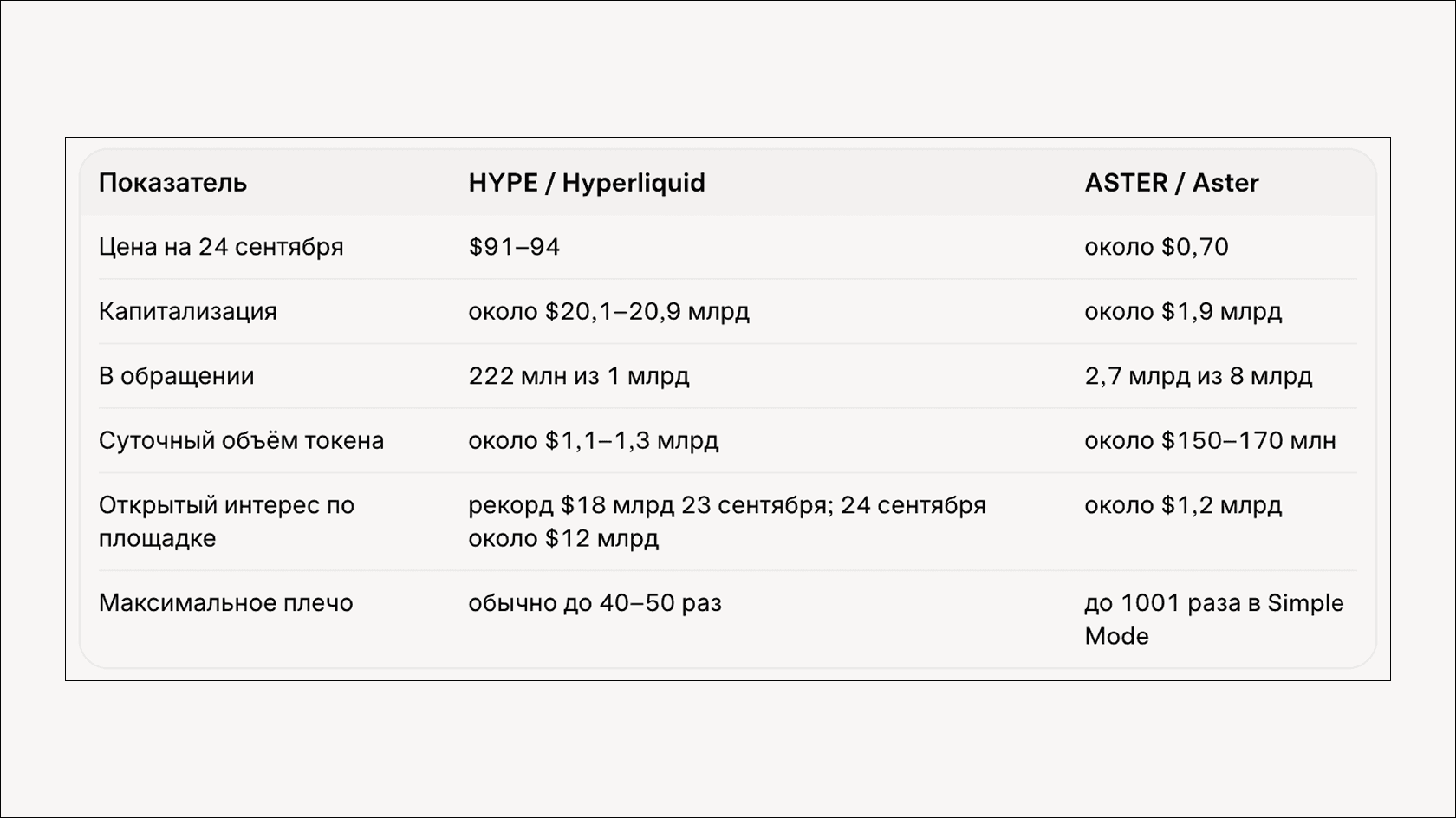
Hyperliquid vs. Aster as of September 24, 2026. Source: CoinGecko
Hyperliquid runs on its own blockchain, with the HyperCore order book and the HyperEVM layer. Its target throughput is around 200,000 orders per second, with confirmation times ranging from 0.07 to 0.2 seconds.
Aster operates across BNB Chain, Ethereum, Solana, and Arbitrum and has been developing its own Aster Chain since March 17, 2026. Its model is hybrid: orders are matched off-chain, while settlement takes place on-chain. In simplified mode, leverage can reach 1001x, while the system also includes hidden orders and zero-knowledge proof elements.
Since June 17, the platform has been using 99% of its daily fees to buy back ASTER for stakers. An equal amount is also burned from the reserve until the total supply falls from 8B to 3B tokens.
In September 2025, according to CoinDesk and Dune, Hyperliquid’s share of on-chain perpetuals fell from 71% in May to 38%. Aster accounted for around 15% of trading volume in the same snapshot.
By January 19, 2026, according to CoinDesk, citing CryptoRank and DefiLlama, Hyperliquid’s open interest stood at about $9.57B — more than the combined $7.34B held by Aster, Lighter, Variational, edgeX, and Paradex. In August, Datawallet, citing DefiLlama, reported around $178B in 30-day volume for Hyperliquid versus about $40B for Aster, with open interest of $9.1B versus $1.8B.
The tokenomics are also different. Hyperliquid did not raise venture capital and allocated 31% of HYPE’s supply to users. Aster allocated 53.5% of its supply for distribution.
What Experts and Market Participants Say
Shortly before the listing news broke, Changpeng Zhao suggested that Binance may have delayed listing HYPE because of the way the token was stored: previously, a large share of the token was held within Hyperliquid’s own infrastructure, creating additional counterparty risk for the exchange.
“For a long time, HYPE was effectively controlled within its own network. Binance probably wanted the assets to be held on the exchange itself to reduce counterparty risk. I think that may no longer be a problem today,” he said.
Alice Liu, Head of Research at CoinMarketCap, believes that a Binance listing could not only increase HYPE’s liquidity, but also pull some trading volume away from Hyperliquid itself.
“The key question is whether there will be enough activity on the platform for it to continue generating enough revenue to support HYPE buybacks and maintain its current price,” Liu said.
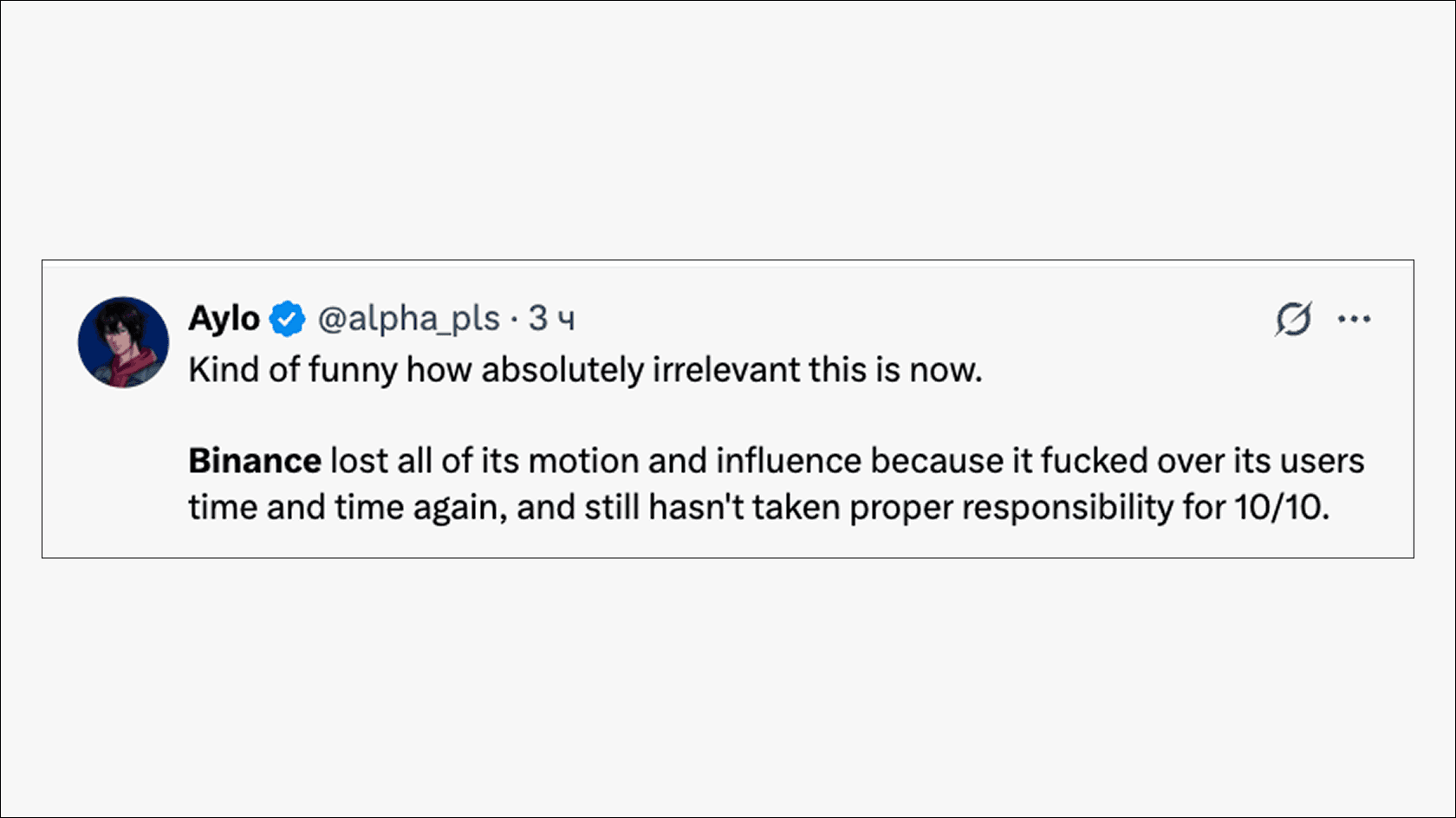
The community largely viewed the news as a late move by Binance, with some traders interpreting it as a recognition of Hyperliquid’s strength.
Source: X
The listing is being discussed not only as a way to expand access to the token, but also as a potential source of price pressure. After the announcement, HYPE briefly climbed to around $94–95 before falling to roughly $89–91 after spot trading opened. Some market participants also raised the question of whether this could be a local peak for the token.
At the time of publication, HYPE was trading at around $94.
Another part of the discussion concerns Binance’s impact on Hyperliquid’s economics rather than the token price itself. If some HYPE trading volume and related activity move to a centralized exchange, this could potentially reduce the protocol’s revenue. Alice Liu, Head of Research at CoinMarketCap, had previously pointed to this risk: Hyperliquid uses its revenue to buy back HYPE, so lower activity on the network could also affect the scale of those buybacks.
Our Take
The main reason Binance is listing HYPE is liquidity. The exchange earns fees from users buying and selling the token, and HYPE can generate that fee flow.
A second motive is that a project taking market share from Binance can now be connected to it from another angle. Binance may have lost part of the perpetuals market to Hyperliquid, but it does not want to give up the fees generated by trading the token itself. So it is joining the broader trend instead.
Promoting Aster also looks like a practical move: Binance gets a share of the growing decentralized perpetuals market. Rather than trying to compete directly with Hyperliquid on its own turf, Binance will likely continue developing Aster, making the connection between Binance’s products and Aster increasingly close without trying to challenge the leader head-on.
For Hyperliquid, a listing on the largest exchange serves as another sign of legitimacy, which can benefit the broader industry and wider crypto adoption. As the saying goes, “If you can’t beat chaos, lead it.”
Binance Users After the HYPE Listing. Source: X
This post is for informational purposes only and does not constitute advertising or investment advice. Please do your own research before making any decisions.