Blockchain has leapt past levels of tech maturity since sad FTX times. A perp dex launch today doesn’t need team-brainstorming for weeks. Devs and even non-devs are shipping solutions in mere days.
And the onus here isn't on building the project on unsafe foundations, but on how soon you can launch it (be it using scripts or YouTube templates).
This read is a practical 48‑hour playbook that you can actually use, covering the entire thing from architecture choice to final security setup.
What is a Perpetual DEX?
A Perpetual DEX is an open trading platform where investors can go long or short on their investments using non-custodial perpetual futures contracts that will never mature (i.e., they can hold their position as long as they like).
The price of each contract is the same as the spot index, but a fee is charged on top of that based on the sentiment of the market. This helps keep prices of perpetual contracts in line with those of the index
Perpetual DEXs exploded after many large centralized exchanges blew up (think FTX!). It made traders seek out those types of platforms that provided on-chain self-custody with known rules, so there was a race to develop this "CEX-like" experience in a DeFi fashion.
So, is perp trading risky for regular people?
Yes. Leverage has two sides. If your margin drops below maintenance rules, liquidation can occur rapidly. Therefore, it's generally a good idea to begin trading at low leverage and learn about funding mandatorily.
Decide your architecture in 3 hours
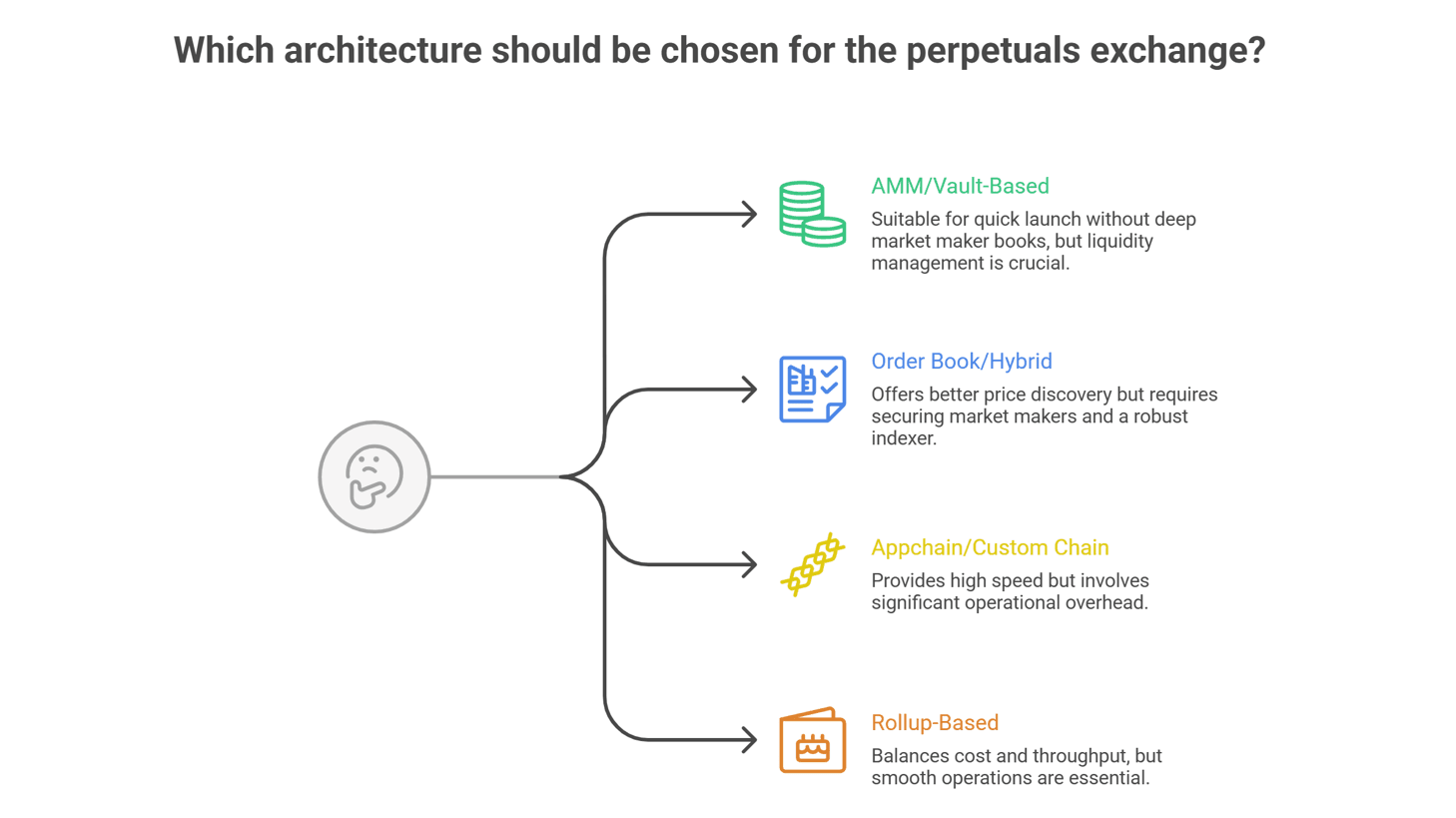
A poor setup can't be corrected by adding more code. Select the option that meets your regulatory, day-one liquidity, and latency requirements.
- AMM or vault-based perpetual trading: You will be able to launch with little liquidity backing from traditional market makers because users will trade against a pool of assets held in a vault instead of a traditional limit order. For reference, see GMX's documentation; it indicates that they are phasing out v1 liquidity through GLP and that v1 trading has been disabled.
- Traditional central limit order books: Uses an order book model for customer execution, offering better execution prices and an indexer system. You must get reliable sourcing of market maker support and indexers. A reference for how the dYdX chain and indexing work is available in the dYdX Chain documentation.
- Custom chain or appchain: A custom chain would be necessary if the entire objective is to gain a competitive advantage in terms of speed; i.e., where the total cost of operations is not a concern. A reference with detailed information regarding a performance-oriented approach is found in the dYdX v4 chain repository and our Hyperliquid deep dive.
- Rollup exchange: A good option between cost and transaction speed; however, the speed of deposits, withdrawals, and set-up of oracle services must be primary priorities.
First, determine which type of DEX to build (vault, CLOB, or Hybrid) and write one sentence explaining your decision. Then, lock BTC & ETH as collateral. Third, select your oracle for real-time price feeds. Fourth, decide how you will settle trades and liquidate positions. Lastly, perform a review as per a perp DEX security guide (for peace of mind).
Technical setup in the first 12 hours
The following outlines what these modules may look like functionally:
- Position Manager: Keeps track of where buyers are located (position), how much buyers paid (entry price), how much of an asset they bought (size), what happens if the buyer sells an asset (realized PnL).
- Margin Engine: Controls initial and maintenance margins, determines whether or not a buyer's position is considered "healthy" (i.e. liquidatable), potentially allows buyers to get "liquidated".
- Funding Engine: Calculates the funding costs on a daily basis and makes sure that the market or index (the price you bought in at) tracks the price over time.
- Liquidation Engine: Allows buyers to close out their account(s) and incur penalties if their accounts fall below a certain level; sends transactions through insurance or vault.
- Oracle Adapter: Gets the inputs from Market Indexes, makes sure that the inputs are not "stale" (i.e. inaccurate), not deviating significantly from the actual market prices, and difficult to manipulate.
- Vault or Liquidity Pool: If running a vault-styled pool, stores liquidity; routes income; deals with account closures and liquidity provisions.
- Fee Router: Divides up maker's fees, taker's fees, referral fees, insurance payouts, buybacks, and treasury.
- Governance Parameters: Set parameters for risk limits and emergency market listings.
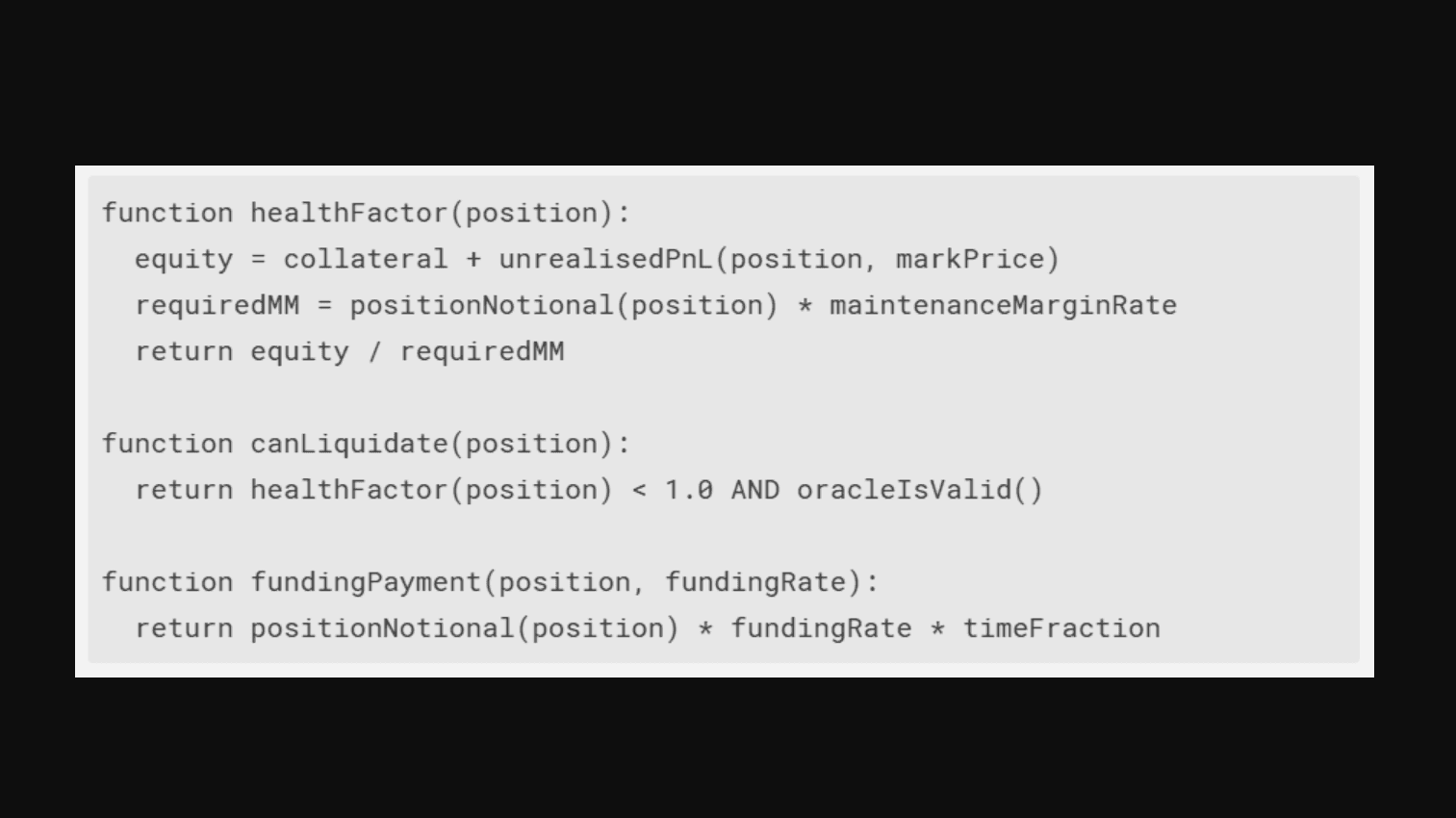
Pseudo code placeholders (to make your build less “mystical”)
These are not production formulas but anchors for your whole team to agree upon what is being computed.
Mini checklist
- Before you publish on any on-network, don’t forget to identify all external connections, such as oracles, keepers, vault routers, and fee routers, that your contracts will have. A hidden dependency that cannot be expressed in one sentence exists for any connection.
- Assign one person to be the ‘risk parameter owner.’ This person is allowed to say no and can alone prevents half of the bad launches.
Scripts that actually save time
Use standard EVM tooling where possible. The goal is to go from a clean .env file to a market that’s ready to trade in one command.
A good environment template includes:
- RPC URL, signer key, chain ID
- Oracle feed IDs, heartbeat or staleness thresholds
- Market list consisting of symbol, base asset, quote asset, max leverage
- Fee config for maker, taker, referral, insurance cut
- Risk config for initial margin, maintenance margin, liquidation penalty, max open interest
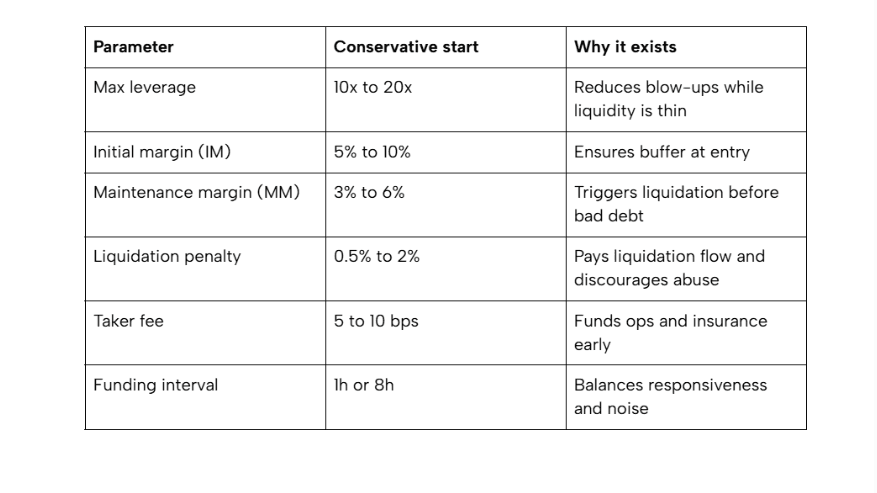
Default parameter table template: Start Conservative
Do not copy numbers blindly. Treat them as “safe defaults” until you see your order flow.
Liquidity bootstrapping in a 3 to 6 hour window
Most launches fail to succeed due to a lack of liquidity. Despite the code being perfect, users will still think something's broken – either fearing terrible spreads, outrageous funding rates, or orders filling at weird prices.
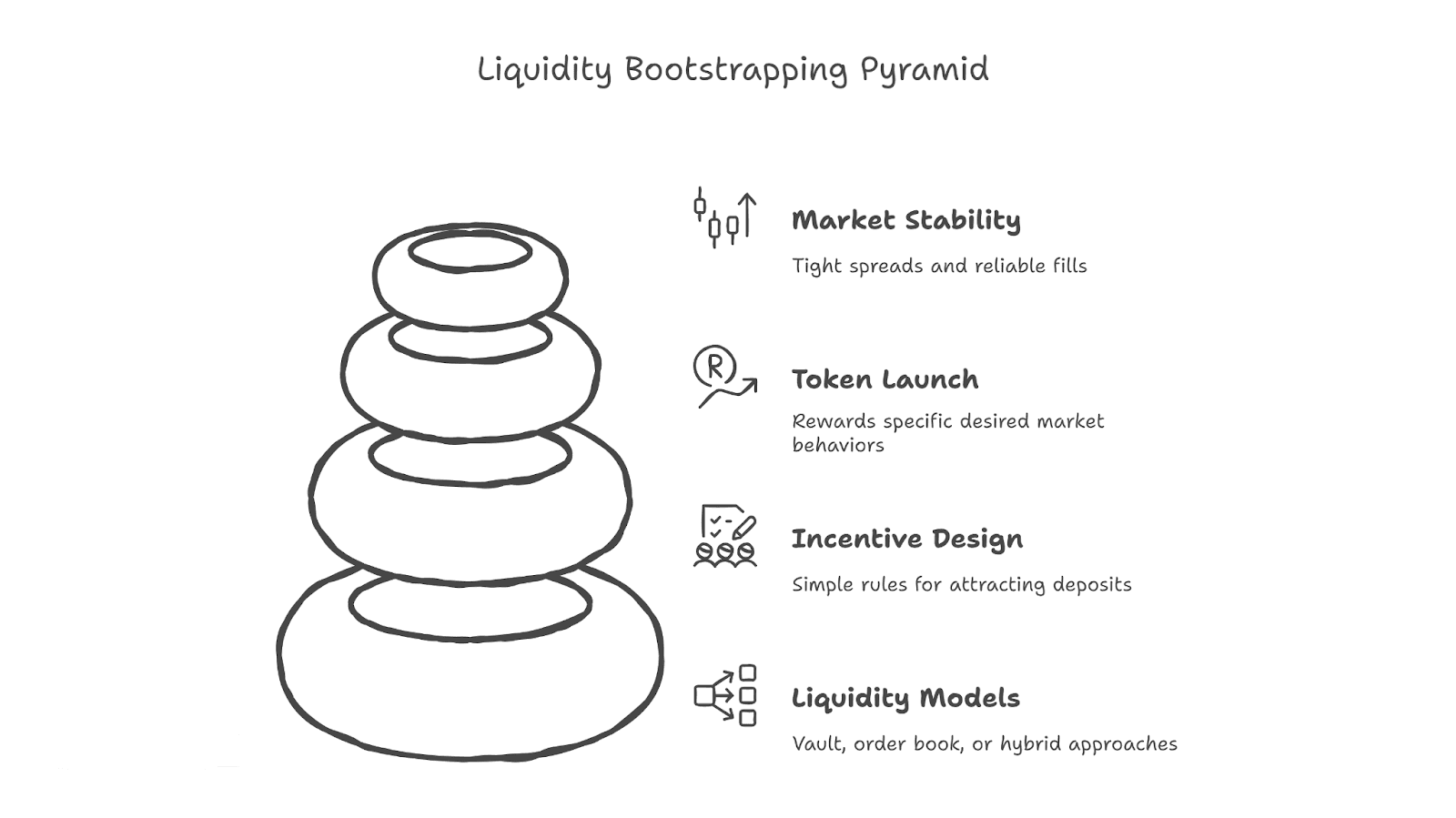
Liquidity topples marketing here. It's the actual product. The first month your job is to figure out which model works best:
- Vault (AMM perpetuals) – LPs deposit funds and earn from trading fees, liquidations, borrowing, and swaps. GMX has solid docs on this.
- Order book – You need market makers and enough order flow to match trades. dYdX Chain open-sourced their low-latency matching system. Just copy it if you don't know how to build one from scratch.
- Hybrid – Order book execution with protocol-level backstops like insurance funds and circuit breakers.
Incentives should be human-friendly
To attract deposits, clear rule setting is mandatory.
- "Deposit USDC, get X% of fee earnings. Withdraw funds anytime" is an easy-to-follow rule.
- "Deposit, stake, lock up funds, boost, vote, vest" is something an exchange should provide as part of an advanced roadmap after first two months.
A perp dex token launch may help achieve necessary behaviors (depth, tight spreads, time-weighted liquidity, market makers operating at a high level). Offering high fees for raw volume means the company will encourage wash trading.
Risk management that does not slow you down
A perps product is based on risk. If you cannot clearly see your risk engine, every other part of your system feels risky, even if everything else works properly. Your oracle design will be your most significant silent failure point.
Oracle design: your biggest silent failure mode
Oracles failures without anyone noticing are commonly associated with perp projects. Dated data feeds, lags during peak volatile periods, or price manipulations during less liquidity can occur.
During smart contract development, a setup to check stale data must exist before assuming the system will always fetch data timely.
Chainlink, for example, assumes that price feeds update based on pulses (some refer to as heartbeats) of previous prices. Pyth also has a built-in process for generating confidence intervals, which can be extremely useful during times of market chaos.
TWAP helps, but short windows plus thin liquidity can still be pushed around. So treat it as a single layer instead of your only shield.
The easiest examples of what you can use to validate price data from an oracle include:
- Rejecting old price data and/or large price deviations.
- Ensure that multiple indicators are used when validating price data (i.e., time of last price updates, deviation from average price, and source of last price).
- Make a "close only" mode available on your Oracle system when there is a failure to validate.
Bonus tips to make sure:
- Liquidations should be boring and predictable
- Buffer insurance funds should be set up and ready for messy cases
Regulatory and compliance in 1 to 2 hours
To target Europe, you need to understand MiCA at a high level. ESMA summarises it as uniform EU market rules for crypto assets. Your DEX needs to meet requirements around transparency, disclosure, authorisation, and supervision for parts of the sector. It is a pretty straightforward framework.
FATF guidance equally matters if you touch fiat ramps, custody, or anything resembling a service provider. AML expectations extend to virtual assets and VASPs now. Regulators aren't messing around here.
Teams follow a few pointers for fast launches. They
- Pick a jurisdiction strategy early
- Decide whether or not they’ll block certain regions at the front end
- Make sure optional KYC modules exist for certain market segments
- Ensure audit logs and monitoring are real
Front-end, API, and trader experience in 2 to 4 hours
If the UI is confusing, traders will assume the protocol is risky. Expert devs always recommend rapid churn, i.e., make onboarding boring fast:
- connect wallet,
- pick collateral,
- deposit,
- open a tiny position, then
- show PnL and liquidation price right away.
Wallets change quickly, so keep your flow modular. Avoid getting hard-coded to one wallet feature. For example, MetaMask adding Bitcoin support.
On the main screen, keep only what matters:
- Chart with mark and index,
- A simple order ticket with leverage,
- A position table where the liquidation price is always visible, and
- a small funding panel with the next payment time.
Prevent mistakes by snapping the leverage to safe presets. The DEX should only show ‘order accepted’ when it is truly confirmed.
End Takeaway
The fastest teams proactively think about launch from day zero instead of considering it as some end objective. The first week, let trades fill in and liquidations happen, then tweak settings slowly and post a short public update on uptime and any incidents.
Only when you roll on to the first month mark, introduce a token if it genuinely helps governance or liquidity, and add new markets only when real liquidity shows up.
Wanna learn more about cost impacts on traders? Check out our NFT.EU’s Wanna learn more about cost impacts on traders? Check out our NFT.EU’s gas fee piece to understand how execution costs and bridging friction can silently kill retention, even when your trading engine succeeds.