Inside the self-funded strategy of Harvard's Jeff Yan and how Hyperliquid captured 70% of the perp DEX market share through superior L1 order book tech.
At Hyperliquid’s office in Singapore, a bodyguard sits at the front desk. 10 out of the 11 team members work under a pseudonym. The co-founder, without one, had started getting approached by strangers on the street and being followed to his home.
To draw less attention, the team moved to a new office, where the cleaner thinks she works for a merchandising company that makes stuffed cats. The team hasn’t yet corrected her assumption–a safer bet than telling the truth, as people get kidnapped and tortured for their success in this industry.
Dom Cooke offers a first-person account of his visit to the office of one of the world's most successful startups. Today, Hyperliquid’s 11 team members sit on a profit of $900 million. Very recently. The DEX entered the top 10 most-traded perpetual trading platforms by trading volume worldwide, recording $1.59 trillion in trading volume between August 2025 and January 2026.
Source: Colossus.com | Dom Cooke shares a first-person account and the story of Hyperliquid becoming the most profitable exchange per employee
From 10% market share in 2024, Hyperliquid owned 70% the decentralised derivatives market by the end of 2025. It even surpassed Coinbase International's derivatives volume for the first time in Q2 2025. What makes Hyperliquid an outperformer than its forerunners–let’s break down the whys, hows, and whats.
The Architect Behind Hyperliquid: Jeff Yan and "Math Wunderkind" Edge
Hyperliquid isn’t the first venture Yan has been involved in. Earlier, he led the largest anonymous trading operations called Chameleon Trading in Puerto Rico. Chameleon was his handle when he played video games in high school. His X profile is still named Chameleon.
He funded the venture with his own savings. Chameleon trading grew at thousands of percent a year before he started building Hyperliquid. Yan is a Harvard Mathematics graduate and a former quantitative trader at Hudson River Trading, an elite name in Wall Street’s high-frequency trading firms.
Chameleon Trading’s bumper profits enabled Yan to self-fund Hyperliquid’s entire development. Yan's co-founder, Iliensinc, brought distributed systems expertise to Hyperliquid as its CTO. Together, they assembled a core team of roughly 11 people with backgrounds from Hudson River Trading, Citadel, and Big Tech. People used to operating under extreme reliability and speed requirements.
Dom Cooke describes Yan’s vision for Hyperliquid: “ Yan’s vision for it, stated without irony, is to house all of finance. That is a mark of ambition or absurdity, depending on whether you are looking at the cats or the platform’s numbers. Because in the months since my visit, markets that have traded the same way for over 100 years have started, in small and measurable ways, to bend.”
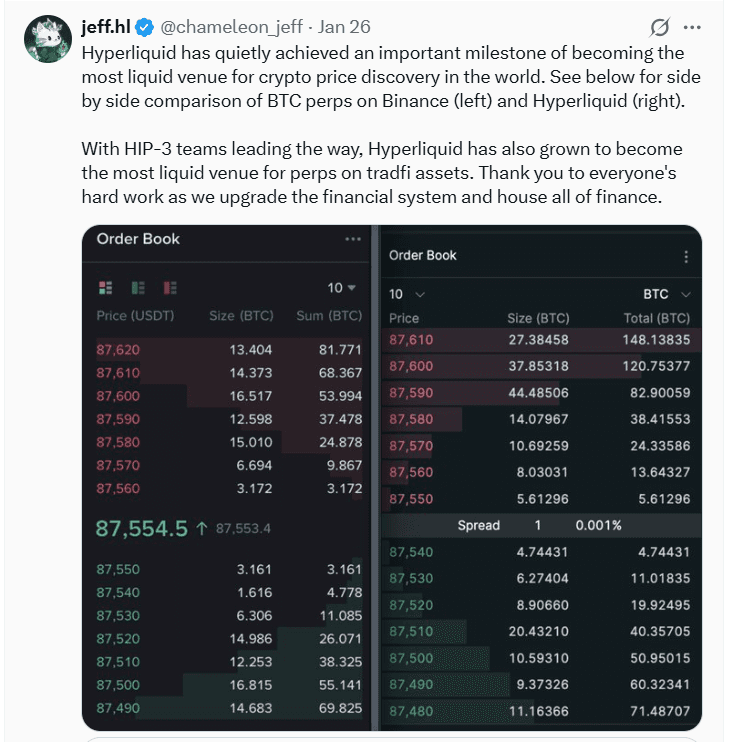
Source: Jeff Yan’s Official X account | Hyperliquid became the most liquid platform for crypto price discovery in 2026
How Self-Funding Added to Hyperliquid’s Integrity
Most projects, including the ones in crypto, run after VC capital. Then dump the funds in marketing and partnerships. Launch happens, and investors pour in. The token starts crashing as soon as initial investors take the exit route.
That’s the trap Hyperliquid avoided entirely.
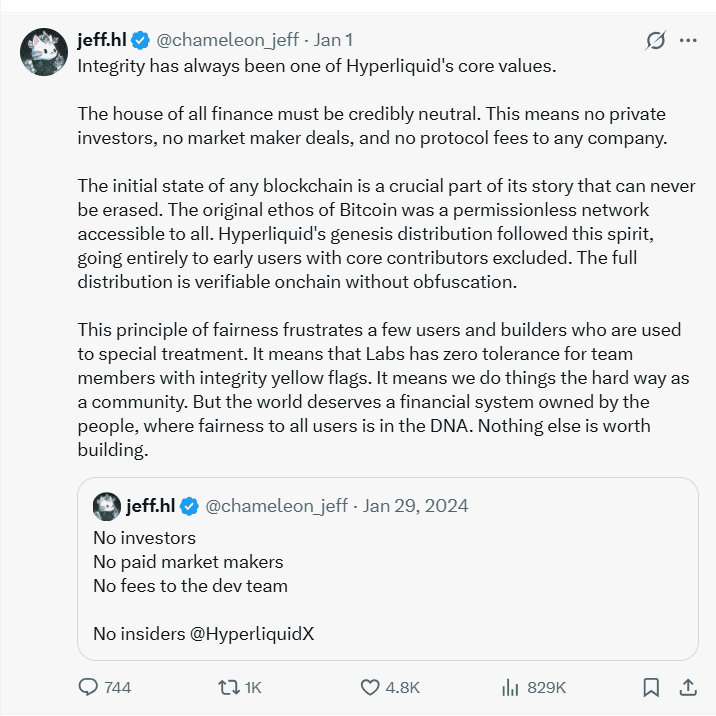
Source: X | Integrity is one of the core values Hyperliquid is built on
No VC pressure meant no compromise on product quality for the sake of quick exits. The team could focus on strategy execution and product development. When the HYPE token launched, it went to real users who'd actually traded on the platform.
Hyperliquid reflects Yan's philosophy of execution quality over decentralisation slogans. That pragmatism runs through every product decision.
Why Did Hyperliquid Build Its Own Blockchain?
Hyperliquid is a derivatives exchange that began with perpetual futures trading and has expanded into everything in finance today. The perpetual futures market is 6-8 times larger than the spot trading market, and is worth trillions. Earlier, the market virtually existed on CEXs.
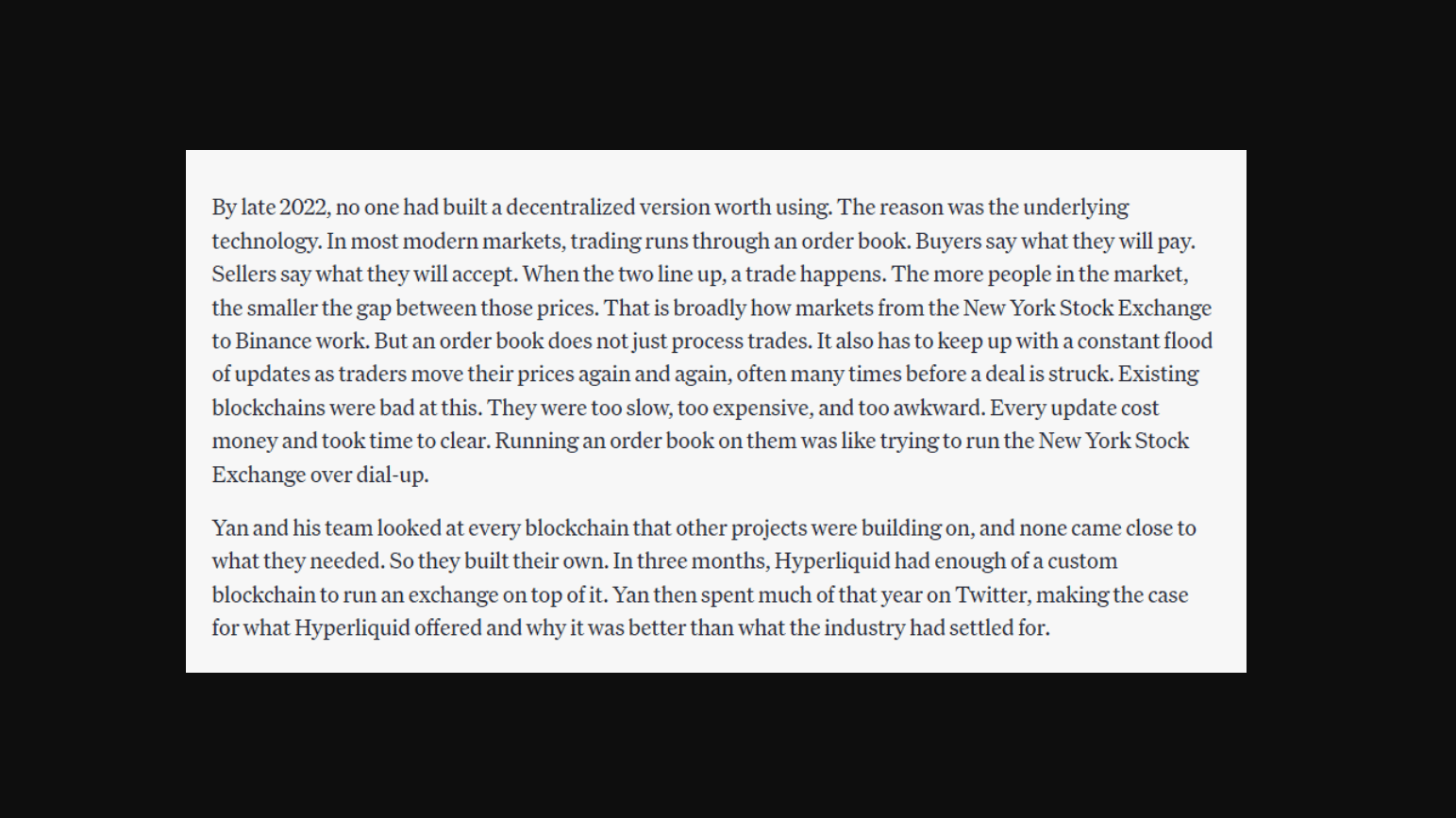
Hyperliquid changed that. It built its own layer-1, HyperCore, as the existing infrastructure wasn’t good enough.
Excerpt from Cooke's piece on Yan and Hyperliquid
Ethereum lagged, and did not have the infrastructure to run a proper exchange, so do the L2s. Solana was better, but it wasn’t designed for order-book-based derivatives trading.
Professional traders demand execution speeds that feel instant.
→ Latency equals slippage.
→ Slippage equals lost money.
→ Lose money, and traders leave.
HyperCore launched in 2023 with HyperBFT consensus, a custom mechanism optimised for low latency above everything else.
HyperBFT executes 100,000 to 200,000 orders per second. Sub-second finality. Trades settle in under a second. Zero gas fees for users. It records every order and trade on-chain, but at a speed that matches centralised servers’.
When the team wanted to introduce spot trading on Hyperliquid, he did not want Hyperliquid to become a custodian of user assets. Yan knew self-custody would be the only choice.
Yan realized ‘he had to stop thinking of Hyperliquid as an exchange that sat on a blockchain and start thinking of it as a blockchain with an exchange built into it.’ The blockchain was already executing thousands of transactions per second. It could be made programmable, where anyone could write code and build applications, just like Ethereum.
Why Binance Traders Moved On-Chain: HLP’s Products Users Always Wanted
Hyperliquid’s architecture has a fully on-chain central limit order book (CLOB) preferred by professional traders for price discovery. Users can trade directly from their wallets without depositing or handing over the custody of their assets to the exchange. This combination of CEX-grade speed with DEX-grade custody hadn't existed before Hyperliquid.
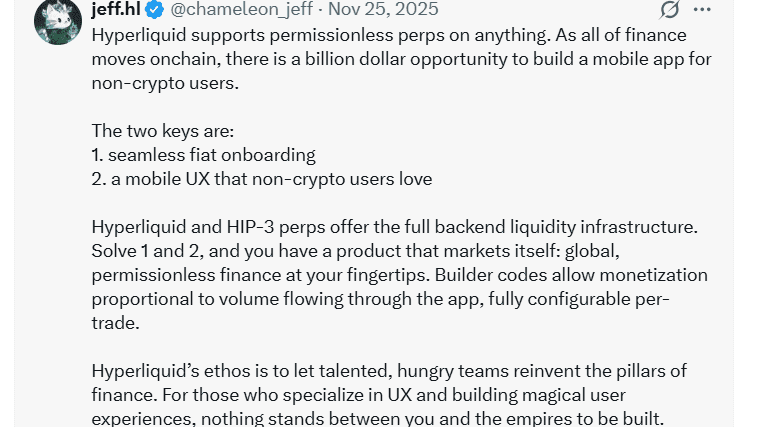
Jeff Yan frequently shares his ideas and visions on X
HLP: The Liquidity Engine
Yan used the strategies that made Chameleon Trading successful to build the HLP, Hyperliquid Liquidity Provider (HLP) in 2023. HLP is a protocol-level master liquidity pool. Users could deposit funds at no fees. The system ran automated strategies. Every single penny of profit goes to users investing in the vault.
The protocol centrally manages HLP. It routes liquidity where needed. New markets can launch with deep liquidity from day one. The pool reached roughly $230 million by March 2025.
The CLOB works alongside HLP. It allows professional traders to see full order book depth. Traders can deploy market-making strategies. Algorithmic traders get the API support they need.
How Hyperliquid Expanded Products Beyond Perpetuals
Hyperliquid didn't stop at crypto perpetuals. It later introduced hyperps, or perpetual contracts on assets, before they got listed anywhere. Traders trade around expectations about launch prices. An 8-hour exponentially weighted moving average replaces external price oracles, reducing manipulation risk.
In February 2025, the HLP team introduced HyperEVM. It is an Ethereum-compatible smart contract layer within the HyperBFT consensus. Smart contracts can interact directly with on-chain order books. Third-party developers can build staking protocols, yield farming, and prediction markets.
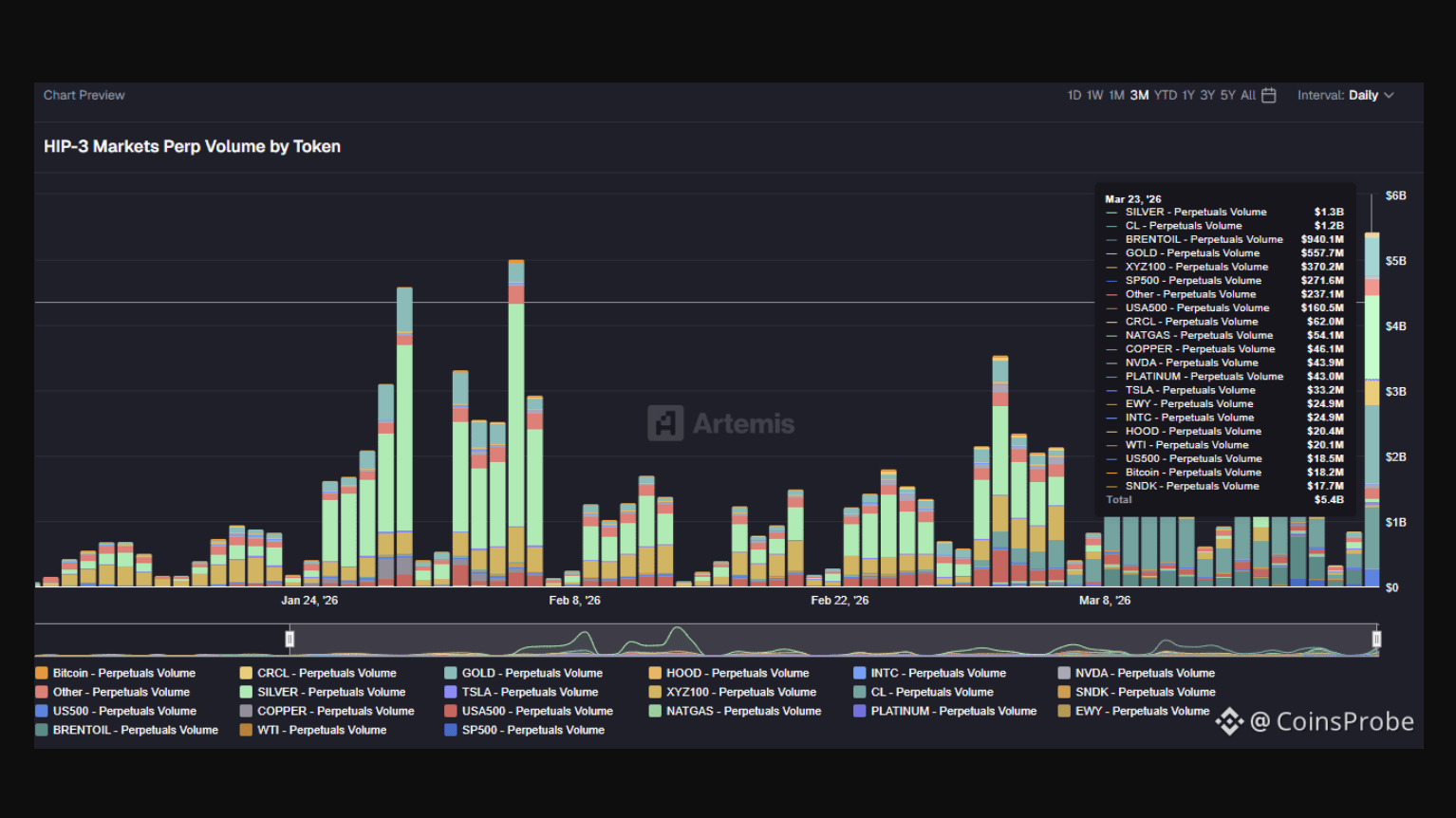
HIP-3 enabled trading of traditional assets, including equities, indices, and commodities. In March 2026, the S&P 500 perpetual was launched as the first major equity index with a licensed perpetual running onchain. Since October 2025, the S&P 500 perp alone has processed over $100 billion in volume. On March 23, 2026, HIP-3 markets recorded an all-time high of $5.4 billion in daily volume. Silver contributed $1.3 billion in volume, and WTI crude oil $1.2 billion on Hyperliquid.
Source: CoinsProbe | HIP-3 market perpetual volume by token on Hyperliquid
HIP-4 brought outcome contracts. These contracts help tie prediction markets to event outcomes. HIP-4 is fully collateralised with fixed payout ranges. There are no liquidations, continuous funding, defined expiry, or deterministic resolution.
11 People vs. 5,000: The Comparison
How does an 11-person team compete with Binance's thousands of employees?
Metric
Hyperliquid
Binance
Team Size
~11 people
8,000+ employees
Funding
$0 (self-funded)
Hundreds of millions
Settlement Speed
Sub-second
Near-instant
Custody Model
Self-custody
Custodial
Daily Volume (Peak)
$32 billion
$50-100+ billion
Hyperliquid’s Growth Flywheel: Points, HYPE, and the 31% Airdrop
Hyperliquid's growth strategy is centred on points. When you trade, hold, or provide liquidity, you earn points. There’s no promise of a token. Users just accumulate points.
The Success Milestones and the Journey So Far
From November 2023 to May 2024, 1 million points were distributed weekly. Hyperliquid transitioned to Season 2 with increased multipliers. Season 2 ran from May through September 2024. Season 2.5 got over before the token got launched.
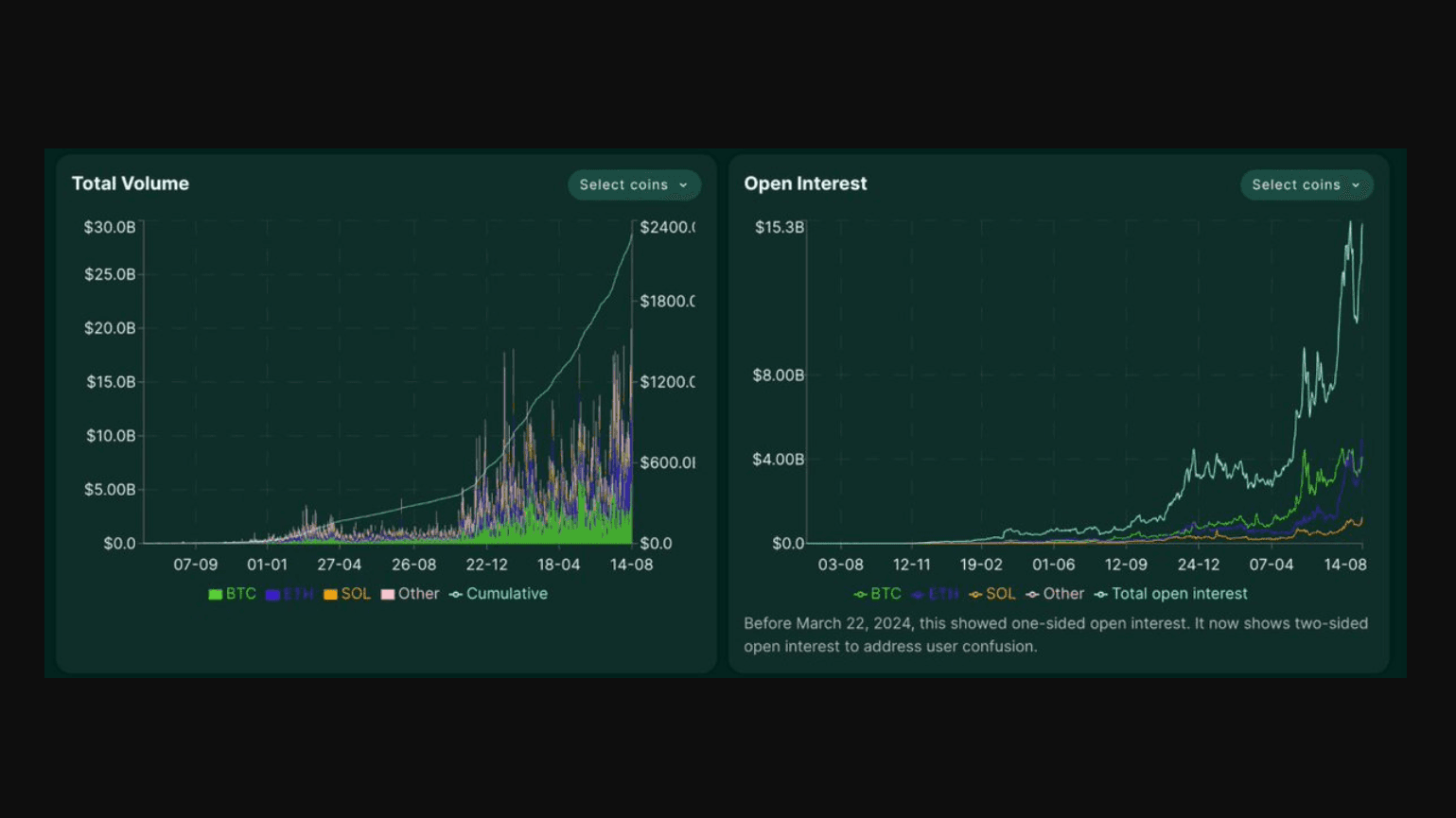
The results were spectacular. Daily trading volume climbed from $70 million in August 2023 to $1 billion by October 2024. Unique daily traders on Hyperliquid grew from 250 to 7,000. At the same time, open interest rose from $6 million to $1.2 billion. The total user base expanded from 300,000 to 1.4 million.
Source: Binance | Hyperliquid’s total volume and open interest accumulated to $2.3T and $15B by August 2025
Launch of Hype Token: On November 29, 2024, Hyperliquid launched HYPE. The team distributed 31% of the total supply to roughly 94,000 addresses. The opening price was approximately $3.90 per token.
The total airdrop value was $1.2 billion, the largest in crypto history.
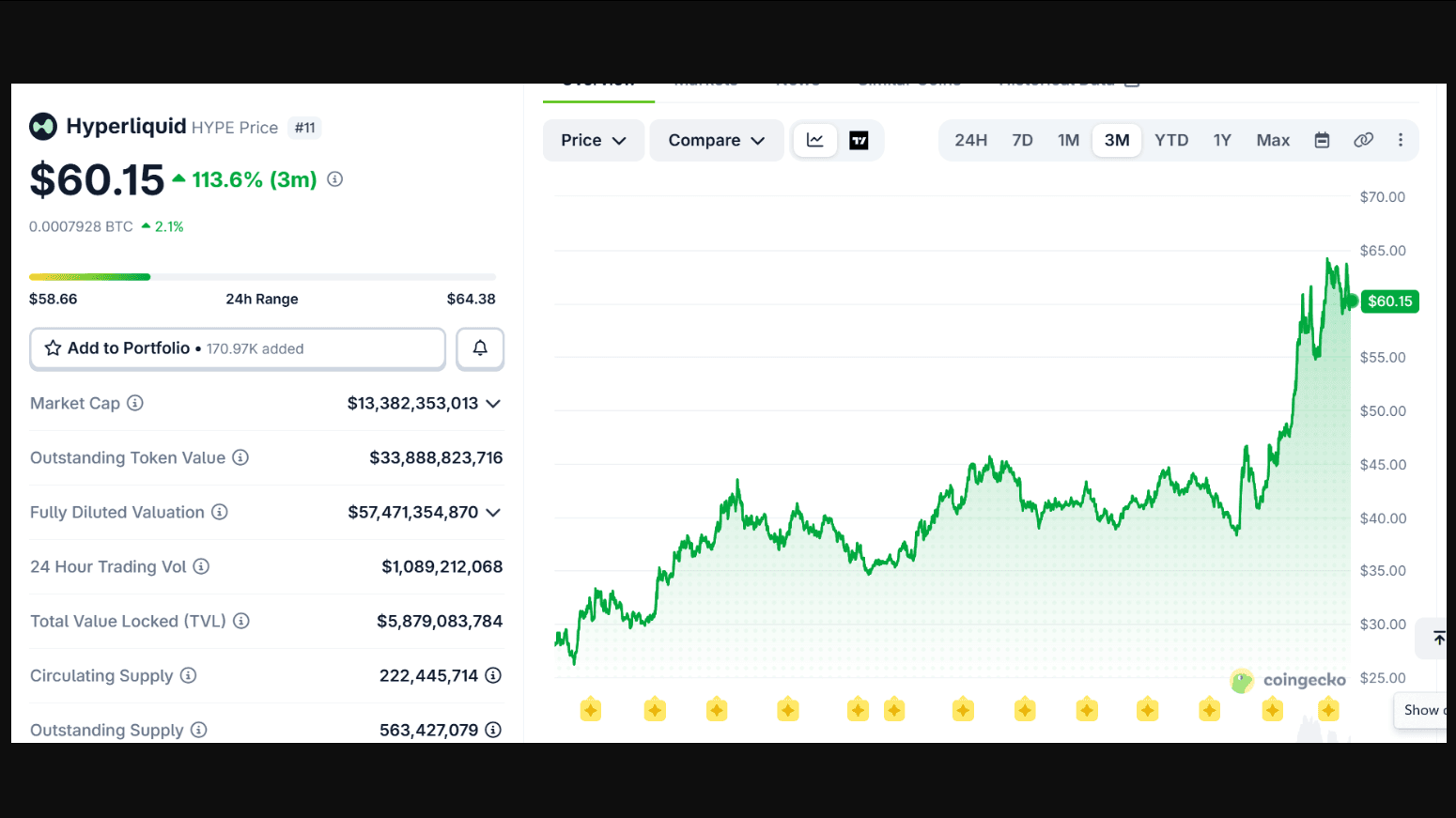
During the first twelve hours of the token launch, the price increased by 63%. By summer 2025, HYPE had started trading above $40. As of 27th May 2026, HYPE has reached a new high of $60, at a market cap of $13 billion, and ranks #11 globally.
Source: Coingecko | Hyperliquid ranks 11 globally
The airdrop was a big success as the recipients were real users who believed in the platform. They felt ownership. There were no VCs to dump tokens. Platform volumes surged several times after the launch. Hyperliquid quickly overtook dYdX in on-chain volume to capture the perp DEX market.
The token launch was for the community. Hyperliquid also introduced the HyPurr NFT collection for early users. The success metrics speak for themselves, but industry observers like Arthur Hayes have predicted significant growth for the HYPE token based on the platform's fundamentals.
How did the JellyJelly Crisis bring HLP’s governance into question
Not all’s white and bright in Hyperliquid’s growth story. March 2025 tested Hyperliquid's claims about decentralisation. An attacker opened a massive short position on JELLYJELLY, an illiquid meme token with a roughly $25 million market cap.
Simultaneously, the attacker pumped JELLY's price on external markets by over 400% within an hour. The HLP pool where the attacker held the short position faced potential liquidation. Potential losses could run to approximately $12 million.
Validators saved the scene by forming a quorum in two minutes. They delisted the JELLYJELLY market. The validators settled positions at a fixed price of $0.0095 forcibly. Thinstead of the manipulated $0.50 market price. The attacker withdrew roughly $6.26 million of the $7.17 million deposited. The remaining funds were frozen, and the pool was saved from a $12 million loss.
This incident raised many questions.
Could validators override markets in minutes?
Does Hyperliquid operate like a CEX?
The intervention exposed centralised control levers that contradicted decentralisation narratives. Hyperliquid responded with changes through the January 2025 announcement. The protocol increased the number of validators from 5 to 16. Added new position size limits for illiquid assets, improved price oracle mechanisms, and brought in a formal validator vote process for delisting anomalous markets.
The community largely supported the intervention. The episode crystallised Hyperliquid's position of efficiency over pure decentralisation.
Hyperliquid’s Execution Over Everything Rule Wins
There’s a big lesson crypto can learn from Hyperliquid’s success. It’s not the firm’s size or amount of VC backing that decides the fate of an organisation. In Hyperliquid’s case, eleven people beat companies with thousands of employees. Zero venture capital beat hundreds of millions in funding.
Hyperliquid led the market for perpetual futures on DEXs, increasing its share from 2% in January 2024 to 10% in January 2026. Absolute volume grew 8x in just 3 years. Hyperliquid processed approximately $653 billion in Q2 2025 alone, surpassing Coinbase International's derivatives volume for the first time. It recently captured 7% of the aggregate perpetual futures’ open interest, rivalling mid-tier centralised exchanges.
The platform proved that a DEX can compete with CEXs in performance, offering sub-second settlement, 200,000 orders per second, zero gas fees, deep liquidity through HLP, professional-grade order books, and API support for algorithmic traders, all while maintaining self-custody and avoiding KYC.
The airdrop created genuine community ownership. When the team distributed 31% of the supply to users instead of VCs, they aligned incentives properly. Tokenholders traded on the platform and believed in the platform and its products.
Hyperliquid's success validates a specific thesis: in derivatives trading, execution quality matters more than decentralisation rhetoric. Traders don't care about ideology. They care about speed, liquidity, reliability, and keeping custody of their funds.