In 2007, the Federal Reserve Bank of New York published its quarterly economic outlook and projected 2008 GDP growth at 2.6%. Less than a year later, the U.S. economy was shrinking at 3.3%. This was one of the sharpest contractions since the Great Depression.
The analysts in this case did not lack competence. What they lacked was a mechanism that could help them double-check the accuracy of their forecasts and correct them. The last decade has seen a different class of forecasting tools emerge. These tools are called prediction APIs.
Prediction APIs are programmatic interfaces that use structured data as inputs and yield a calibrated probability as output. Each one of these probabilities is given a score when the event in question completes. Together, these scores create an automatic and unconditional feedback loop that is impossible for human analysts to replicate structurally.
In this article, we discuss what prediction APIs are, how they work, and how teams are building real systems around them.
What prediction APIs actually are
A prediction market API takes structured data inputs that describe the current state of the world and presents a probability estimate about a defined future state or value range. The data inputs can include historical time series, event signals, market prices, economic indicators, behavioural signals, or any data related to a particular event, such as US election results or inflation data.
The estimate is not a narrative opinion. It is a calibrated numeric probability. The output is always a number between 0 and 1. Prediction APIs work fundamentally differently compared to analyst opinions or AI model APIs.
- Analyst opinions are derived from expert human judgments in narrative form and later converted to point estimates. For instance, investment bank GDP forecasts, analysts' price targets, etc. Analyst opinions are subject to all kinds of cognitive biases that human judgment is prone to. There’s no systematic feedback loop, and they aren’t probabilistically scored.
- Statistical or AI-led Model APIs are machine learning models trained on historical data. These APIs return probability distributions as outputs, and since they are deterministic, they are recalibrated each time new data is used to train the model. For example, PredictHQ’s demand intelligence API is used by Uber, Marriott, and other major brands.
- Crowd- or Market-based Prediction APIs aggregate thousands of financial market bets into probability prices. The Polymarket API, the decentralised prediction market on the Polygon blockchain; the CFTC-regulated Kalshi API; and the academic-grade Metaculus API are good examples.
Also Read: Kalshi vs Polymarket: The Grocery Battle for New York
From where do Prediction APIs derive structured data inputs?
Different prediction APIs require different data sets and data types. Here is a list of typical data sources from which production forecasting systems draw data:
- Historical time-series data consists of past values of the variable being predicted. It may include GDP histories, demand curves, price histories, and weather records. The APIs recognise patterns better as the length and quality of this data improve.
- Market signals represent the collective beliefs of financial markets about future states. These signals can be about options pricing, futures curves, credit spreads, and bond yield movements.
Also Read: The Prediction Market Signal That Called Tesla’s Crash
- Event data captures discrete occurrences that influence demand, behaviour, and outcomes. The events can be conferences, concerts, sports events, political gatherings, and public holidays.
- Behavioural signals consist of search query volumes, social media sentiment, consumer confidence indices, and survey data.
REST vs. WebSocket: The Architecture of a Forecasting API
Prediction API delivers outputs using two architectural patterns that serve different use cases–REST and Websocket APIs
REST APIs handle request-response interactions. In this kind of API, a client sends a query, the server returns a probability, and the connection closes.
REST APIs are ideal for:
- Decision dashboards that refresh on a schedule
- Batch scoring pipelines that process thousands of inputs overnight, and
- Risk reports generated at defined intervals.
WebSocket APIs maintain persistent connections that push updates to the client as they occur. PolyMarket uses a WebSocket endpoint that streams order-book changes and price updates continuously.
WebSocket APIs are ideal for real-time applications like
- Algorithmic trading systems require probability updates within milliseconds of a price movement
- Operational dashboards that must reflect rapidly evolving situations, and
- Risk alert systems where decision lag has a measurable cost.
The practical choice between them depends on the application's tolerance for information lag. A weekly inventory planning model can use REST without material accuracy loss. A trading system pricing derivatives against election outcomes cannot.
Real-Time vs. Snapshot Predictions
Another distinction to note between forecasting models is whether the probability needs to be tracked over time or at a single point in time.
Snapshot predictions measure a single probability at a moment in time. These kinds of predictions are sufficient for most strategic planning applications. To understand better, look at the following questions:
- What is the probability of a recession in the next 12 months?
- What is the probability that this product exceeds the demand forecast by 20%?
These questions can be answered with a single API call, cached, and refreshed periodically.
Real-time predictions are necessary when the probability itself is an actionable signal that changes frequently. For instance, Polymarket's data shows that prediction accuracy improves measurably as market close approaches. That level of accuracy is only meaningful if the system consuming the probability can act on updates as they arrive.
The Data Proof: Accuracy Beats Expertise
AI algorithmic forecasting outperforms human experts. To prove our argument, let’s make a few controlled comparisons supported by large sample sizes and rigorous scoring methodologies.
Three well-known metrics you must understand to evaluate a forecasting system honestly include the Brier Score, the Log Score, and Calibration curves.
Brier Score
Meteorologist Glenn Brier introduced the Brier Score for scoring predictions in weather forecasting in 1950. The Brier score is the mean squared error between a predicted probability and the actual binary outcome.
For instance, if you predicted 70% probability for an event that has already occurred, your Brier score for that prediction is 0.09.
(0.7 − 1)² = 0.09
And if the event did not occur, it is 0.49.
(0.7 − 0)² = 0.49
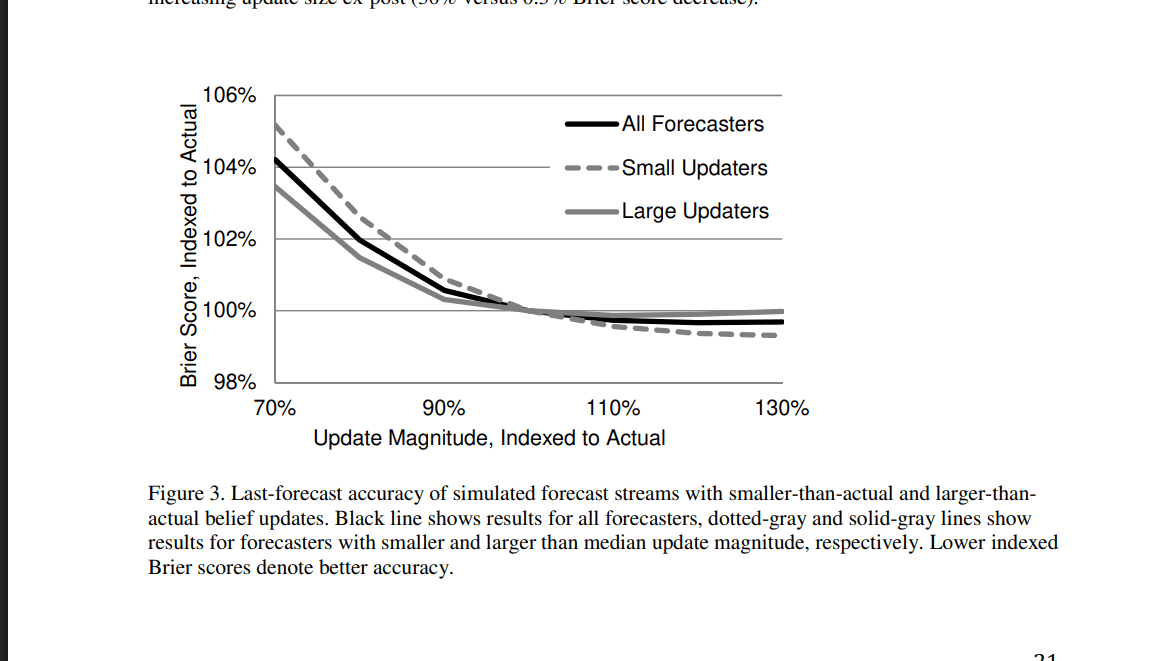
The lower the scores, the better they are. The differences between forecasting systems are often small in absolute terms, but these differences have large practical significance.
The Log Score
The Log score is also called logarithmic scoring. It is a stricter test, i.e., it exponentially penalises overconfident wrong predictions. Suppose a model predicts 99% probability for an event, and the event does not occur. In that case, the model receives a catastrophically bad log score.
Log scoring is preferable when calibration matters more than average accuracy. The log score identifies a system that is occasionally very wrong, while claiming very high confidence. TheBrier score may partially obscure such systems.
Calibration Curves
Calibration curves are visual metrics. If a forecasting system assigns 70% probability to 100 different events, a well-calibrated system should see approximately 70 of them occur.
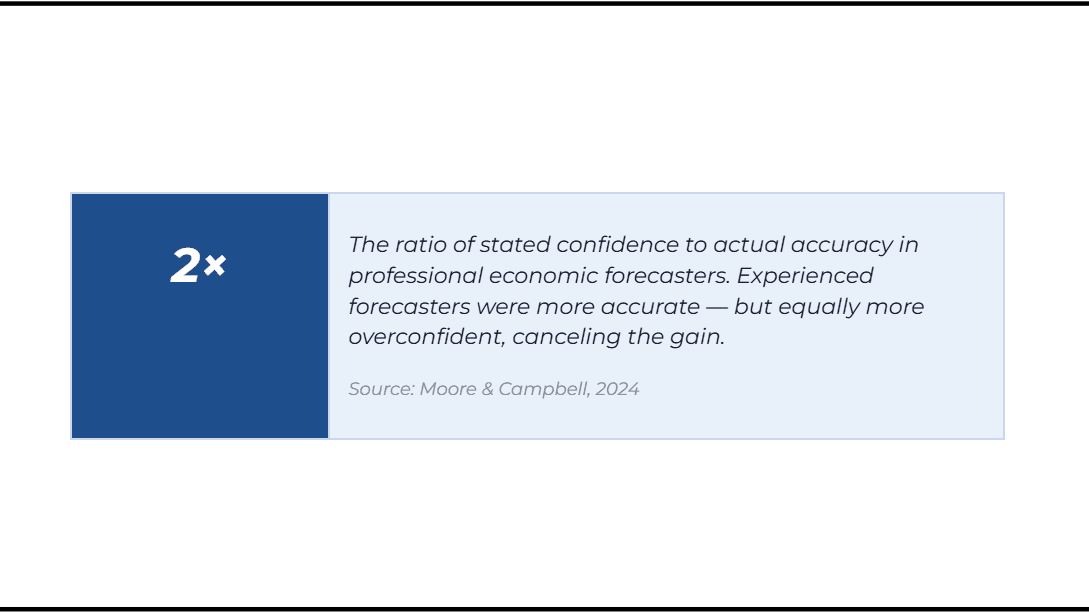
Plotting predicted probability against actual frequency produces a calibration curve. A perfectly calibrated system produces a diagonal line. Human expert forecasters consistently perform below this diagonal, i.e., their stated confidence systematically exceeds their accuracy rate. However, well-engineered prediction APIs that use continuous scoring and recalibration track much closer to the diagonal.
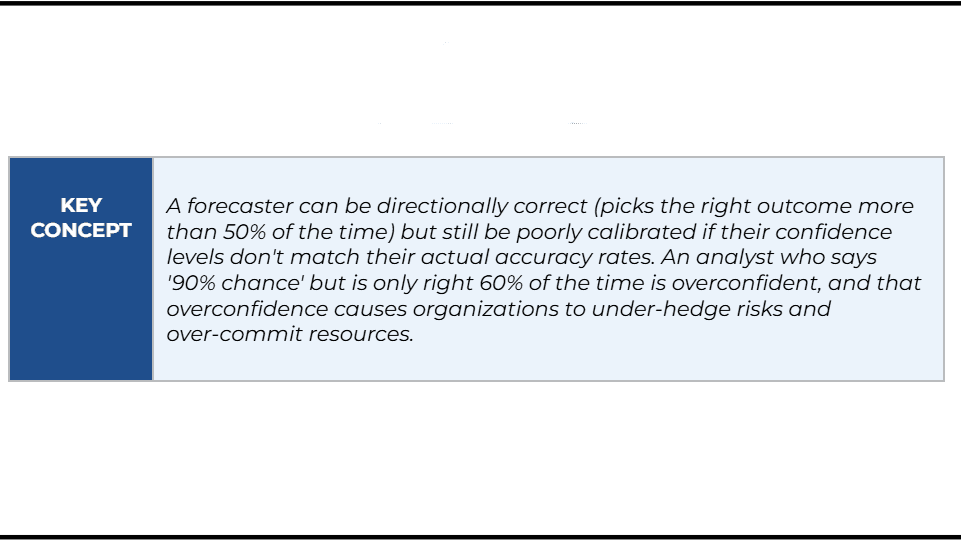
What we need to understand is why the distinction between calibration and raw accuracy matters in real-world operations. A forecaster may be right 70% of the time, but they claim 95% confidence on every prediction.
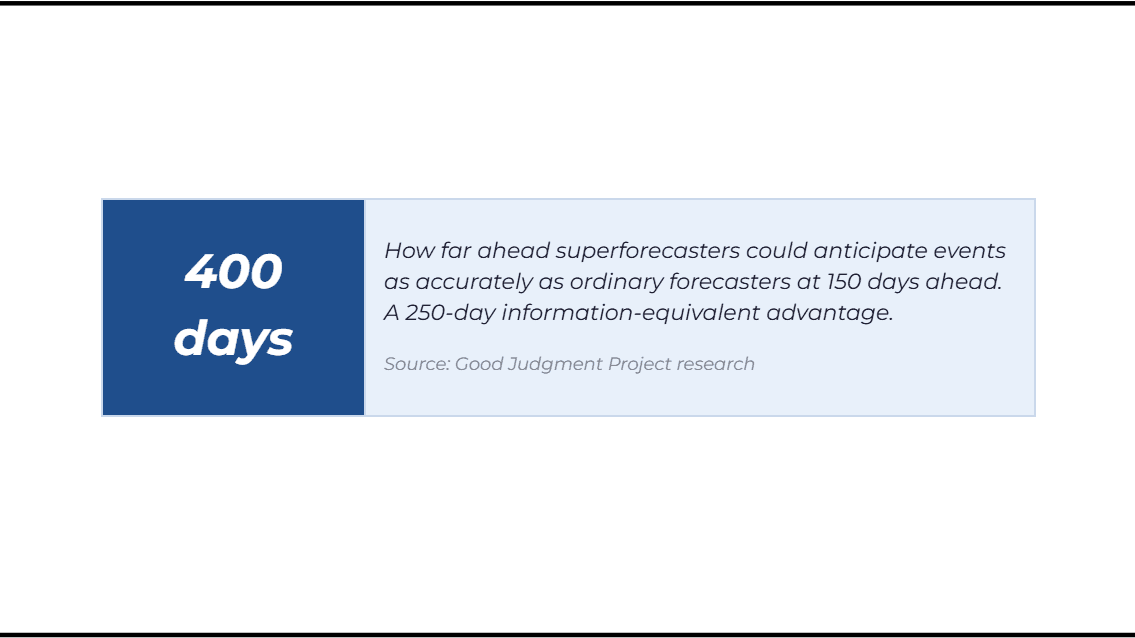
The mechanism that made them win was calibration discipline enforced by a scoring system. Participants received immediate Brier score feedback on every resolved question. Those who were overconfident got immediate, quantified evidence of it.
Example 3: PolyMarket on the 2024 U.S. elections
Polymarket’s API tracked vote releases, legal rulings, and rapidly shifting turnout data during the 2024 US elections. Post-election analysis confirmed Polymarket's market prices aligned more closely with final electoral outcomes than most major polling averages.
It earned a Brier score of 0.0581 across approximately 90,000 predictions. To put that in context, state-of-the-art weather forecasting models achieve Brier scores comparable to those for precipitation prediction at 12-hour horizons. And the weather forecast is a domain with 70 years of computational investment.
Also Read: How Prediction Markets are Creating New Investment Opportunities in DeFi
The comparison published in the International Journal of Forecasting, examining IARPA's Aggregative Contingent Estimation study, found that raw prediction markets were 22 to 30% more accurate than unweighted prediction polls in Brier score terms.
Calibration: why prediction APIs stay honest over time
Accuracy is what most people think of when evaluating a forecasting system. However, Calibration is the deeper property that determines whether a forecasting system is actually trustworthy enough to build decisions around. The two are related but not identical, and the distinction has practical consequences that most organizations underestimate.
A system is well-calibrated if, across all predictions made with X% confidence, the outcome occurs X% of the time. Example: a weather model claiming 70% rain probability should see rain in exactly 70% of those situations over time. Calibration is measured visually via calibration curves and quantitatively via decomposed Brier scores.
Brier Score decomposition: The Brier Score can be decomposed mathematically into two independent components.
- Reliability: whether stated probabilities match actual frequencies across the full range of predictions. This is calibration in the strict sense.
- Resolution: whether the system gives decisive predictions rather than hedging everything near 50%.
A system can appear well-calibrated in aggregate by assigning 50% probability to everything, since 50% predictions can never be clearly wrong. But this is what forecasting practitioners call epistemic cowardice. i.e., technically calibrated, operationally useless. A good forecasting system needs both calibration (reliability) and decisiveness (resolution).
Overconfidence and Longshot Bias: This may seem simple, but it is, in fact, extremely difficult for humans to meet. The same cognitive machinery that makes us excellent at rapid judgment under uncertainty often leads to overconfidence in formal probabilistic settings.
Similarly, longshot bias is a specific calibration failure documented consistently in prediction markets, and it is the opposite of human overconfidence. Markets systematically underestimate the probability of rare events and overestimate the probability of near-certain ones. This systematic error at the extremes is quantifiable from historical market data, and well-engineered prediction APIs apply correction algorithms to compensate for it.
Feedback Loop: When an analyst publishes a GDP forecast that turns out to be wrong, there is no automatic mechanism to measure the degree of overconfidence, score it, and adjust future confidence intervals accordingly. The analyst's priors update through social and professional processes that are slow, selective, and subject to motivated reasoning.
When a prediction API returns a wrong outcome, several things happen automatically and immediately. The prediction is logged with its timestamp, probability, inputs, and outcome. The scoring function calculates the Brier contribution. This score is stored in a performance database. If the system is a statistical model, the deviation between predicted and actual feeds back into the next retraining cycle, adjusting weights across the model's feature space.
Integration in Practice: How Developers Build with Prediction APIs
Understanding what prediction APIs can do is one thing. Building production systems around them is another. Let’s figure out the architecture, use cases, and failure causes of prediction API integrations in a real-world environment.
Production forecasting systems built on prediction APIs follow a recognisable three-layer architecture:
Layer 1: Data Ingestion
This is the most labour-intensive layer in any prediction API. The ingestion layer handles the collection, cleaning, and normalization of input data. Raw data comes from heterogeneous sources, such as financial market feeds, internal CRM data, economic release calendars, event databases, and weather APIs.
Layer 2: Prediction Layer
The prediction layer makes the API call and receives the probability output. In well-designed systems, this layer is thin. It handles authentication, rate limiting, retry logic for failed requests, and response parsing.
Layer 3: Decision Layer
The decision layer is where the business logic lives. It triggers alerts if probability crosses a threshold, feeds into risk models, powers dashboards, or initiates automated actions, such as order adjustment, hedging, and resource reallocation.
Common Use Cases
Prediction API usecases span from high-frequency financial applications to operational planning tools used in logistics, retail, and hospitality.
- In market forecasting, to track event probabilities at millisecond resolution.
- In demand forecasting, to predict demand spikes for hospitality, transportation, and retail.
- Risk alerting systems monitor prediction market probabilities for geopolitical events, regulatory decisions, or macroeconomic outcomes and trigger automated alerts when probabilities cross defined thresholds.
- Scenario modeling is a batch application in which teams submit multiple input scenarios to prediction API endpoints and receive probability-weighted outcomes for each.
Integration Challenges That Matter
Prediction API integrations fail in predictable ways, such as:
Latency mismatches
A WebSocket feed that streams probability updates every 100 milliseconds is only useful if the downstream decision system can process and act on updates at that frequency. Most business intelligence infrastructure operates in batch mode. Connecting a millisecond-resolution prediction stream to an hourly-batch decision system creates a false precision problem.
Rate Limit Management
When limits are exceeded, most APIs queue requests, but those requests arrive delayed, defeating the purpose of real-time monitoring during volatile events.
For instance, Polymarket's standard API tier allows 1,000 calls per hour, sufficient for polling at approximately 3.6-second intervals, but potentially constraining for systems monitoring many markets simultaneously. Kalshi and Manifold Markets offer more generous limits on their standard tiers.
Data Normalization
Prediction market APIs return probabilities calibrated to their specific resolution conditions that may not always map cleanly to the decision criteria the integrating system uses. For instance, a Kalshi contract resolving on "CPI exceeds 3.5% in the next release" may not align with a risk model's definition of "elevated inflation risk."
Authentication complexity
Different kinds of prediction APIs require different authentication processes. For instance, Polymarket requires EIP-712 digital signatures, a blockchain cryptographic standard that requires Web3 wallet management infrastructure. Kalshi uses HMAC-SHA256 request signing, similar to AWS API authentication and familiar to most backend developers. Teams without experience with blockchain infrastructure will find Kalshi's authentication model substantially simpler to implement and maintain than PolyMarket’s.
APIs vs. Analysts: The Economics of Forecasting at Scale
The case for prediction APIs over human analyst teams is not purely about accuracy. It is also about what happens to accuracy, cost, and reliability as the scale of forecasting requirements increases. Human analysis does not scale linearly. Prediction APIs do.
Cost Per Forecast
A senior economist at a major financial institution incurs a fully loaded annual cost that includes salary, benefits, office infrastructure, data subscriptions, and compliance overhead. In a year, a senior economist might produce 150 to 250 major forecast updates. At the midpoint, that is roughly $1,500 per forecast update, before accounting for the time cost of the consumers who must read and interpret the output.
Statistical model API calls cost fractions of a cent at scale. At current LLM API pricing, processing the equivalent of a detailed analyst research note through GPT-4 class models costs between $0.50 and $3.00, depending on length and model tier. Polymarket's API access for prediction market data is currently free for data consumers.
Speed of Updates
Prediction markets aggregate information from participants. These participants are financially motivated to act on new information immediately. On the other hand, institutional forecasting experts operate on quarterly revision cycles. Additionally, institutional approval processes discourage any dramatic revisions before consensus shifts.
Consistency, Auditability, and Historical Performance Tracking
Human analyst forecasting suffers from reproducibility problems. Two analysts at the same institution, given the same data at the same time, will often produce different probability assessments.
Prediction APIs produce consistent outputs for consistent inputs. A statistical model API returns the same probability for the same feature vector on every call.
Building Trust in Probabilistic Systems: Dashboards, Backtests, and the Human–API Partnership
Adopting prediction APIs in organizational decision-making is both technical and a trust-building challenge. Humans make decisions based on probability estimates that they did not compute, from systems they did not build, and about outcomes they cannot control.
This may look bizarre at first, but establishing trust and knowing when it is needed most require deliberate architecture. Prediction APIs deliver the same with accuracy dashboards and continuous backtesting.
But Prediction APIs can never fully replace humans. AI and a human analyst together outperform either alone in unusual, fast-evolving situations. Here’s how the setup should be.
APIs should handle the high-volume, structured prediction tasks. Humans should handle the interpretation and anomaly detection layers when current conditions are sufficiently outside historical distributions.