Back in 2022, Tuur Demeester warned investors to change hands from Tesla to Bitcoin. By the end of the year, Tesla was down by almost 60%. In recent times, GLJ Research, a boutique investment opportunity finder firm, have also invariably held a sell rating, backed by Gordon Jhonson, the Wall Street-famed analyst himself.
But this article is not about the whats. It’s about the whys and hows.
For average Joes like you and me, performing an Nvidia or Tesla stock market analysis, per se, seems almost like acing the hardest maths test. Not a piece of cake for sure.
Also Read: How prediction markets are creating new investment opportunities
But the fact about prediction markets is that it all lies in the fundamentals. If you understand the core facets of it, for example, signals, sentiments, calibration, and bias, then you’ll see that it's not only about maths and numbers. There is a whole other qualitative aspect of it.
What Is A Prediction Market?
A prediction market essentially lets you predict, understand aggregate inclinations, and then place bets on future events. Now this can be an entire platform, a WhatsApp/Telegram group, a hyperactive subreddit…anything.
And likewise, the events can also be anything. From simple stocks, crypto, whether your favourite NFL club will win/lose, to whether or not Henry Cavill will star in the next Superman movie.
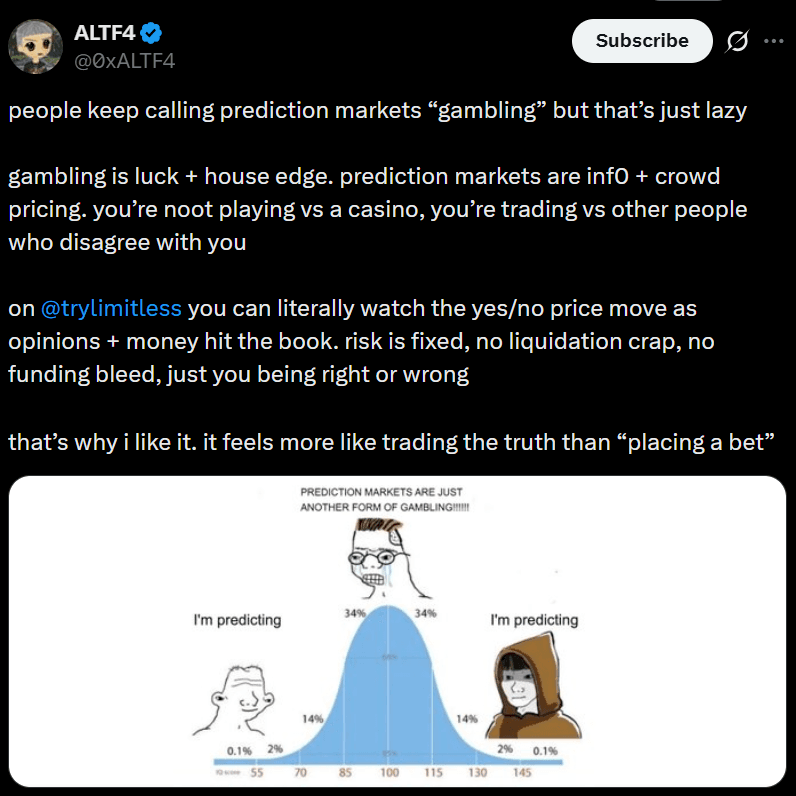
Is the prediction market the same as gambling?
No, cause it's more like chess than a dice game. The stakes reflect real-world knowledge. These markets can aggregate expert insight, reveal crowd biases, and even outperform polls in some cases. The trick is to isolate signals from hype, knowing when the “wisdom of the crowd” is just wishful thinking in a financial costume.
Signal Analysis: The Difference Between Input vs Noise
While your favourite uncle or that office colleague might boast about how they literally doubled their inputs by putting it all on Tesla and it's the next-generational futuristic multi-bagger whatnot, understand that those are merely incidental evidence, not facts.
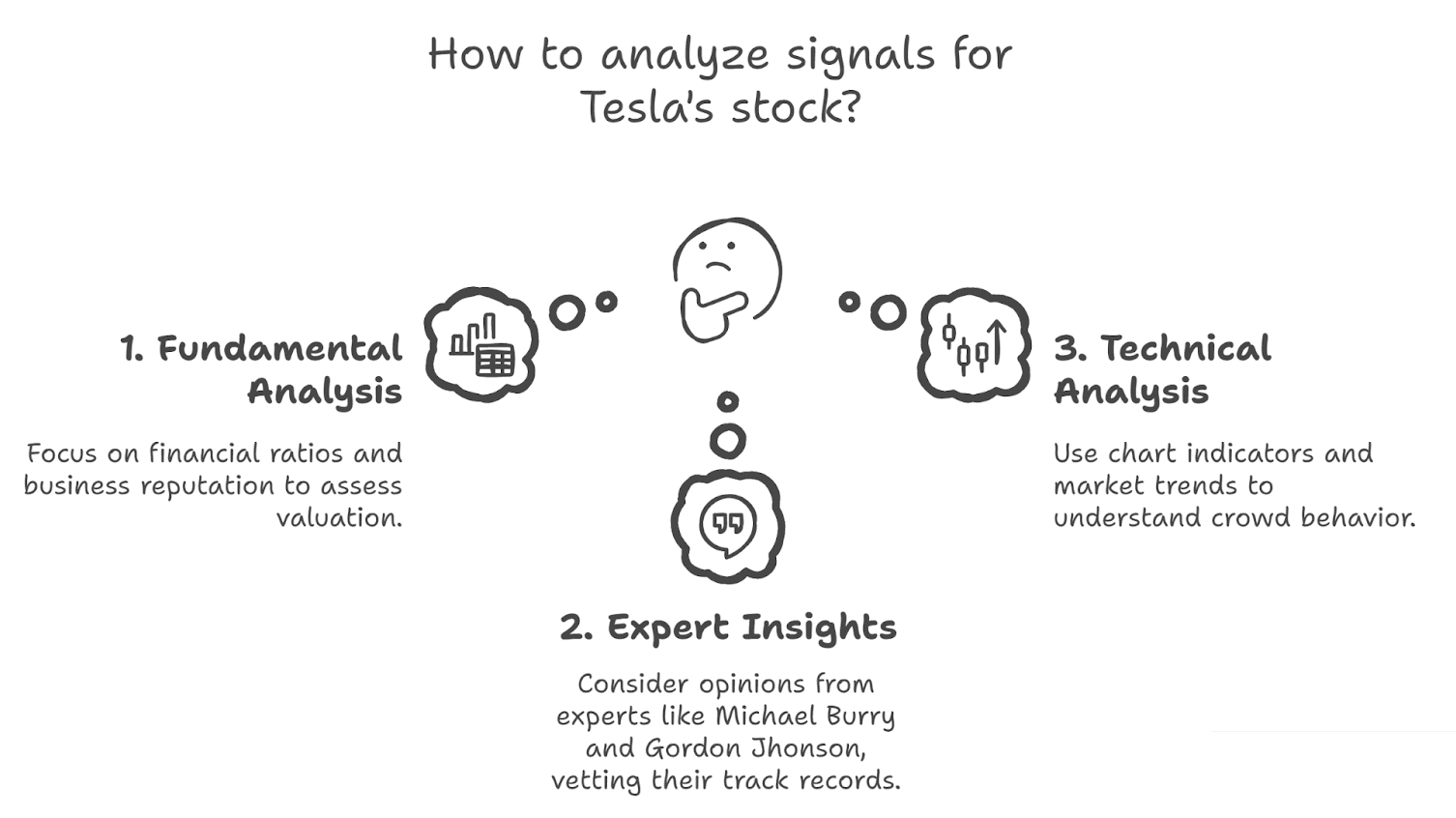
Differentiating between noise and actual input is the very first thing an analyst should learn. And these inputs are roughly of three types:
- Fundamental Input: Stuff like P/E ratio and business reputation
- Expert-advised Input: For example, Michael Burry and Gordon Jhonson’s opinions on Tesla being glazed more than it should be, and
- Technical Input: Numbers, highs & lows, chart indicator checks such as ESI and BB
So, for example, Tesla’s P/E ratio as of now is around 300. That’s good. But that’s only part of the picture. There is no right or wrong way to guess if a stock’s true valuation is over or under simply on a P/E basis. For the best guess, one should compare the current P/E to that of a few of the core competitor P/E ratios (and also guessing the pace of the respective domain/industry) to get a hunch of where their favourite stock stands.
Fundamentals checked, next comes the expert insights. And for Tesla, it's all over the place. It’s you who must choose whom you want to believe. The right way here again is to vet the track record of the expert. Repetitive ambitious calls can be signs of overglazing. While you’re at it, also check the company's annual reports. For example, the Q1 2025 financial performance of Tesla has been significantly lower than that of Q1 2024.
Now, for the technicals, understand first that it's about understanding the crowdforce. Google the basic meanings of RSI, Bollinger Bands, MACD and Moving Averages. Understand what overbought/underbought, oversold/undersold, overextension/underextension signifies.
When all of this is done, now comes “synthesising” or decoding the output. Or in simpler terms, understanding the evens against the odds.
An advice here: As a beginner, always trust YOUR gut feeling against any “secret data leak” about a sudden crash or a potential high-rise signal. In formal terms, assess your risk appetite.
Market Sentiment Analysis: The Non-Numerical Part
Ask any long-term trader or stock broker, and they’ll always say you’ve to first feel the pulse of the market. Know what it means?
It means grasping the chaos of the market, from the day’s start till the day's end, the impact of geo-political forces on prices, how certain news is hypes to move the needle and so on. This is what calibration tracking means.
Example-wise, Tesla recently got overtaken by BYD as the world’s largest battery-powered EV seller. The news spread worldwide. Reading this, the techies will immediately start researching about battery ion techs and the next emerging revolution. But option traders, hedgers, and traders know that this will skew sentiments against (or in favour) of Tesla. If prices still remain high like they would in the “perfect” world, then that’s not a buy signal.
It’s a warning that hedgers are stretching expectations to raise the option prices and might suddenly start selling to balance their portfolio, but you, the newbie, would lose your hard-earned money.
Bias Correction: The Fallacy of Optimism Bias
Investors, specifically retail investors, often act like fans hyping certain stocks simply on a sentimental basis, due to reasons like they love the genius CEO story, they love the company products/services, or cause they’ve made some wealth during their investment stint.
Take Tesla, for example. Catch any Elon fan who loves Tesla EVs or Grok AI, and if you ask them whether you should invest in Tesla or not, most definitely, they will tell you to blindly buy. That's optimism bias.
Also Read: Justin Sun Offers $30M For One Hour Talk With Musk
Institutional traders or industrial don't work this way.
They keep a sharp eye on trending news, check the charts (margins, pricing pressure, demand softness), new collaborations or deals signed, while also reducing portfolio risk via position trimming and caution.
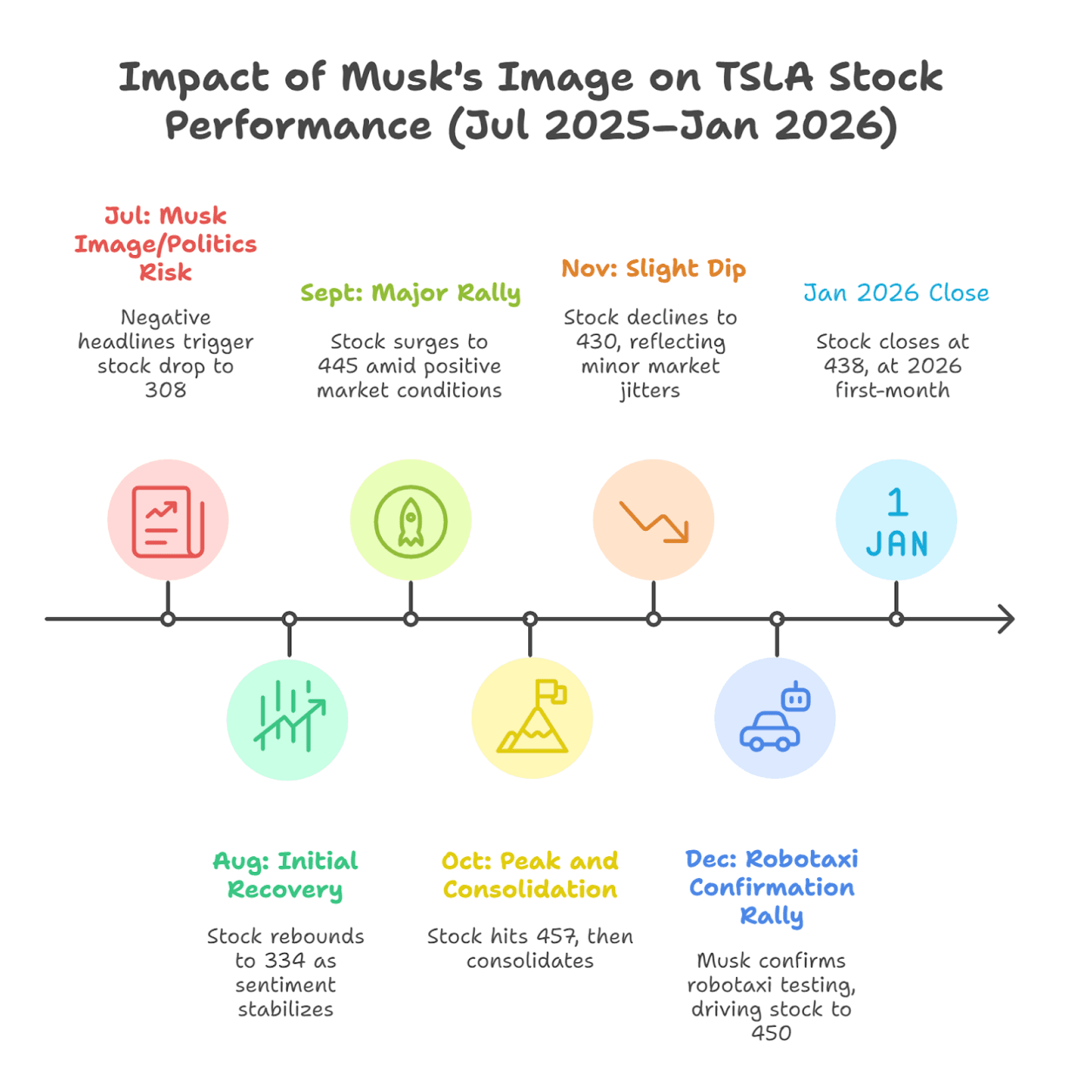
Option markets reveal how much of the price is actually “celebrity premium” cause of Musk’s aura versus the fundamentals, as the protection for the downside (puts) tends to be pricey. The upside to this is that Tesla’s prices most often will remain fairly high cause of the Musk-glazing, but can equally dip if Musk’s image takes a hit.
Also Read: The Hidden Crypto Tax Strategy Saving Investors Thousands
Trading By the Signal: Interpretation Strategies
So what you need basically is a plan of action, following which you can trade as per the signals. There are many ways you can do this, the two primary things being able to interpret volume cliff and momentum failure.
- Volume cliff indicates lost buying support, due to which there comes a sudden dip in a stock/asset’s trading volume. It might be due to the investor base’s loss of interest, which points to a potential market reversal or the start of a new trend.
- Momentum failure is a part of this, as it indicates that not many people are buying the stock due to the fears of an upcoming fall/reversal. To negate this, option traders do something called a bear call spread, i.e. they sell a call at a lower price while buying another at a higher price to limit risk and earn a limited profit for the predicted difference.
- Volatility adjustment comes next. It’s to save yourself from the swings. If you’re predicting high ups and lows, buy less, and buy some steady other stock which can give you less but stable returns.
Last but not least is hedging, but think “long-term.” Think of it as insurance. If you buy, say, $430 puts, their value increases if Tesla falls below it. The only downside is that you lose your insurance money if your prediction is wrong. This needs a bit of experience and time in the market. Google how to avoid panic selling and put buying to understand the nuances better.
A word of advice: Smart sizing and hedging for disciplined exits is not for beginners. It’s actually a honed skill that can perform much better (or worse) depending on how tactically you execute it.
Takeaway
So you see, while it might seem like the recent Tesla crash came out of nowhere, to the fine eye, there were many signs signalling towards it. And such is the case for any asset, be it crypto, stocks, or any prediction market trends.
The core takeaway of this read is to stay informed, research and gain insights from the right resources, not to base your investments on obsolete strategies that worked in 2010.