

In April 2026, Shinhan Card, South Korea’s largest credit card issuer, signed an MoU with the Solana Foundation to explore stablecoin payments and build a hybrid financial infrastructure.
- markets
- ecosystems
- guides
- articles
- 18 May 26
HyFi: The Core of Hybrid Finance & Crypto Integration in TradFi
An overview of Hybrid Finance (HyFi) and its role in integrating decentralized technologies with traditional financial compliance and infrastructure.
0


Shinhan Card isn’t the only name contemplating blockchain payments. Visa, Mastercard, Stripe, PayPal, SWIFT, JPMorgan, BlackRock, Fidelity, Morgan Stanley… the list goes on. Today, TradFi firms engaging in hybrid finance in crypto are looking through the lens of real-world utility.
While Wall Street sits on tokenisation and RWA panel discussions, leading global banks are either exploring or have announced blockchain-based services. Evolving regulations have further added trust in hybrid finance as an infrastructure.
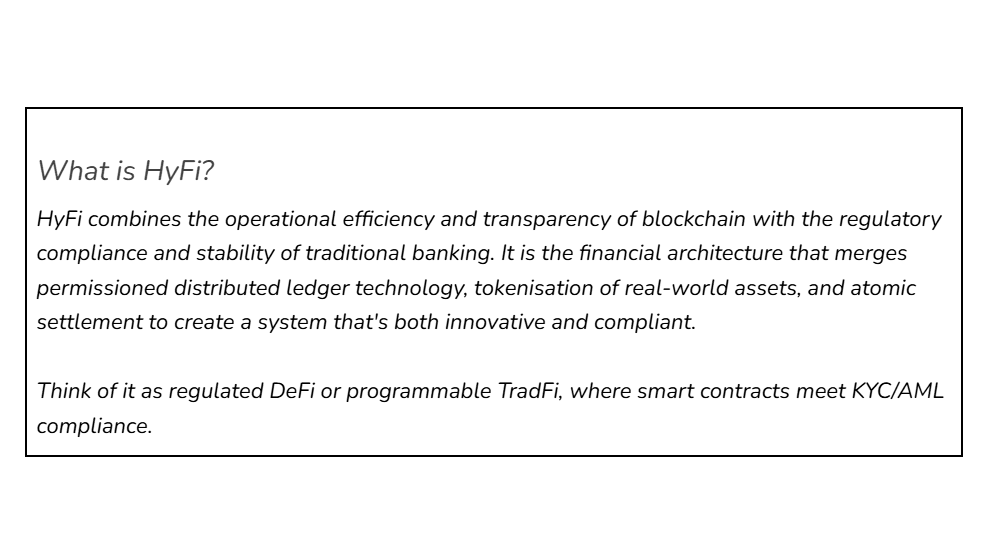
There are no longer two neatly divided camps of regulated institutions and banks on one side, and innovative DeFi platforms on the other. HyFi is emerging as the pragmatic middle ground for TradFi and DeFi to ditch the binary.
This article discusses the limitations driving the emergence of HyFi as the next big financial infrastructure and the technical foundations that make HyFi's gears turn, its real-world applications, and more.
Want to grab a quick bite on HyFi? Watch this YouTube tutorial.

Limitations Driving the HyFi Wave in Finance
Modern markets don’t work on extremes. Both TradFi and DeFi have their inherent weaknesses. Together, these limitations have acted as a catalyst for firms and institutions to look at HyFi as a solution.
Structural Bottlenecks Traditional Finance Faces
TradFi infrastructure has so far been unable to meet the demands of the digital age. Cross-border payments still take days to move through the chain of correspondent banking networks and cost significant fees.
Settlement times remain at T+2 or T+1 at best, and these are far from instantaneous. Multiple intermediaries extract value from every transaction, whilst fragmented IT systems struggle to share information efficiently.
JPMorgan's Onyx platform recognised this issue early on and addressed it using blockchain technology. Rebranded as Kinexys, the network processes blockchain-based transactions on the same day, 365/24/7. To date, it has processed more than $1.5 trillion in tokenised transactions.
TradFi operates only during business hours, limiting global market access. Central Securities Depositories and SWIFT networks, whilst reliable, weren't designed for the always-on, globally connected economy we now inhabit.
Also, the government bonds and treasuries are static instruments, with high administrative costs. Tokenisation can add programmability, reduce admin overhead considerably, and allow 365/24/7 trading. Maker DAO is a great example of how tokenised bonds and treasuries can be utilised in decentralised lending and borrowing.
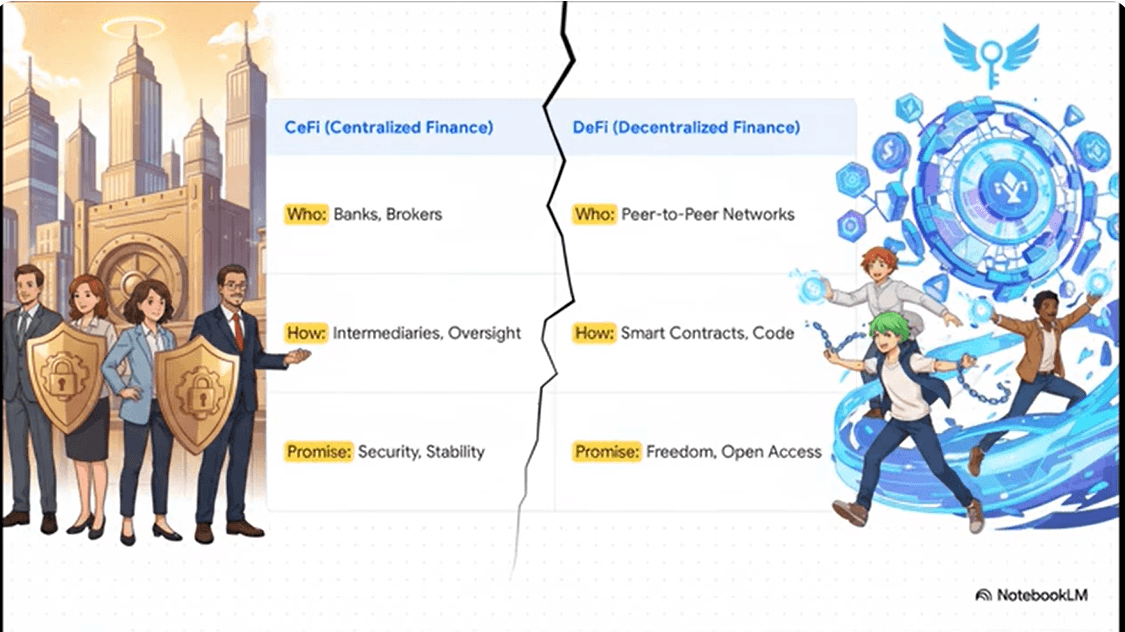
Regulatory and Security Challenges DeFi Protocols Face
DeFi talked about financial innovation and independence until the lack of regulations and security lapses became bigger risks. Peer-to-peer transactions, smart contracts, self-custody, Automated market makers (AMMs), liquidity pools, and zero-knowledge proofs were a few of the tech platforms that were used to carve trustless protocols like UniSwap, Compound, Aave, Hyperliquid, etc.
Also Read: What are Liquid Restaking Tokens?
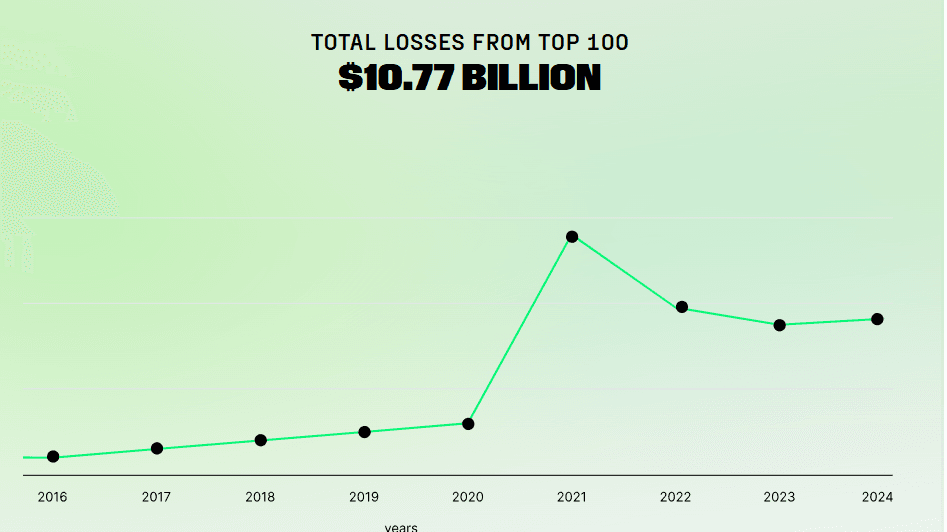
The idea of having complete control over your finances sounds revolutionary, but security statistics are sobering. In 2024, crypto hacks cost users $2.2 billion in funds. By mid-2025, the losses had already crossed the 2024 number. The ByBit hack alone cost $1.5 billion in stolen funds. In 2026, the same story continues. April became the most hacked month in cryptocurrency history, with $651 million lost in a single month.
Halborn Top 100 DeFi Hacks Analysis shows 55.6% of 2024 incidents involved compromised accounts, whilst 80.5% of stolen funds came from off-chain attacks. Flash loan exploits made up 83.3% of eligible attacks.
Beyond security, DeFi faces regulatory uncertainty. The lack of KYC/AML compliance makes institutional adoption nearly impossible. Consumer protection mechanisms are minimal or non-existent. Extreme volatility and market manipulation risks persist. For all DeFi's innovation, it cannot replace traditional finance without solving these fundamental challenges.
How HyFi Works: The Technical Foundation
HyFi employs permissioned blockchains that require KYC/AML verification while retaining blockchain's transparency and programmability. The result is that institutional investors get DeFi's efficiency with TradFi's regulatory protection.
Let’s summarise the tech behind HyFi:
Permissioned Blockchains and Compliant Smart Contracts
HyFi's infrastructure is built on permissioned distributed ledgers. These are blockchain networks where participation is controlled, and participants are vetted. Most tokenised bonds, funds, and structured products in 2025 are issued on these platforms. They integrate seamlessly with traditional custody, compliance, and reporting systems.
Node operators are known entities, such as banks or market infrastructure providers. Goldman Sachs' GS DAP (Digital Asset Platform), R3's Corda, Hyperledger Besu and Fabric, and the Canton Network are a few chains leading the institutional blockchain adoption.
Tokenisation and Fractionalisation of Real-World Assets
HyFi uses asset tokenisation to enable fractional ownership, instant settlement, and 24/7 trading of traditionally illiquid assets. Asset tokenisation involves creating digital tokens on a blockchain that represent claims on physical or financial assets.
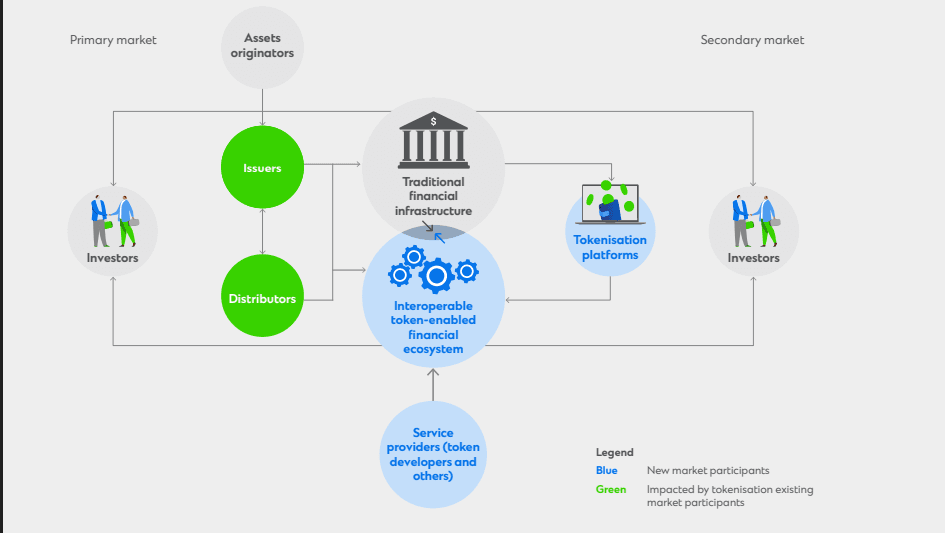
Standard Chartered projects that the RWA market would reach $30 trillion by 2034. The growth is in sync with the projection. On-chain tokenised RWAs, excluding stablecoins, grew from $5 billion in 2022 to $24 billion by mid-2025, representing 380% growth in three years.
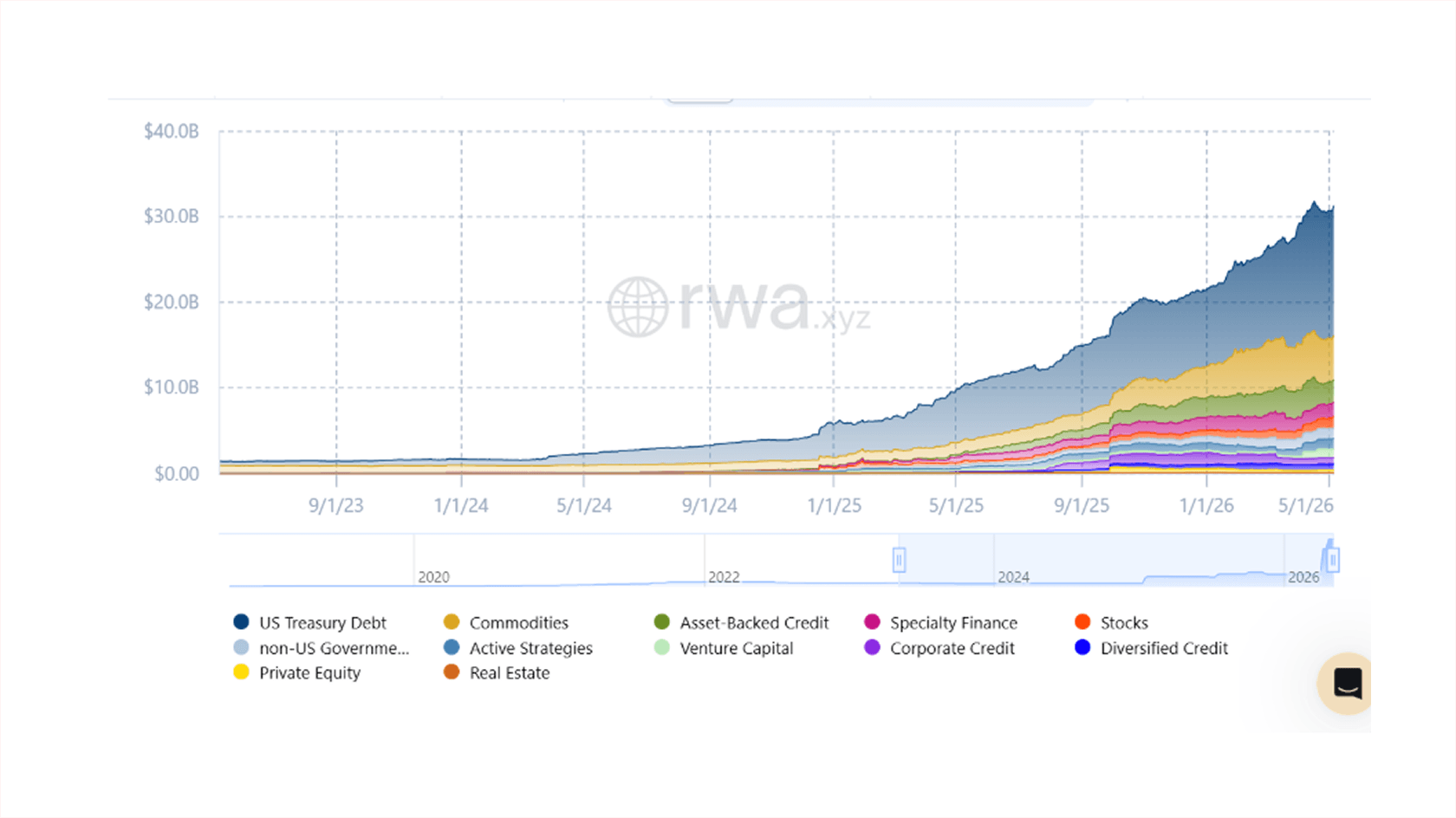
US Treasury debt, commodities, asset-backed credit, speciality finance, and stocks account for 3/4 of the tokenised market share. BlackRock's BUIDL fund leads the charge with $2.6 billion in assets under management. Franklin Templeton's BENJI, Ondo Finance, and Securitize follow closely.
Also Read: Tokenised Private Credit Surpasses Stablecoins in DeFi Share
Atomic Settlement: Eliminating Counterparty Risk
Atomic settlement is the ability to exchange assets and payments simultaneously in an all-or-nothing transaction. If any part fails, the entire transaction reverses. Hence, there’s no counterparty risk or settlement delays, and no capital is trapped in escrow.
In traditional finance, counterparties are exposed to risks when payments don’t settle simultaneously across time zones. Atomic settlement uses cryptographic guarantees to eliminate this risk.
In May 2025, Ondo Finance, JPMorgan's Kinexys, and Chainlink executed a landmark cross-chain delivery-versus-payment transaction with tokenised U.S. Treasury funds. Fnality International, CLS Group, and Project Meridian are a few other names that have explored atomic settlement using blockchain.
Privacy with Zero-Knowledge Proofs
HyFi found the most elegant solution for managing GDPR compliance and user privacy using zero-knowledge proofs. Read in detail bout ZKPs in this article by NFT.EU.
For financial institutions, ZKPs solve critical problems. They help prove KYC/AML compliance without exposing customer data, verify regulatory threshold checks, and blocklist non-members without revealing trading flows or positions.
Real implementations are operational under the EU's eIDAS Regulation for European Digital Identity and Mantra's decentralised identity module. Deutsche Bank collaborated with Nethermind to explore ZKPs for institutional blockchain finance.
Additional Reading: The Great Convergence: Why CeFi and DeFi Are Becoming Frenemies
The Interoperability Imperative
For HyFi to fulfil its promise, systems must communicate seamlessly across different blockchains and between blockchain networks and legacy infrastructure such as SWIFT and Central Securities Depositories.
But a tokenised real estate fund on Ethereum struggles to integrate with DeFi protocols on Polygon, while fragmented global regulatory frameworks create compliance complexity across jurisdictions.
To counter this, protocols such as Chainlink's Cross-Chain Interoperability Protocol (CCIP) and the Inter-Blockchain Communication (IBC) protocol enable token transfers and standardised cross-chain messaging. Oracle networks and API integrations connect blockchains to external data feeds and traditional systems.
TradFi vs DeFi vs HyFi: The Essential Differences
The table below illustrates how HyFi synthesises the strengths of both systems whilst mitigating their weaknesses.
| Characteristic | Traditional Finance | DeFi | HyFi |
|---|---|---|---|
Settlement Time | T+1 to T+2 days | Seconds to minutes | Seconds to minutes |
Operating Hours | Business hours only | 24/7/365 | 24/7/365 |
KYC/AML Compliance | Mandatory | Absent/Optional | Built-in via permissioned access |
Transparency | Limited | Full (public ledger) | Controlled (verified participants) |
Counterparty Risk | Present during the settlement | Eliminated via smart contracts | Eliminated via atomic settlement |
Infrastructure | Centralised, fragmented | Decentralised, permissionless | Distributed, permissioned |
Consumer Protection | Extensive regulatory safeguards | Minimal/Code is law | Regulatory compliance + smart contract audits |
Real-World Applications of HyFi
The finance world is witnessing several use cases of HyFi in traditional finance:
Bank-Backed Stablecoins
Stablecoins are the new institutional infrastructure, processing $20-25 billion in daily transactions. In 2025, stablecoins facilitated approximately $33 trillion in total transaction volume. McKinsey projects this could reach 20% of cross-border flows within five years, representing over $60 trillion annually. Total tokenised cash circulation reached approximately $322 billion by May 2026.
Major institutions are building their own tokenised deposits. Citi built tokenised deposits via the Regulated Liability Network for faster settlement times and greater institutional liquidity. JPMorgan's deposit tokens (JPMD) allow instant cross-border transfer settlement.
Also Read: How DeFi Protocols Are Solving Liquidity Crisis Using LM 2.0
Integration with Traditional Securities Markets
The SEC approved 10 spot Bitcoin ETFs in January 2024. These products accumulated over $100 billion in assets under management within months. The July 2024 approval of spot Ethereum ETFs further extended institutional access. By summer 2025, Robinhood launched tokenised U.S. stocks and ETFs on Arbitrum for European users. Slowly yet steadily, Web3 finance infrastructure started supporting traditional securities.
Central Bank Digital Currencies and Cross-Border Payments
HyFi got maximum mainstream adoption through central bank digital currencies. As of 2025, 137 countries and currency unions are exploring CBDCs. These countries represent 98% of the world’s GDP. 72 of these are either in advanced phases of development, in pilot programmes, or have been fully launched.
China's e-CNY CBDC program is the largest in scale. By June 2024, the CBDC transaction volume reached 7 trillion yuan ($982 billion). The pilot operates across 17 provincial regions.
India's e-rupee program is in the pilot stage. Its circulation increased to ₹10.16 billion ($122 million) by March 2025, up by 334%. Its daily transactions reached 1 million by December 2023. The wholesale e-rupee settled ₹2.75 billion ($33 million) in bond settlements on its launch day alone.
Nigeria's eNaira expanded from 5 million active users in 2023 to 10 million in 2024. The Bahamas' Sand Dollar, Jamaica's Jam-Dex, and the Eastern Caribbean's DCash represent fully launched retail CBDCs serving real populations.
Wholesale CBDC experiments target institutional markets.
Under Switzerland's Project Helvetia III, the Swiss National Bank issues tokenised Swiss franc wholesale CBDC. This CBDC is available for settling commercial transactions on SIX Digital Exchange. Singapore's Project Guardian involves approximately 24 financial institutions. Project mBridge explores cross-border CBDC platforms. Project Rialto uses wholesale CBDC settlement for instant cross-border payments.
The UAE's Digital Dirham completed its first cross-border payment to China in January 2024. The European Central Bank entered its digital euro preparation phase, having finalised its rulebook and begun provider selection.
What are the regulatory challenges of implementing HyFi?
HyFi must navigate fragmented global regulations, such as MiCA in Europe, the GENIUS Act in the U.S., and differing CBDC approaches worldwide. Each jurisdiction has its own licensing, capital requirements, and consumer protection measures.
Cross-border interoperability is one of the core requirements for HyFi to be successful. Cross chain interoperability requires standardising legacy data models to work with both SWIFT networks and blockchain simultaneously. The regulatory landscape is maturing rapidly, but coordination across jurisdictions remains complex.
HyFi Will Be the Future Infra For DeFi and TradFi
Hybrid finance removes the false choice between traditional finance and DeFi in modern financial systems. HyFi takes the best of both worlds. It pairs blockchain's transparency, programmability, and operational efficiency with the regulatory compliance, consumer protection, and institutional safeguards traditional finance offers.
However, the challenges cannot be ignored. Interoperability across chains and between blockchain and legacy systems requires continued standardisation. Custody solutions must keep pace with asset growth. Regulatory frameworks must coordinate across jurisdictions, and security cannot be compromised.
Nevertheless, the trajectory is clear. HyFi has to be the infrastructure ultimately. It's finance becoming faster, smarter, more inclusive, and more reliable. This finance would be powering tokenised economies, digital securities, and compliant cross-border services throughout the coming decade.
0
Comments
0
Write a comment.