Humankind’s desire for “wins” over others has always been a prime driver. The principle of liquidity mining also feeds on this same agenda. Freebies, you can call them. Park whatever amount you want early, and in its place, get extra rewards. The protocol raises TVL while you get that sweet dopamine and oxytocin of getting something extra. Win-win for both.
Liquidity mining 2.0 is a countermeasure to this farm-and-run mindset, a step to actually maintain the community. Let’s explore the ropes of this.
What defines Liquidity Mining 2.0?
How to implement liquidity mining 2.0?
An improvement upon the stale DeFi yield farming models, liquidity mining 2.0 essentially wishes to sustain communities by eliminating “mercenary capital”. No short-term 100x returns like bogus claims.
The idea is to enable more passive earnings without staking. Plus point here, higher APRs, but the downers for some might be the committed time (cause apparently everyone nowadays thinks crypto = fast cash).
Four main ideas govern LM2:
1) Instead of mere presence, performance gets incentivised
Earlier, it used to be such that even if a pool was useless, people would still invest money just to get an extra % of tokens. As per LM2, though, rewards are only achieved if invested liquidity helps the protocol achieve some goals.
For example, Polygon’s LM 2.0 allots KPI based rewards via tracking time-weighted TVL. Weekly snapshots of active users are also considered, and rewards are given according to the activity of each user. Bot-like activity isn’t entertained.
2) Time weighted participation
Staying longer and participating count more than popping up at the right time. The formulaic way to calculate this is
Time weighted average = (duration of stay x value) / total time.
The average of the entire week is usually snapped and recorded, and the impact is measured based on the average involvement of the user in that duration.
3) Protocol-owned liquidity (POL) over Protocol-controlled liquidity (PCV)
Earlier, rental liquidity was given much preference. This was cause the protocol managers focused on liquidity itself as the sole metric. But the problem here is that it’s rental, so as soon as the money is gone, everyone flees, which leaves mass hyped protocols desolated after the period ends.
Ownership liquidity, on the other hand, translates to protocols actually owning liquidity by earning LP fees “honestly” for stable money flows during bear scenarios.
4) Making LPs act like owners
LM2’s ultimate focus is governance alignment, focusing on gradually unlocked rewards that must involve community participation. It also tries to link rewards to some amount of governance influence via strategic lockups. But for this, there has to be a certain amount of community trust in the project. Basically, making people feel like owners instead of collectors.
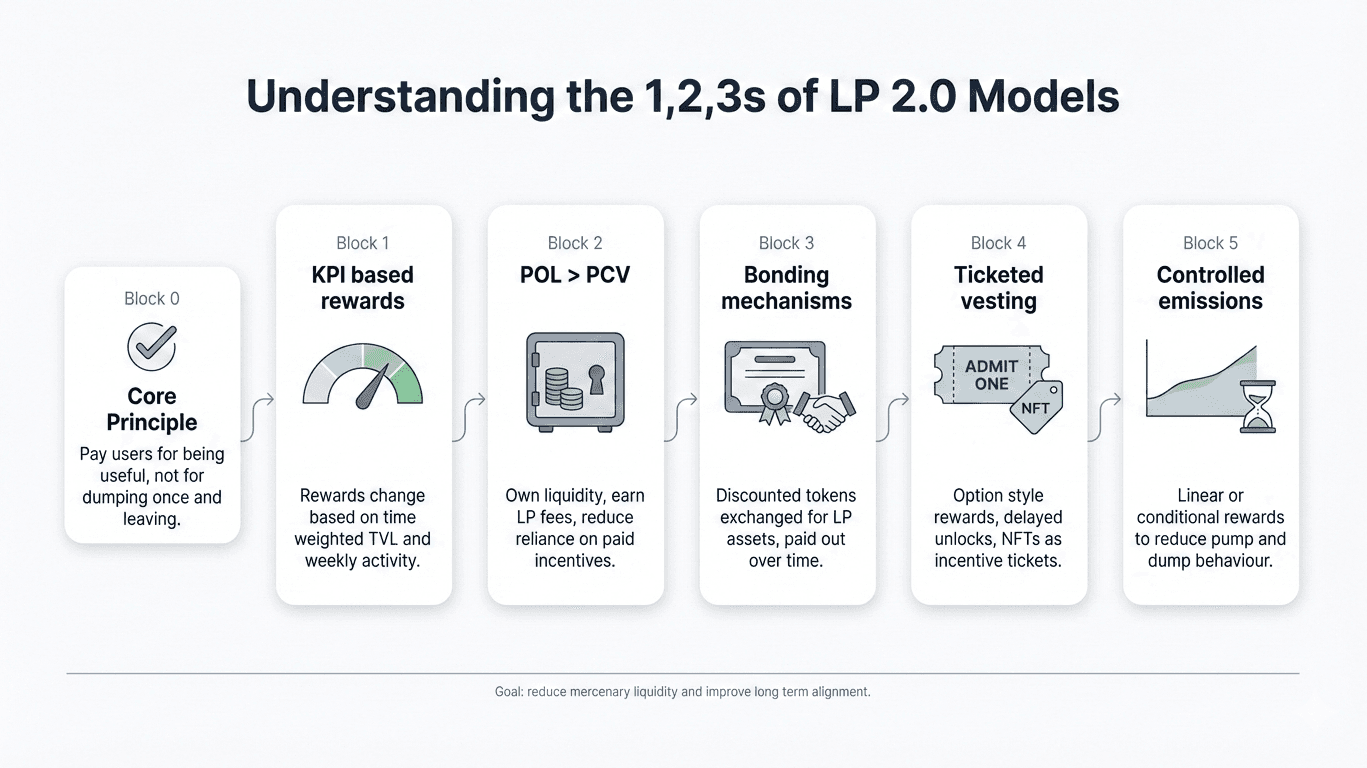
Understanding the 1,2,3s of LP 2.0 models
LP 2.0 models
But before diving in, know that the fundamental principle of every model is to pay the user for being useful, not for only dumping once and then leaving.
KPI based rewards: Same pinch. Rewards increase or decrease based on time-weighted TVL and weekly activity impact. In a simpler sense, suppose you join the first but leave once the rewards reduce…then you aren’t actually contributing consistently, hence your impact and reward ratio is low.
POL>PCV: NY’s DeFi risk management firm Gauntlet tells how spent incentives are unrecoverable, which is why, instead of spending it for bot-like community bases, replenishing base treasury via LP fees actually becomes the smarter move. No harm to the project during bear periods, too, as spending can happen even during bear conditions.
Bonding mechanisms:OlympusDAO uses this for discounted token selling and exchanges for LP tokens. The discount here is paid bit by bit over a five-day span, much like a “bond” between the protocol heads and the sellers. It omits the chances of increased selling pressures during the payout windows.
Ticketed vesting: Ticketed or option style rewards stretch the lock-in period longer while providing the time to decide on the right fixed price for the worthy buyer. An example of this would be PoD Finances' way of paying LPs with NFTs.
Controlled emissions: To skip the pump-n-dump miseries, protocols like Polygon instead follow a linearly spread emission/airdrops over a certain timespan. It's also the smarter way as the conditional reward element holds the crowd hooked to the project, stabilising liquidity and participation.
Case Studies and Community Building Explained
Source: Pixabay
Let’s now understand via a real-world lens how the industry is implementing LM2 mechanisms in its liquidity mining strategies:
Curve determines the routing of CRV to reward recipients based on a vote from all holders of veCRV. This model places a significant portion of control over CRV rewards in the hands of governance rather than simply who can make a deposit first. Rewards will be influenced (more or less) by voting power as well as deposit speed. To earn veCRV, one must lock their CRV in Curve for a period of time.
The longer the lock, the more veCRV earned, which also increases voting power and adds additional incentives such as fee reductions and boost increases to earnings. A "good" outcome would be rewards that have become more "sticky" due to the fact that one's reward is directly tied to how long they lock their tokens. A "bad" outcome would be an increase in "bribery" type of markets and "meta game" type of markets.
Case #2: GMX
GMX pays its stakers using actual protocol fees via escrowed rewards (esGMX) that are capable of being vested for an extended period of time. The GMX documentation describes how staking will give you governance voting rights and how you will receive fee rewards in a way that is similar to a buy-back model, as described by a majority vote from the DAO. The esGMX will be able to be vested for up to a one-year duration, and once vested, the user must continue to hold their underlying stake in reserve, which averts "hit and run" behaviour.
Users cannot liquidate all of their holdings at once. In order for a user to experience the full benefits of this staking process, they must maintain a position as a staker. Staking, combined with governance rights and receiving a portion of each transaction, gives stakers the feeling that they are actually owners. However, if users desire rapid liquidity, they may choose to avoid this model.
Case #3: Pendle
Source: X
Pendle's ve model allows holders to vote on how to distribute rewards to pools. Additionally, Pendle has released sPENDLE and has expressed interest in moving towards an algorithmic emissions approach based on KPIs that will improve the efficiency of allocation and decrease emissions by approximately 30%.
sPENDLE, now, has replaced multi-year lock-ups with a "liquid staking" type system and a withdrawal period. Rewards are going to be distributed to performing pools (those who are actually doing what they say), rather than just the ones that yell the loudest. Users have the opportunity to participate without being tied down for multiple years. While voting and staking will still be available; it is clear that the new system is attempting to create a "membership with flexibility," instead of a "lock-up jail." This results in improved emissions efficiencies and decreased pure farming energy.
Case #4: Frax Finance
Frax has gauges and veFXS in order for a longer-term oriented locker to have influence on the direction of the emission. The documentation says that gauges are used to align the incentives to allow those with the greatest amount of long-term veFXS to determine the flow of the rewards to their veFXS, and this seems to favor LPs that continue to stake in order to build up their veFXS holdings.
If a user were to take the reward and never lock, they would lose influence and potential upside. When a user locks their FXS to generate their veFXS, this ties their governance power to the length of their commitment. This can turn an LP into a stakeholder who cares about the future of the protocol. Rewards are now "earned by commitment" as opposed to "being first". But when users lock their funds, they also reduce their flexibility (cause there are some users who don’t want to be locked into a longer-term lock).
Notice the common element? It’s clear across all of these case studies.
Incentives are used in a way to have participants be part of a community (not just reward hunters), they incentivise voting/governance participation as well as long-term commitment through staking/lockup mechanics. They create additional incentive mechanisms for builders/helplines as opposed to simply "money parkers". Reputation-based incentives such as badges, boosts, and early access are added as well. Therefore, we can view incentives as training wheels that transform liquidity providers (LPs) into true owners.
A major open question at this point is whether the next wave of DeFi will continue to incentivise actual users and builders or if it will once again primarily incentivise those who farm rewards as quickly as possible.