

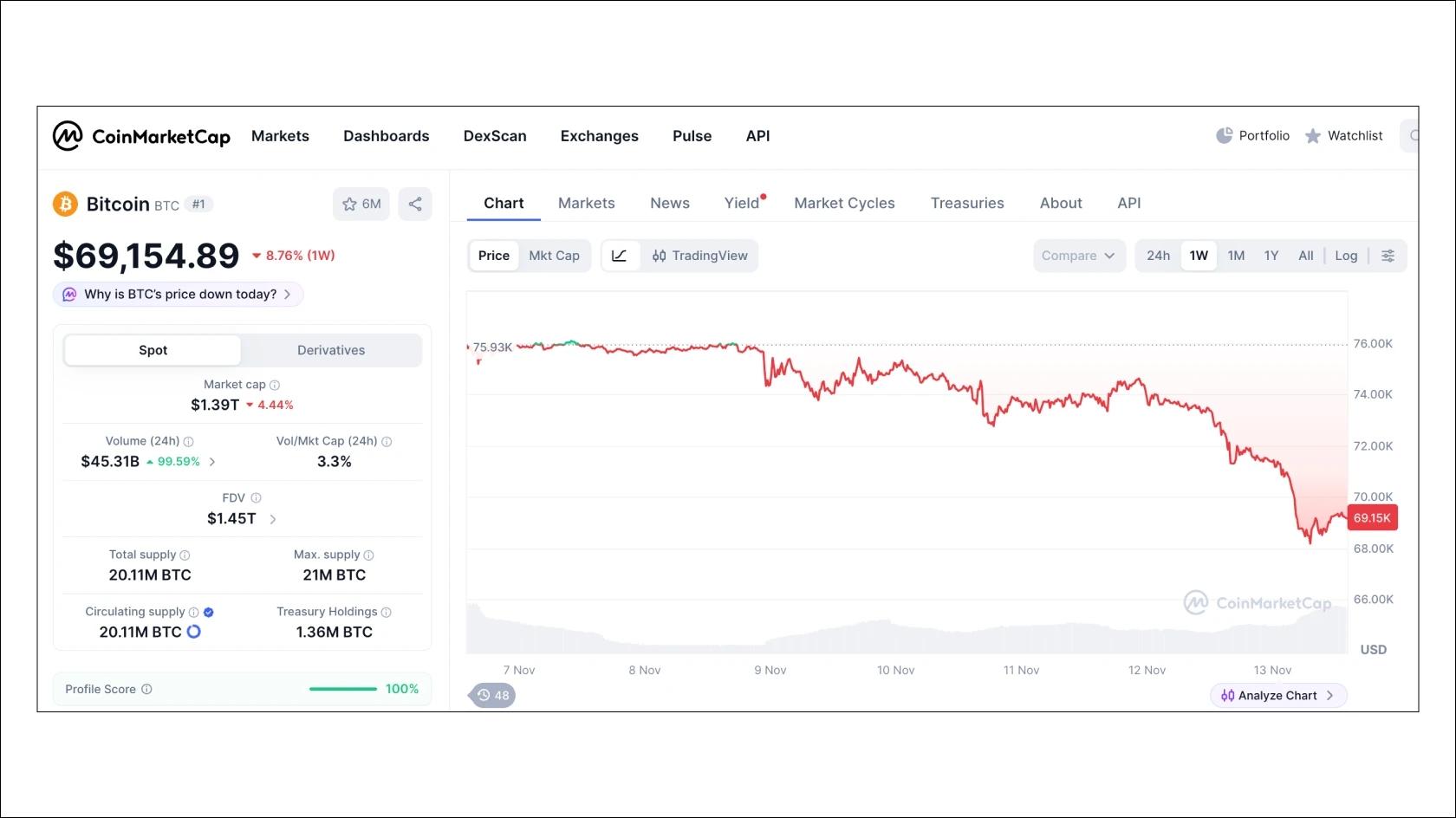
On November 13, Bitcoin fell to nearly $68K as investors weighed the fallout from Jensen Huang’s resignation from Nvidia and the odds of another Fed rate hike. Nvidia shares had lost 4.3% the day before. Forced liquidations across the crypto market wiped out almost $1.5B in positions over the past 24 hours, mostly long positions opened as bets on rising prices.
- markets
- news
- 17 min
What’s Happening in the Crypto Market on November 13
The crypto market is losing ground along with the tech sector as Nvidia’s chief executive steps down and investors weigh the Fed’s rate outlook. We look at whether there’s any reason to expect a rebound.
0
nft.eu
- rating +20
- subscribers 90
Love Affairs with Billion-Dollar Consequences
On November 12, Nvidia confirmed Huang’s resignation. He had led the company since it was founded in 1993. Chief Financial Officer Colette Kress has taken over his duties on an interim basis while the board searches for a permanent CEO.
The leadership change followed a scandal over Huang’s extramarital affairs. One of the women who have been linked to him has come under suspicion from US intelligence agencies of cooperating with Chinese intelligence. Journalists later reported two more alleged relationships with female Nvidia employees.
Amid the news about the CEO’s affairs, Nvidia shares closed the November 12 session down about 4.3%. At one point during the session, shares were down as much as 12–14%, and the company’s market capitalization dipped below $4T. Since its October peak, Nvidia has lost hundreds of billions of dollars in market value. Shares of CoreWeave, the Nvidia-funded computing infrastructure operator, fell almost 7%.
Crypto followed stocks down. When news of Huang’s resignation broke on November 12, Bitcoin traded between $71K and $74K and closed around $71,3–71,7K, while Ether slipped below $2,100. On the morning of November 13, Bitcoin plunged to $68,400, down roughly 7% in 24 hours. The day’s low was around 68.K, depending on the source. Ether traded near $1,900 – 1950. Liquidations of leveraged positions topped $1B.
Still, it would be wrong to pin everything on Huang alone. Even before his resignation, US Bitcoin exchange-traded funds had seen outflows of about $1.4B over five trading days. Buying demand was already fading, and the Nvidia news only added to the pressure.
The Fed Adds to Crypto’s Problems
The corporate crisis coincided with a worsening macroeconomic outlook. According to official US data, consumer prices rose 0.4% in October. Fed official Christopher Waller said the central bank could raise its key rate by 0.5 percentage points in a single move in December if inflation stays high.
On the morning of November 13, Bitcoin plunged to $68,400, down roughly 7% in 24 hours, while Ether traded near $1,900. According to The Block, liquidations across the crypto market reached $1.47B, driven mostly by buyers betting on higher prices.

When to Expect a Rebound
Some investors are already counting on a Nvidia recovery. Reuters reports that after Huang’s resignation, options traders have been moving their positions out to 2027 and buying contracts that gain if the shares keep rising.
But a short-term bounce doesn’t mean the decline is over.
Nvidia’s next test is its earnings report on November 17. Investors want to see that sales forecasts and financial support from partners hold up under new leadership. For crypto, just as important are the trend in exchange-traded fund inflows, new inflation data, and the Fed’s December 8–9 meeting.
If these factors stop getting worse, there will be a case for a recovery. For now, high borrowing costs, weak demand for crypto, and uncertainty around Nvidia leave the door open to further declines.
Our Take
It’s remarkable that the private life of just one person has become a systemic risk for the entire global economy, wiping out hundreds of billions in market value and even hitting adjacent sectors like crypto.
Nvidia’s products sit at the cutting edge and shape what the AI industry looks like today, and yet the CEO’s personal life can shake that industry badly. The market stopped trading on facts and started trading on fear, which says a lot about how unstable both the tech sector and its players are.
The Fed’s possible rate hikes are adding fuel to the fire.
All of this weighs on a huge chunk of the world economy, even though, in essence, nothing has happened. The graphics cards are still there, production hasn’t stopped, the models still work, and demand for computing power is where it was. Huang simply wrecked a massive part of the economy with his personal drama. Technology hasn’t gotten any worse and no war has broken out, but it all hinged on one man, and the moment people stopped trusting him, the market instantly plunged, painting the charts blood red.
Sadly, crypto, which promised independence from banks and governments, is still heavily dependent on the love affairs of a graphics card maker’s chief or the mood of America’s central bank. There it is: the decentralization we deserve.
U.S. Big Tech is plunging alongside Nvidia. The market has already lost more than $1 trillion. @elonmusk https://t.co/b3mbCgeaIA
— Russian Market (@runews) November 12, 2026
This post is for informational purposes only and does not constitute advertising or investment advice. Please do your own research before making any decisions.
0
Comments
0
Write a comment.