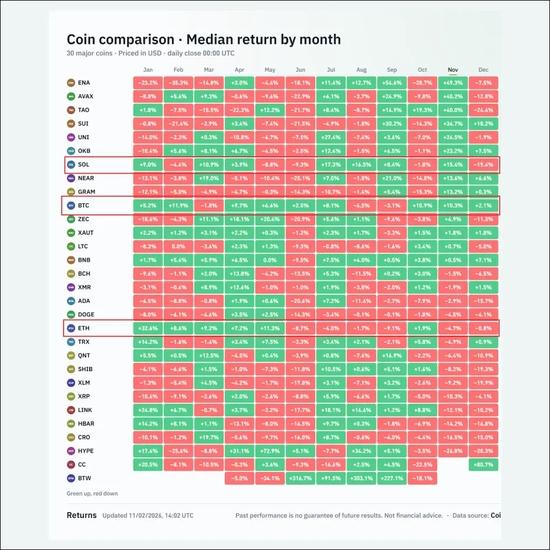
Calendar patterns in crypto work only until too many people start believing in them. Crypto traders were counting on an October rally, but the market went against the crowd’s expectations. For the second year in a row, we’ve seen a no-Uptober: just like in 2025, the market showed broad weakness and closed October in the red. In November, the crypto community is once again looking for a reason to feel optimistic, this time in the form of Novembull.
The Market Doesn’t Believe in Altcoins
The real failure of the month was the market’s lack of trust in alts: of the top assets we track, only a handful ended October in the green.
While Bitcoin lost 7.3% in October, Ethereum sank 16.1% and Solana dropped 19.2%. According to our newsroom’s tracking, only 28 of the top 200 coins finished the month with gains.
ETF inflows aren’t enough to turn things around. Interest in Bitcoin via regulated products isn’t the same as demand returning to alts. One part of the market can pull in more institutional money while the rest of crypto keeps sliding.
As investors look for signs of the next altseason, October raises an uncomfortable question: is there even enough demand?
Is Bitcoin at Wall Street’s Mercy?
Until October, Bitcoin ETFs saw steady inflows in aggregate, but that didn’t show up in Bitcoin’s price. The takeaway: institutional demand doesn’t guarantee growth.
Spot ETFs were supposed to make life easier for institutional investors and open the crypto market to more capital. And they did. But there’s a catch: access to Bitcoin through familiar financial instruments doesn’t mean investors will buy it no matter what the market is doing.
Money comes in when it sees opportunities and leaves when it wants to reduce risk. No magic here, just plain investor logic.
The problem is that people increasingly gauge the market by the behavior of the very players crypto was supposed to free people from. Bitcoin was meant to be an alternative to TradFi, yet now the crypto crowd watches ETF flows and waits for Wall Street’s approval almost as if it were the starting gun for a bull market. Institutions didn’t ruin crypto simply by showing up, but the market has grown more dependent on their appetite for risk, and therefore on the rules of traditional finance.
What to Expect in November
After Uptober comes Novembull, a fresh, optimistic attempt to find a bull market in a month’s name.
Year-end forecasts for 2026 don’t agree on a single scenario.
Coinbase Institutional keeps a constructive outlook for the fourth quarter but points to liquidity constraints. In its October review, the company identified a potential resistance zone for Bitcoin around 89,600–93,700, where, by its estimate, about 1.7M BTC of potential supply sits.
Fidelity is less optimistic and doesn’t rule out that the bear market may still be underway. In its September 1 review, the company noted that November 2026 could mark the bottom of Bitcoin’s current cycle. But that’s just one possible outcome: the recent price rise doesn’t yet mean the market has turned around.
These forecasts don’t contradict each other: Bitcoin can bounce even if the bear market isn’t over. But the upside is limited: near the resistance zone, sellers could regain control.
Uptober didn’t pan out, but that doesn’t mean Novembull will necessarily share its fate. Still, looking for patterns in the calendar, in Mercury retrograde or whatever else tells you nothing at all about where the market is headed.
As always, instead of seasonal omens, it’s worth watching three things in November:
- ETF flows. Is steady demand coming back, or are the inflows still isolated one-offs?
- Altcoin performance. If only Bitcoin is rising, it’s too early to call it a market-wide recovery.
- Resistance and liquidity. Even if buyers return, pressure from sellers can limit the upside.
We’re watching not the name of the month, but whether real reasons for growth appear.