

On November 19, Anthropic, the developer of Claude, listed on the Nasdaq and raised $81.3B. The next day, the banks underwriting the offering exercised their option to buy another 147M shares at the original price of $83. That brought the total size of the IPO to $93.5B.
- ai
- news
- 11 min
A Trillion in Commitments Behind Anthropic's Triumph
Anthropic Raised a Record $93.5B, but the Nasdaq Lost 2.25%. Nearly a Trillion in Commitments and Supplier Investments Expose the Risks of the AI Market.
0
nft.eu
- rating +20
- subscribers 90
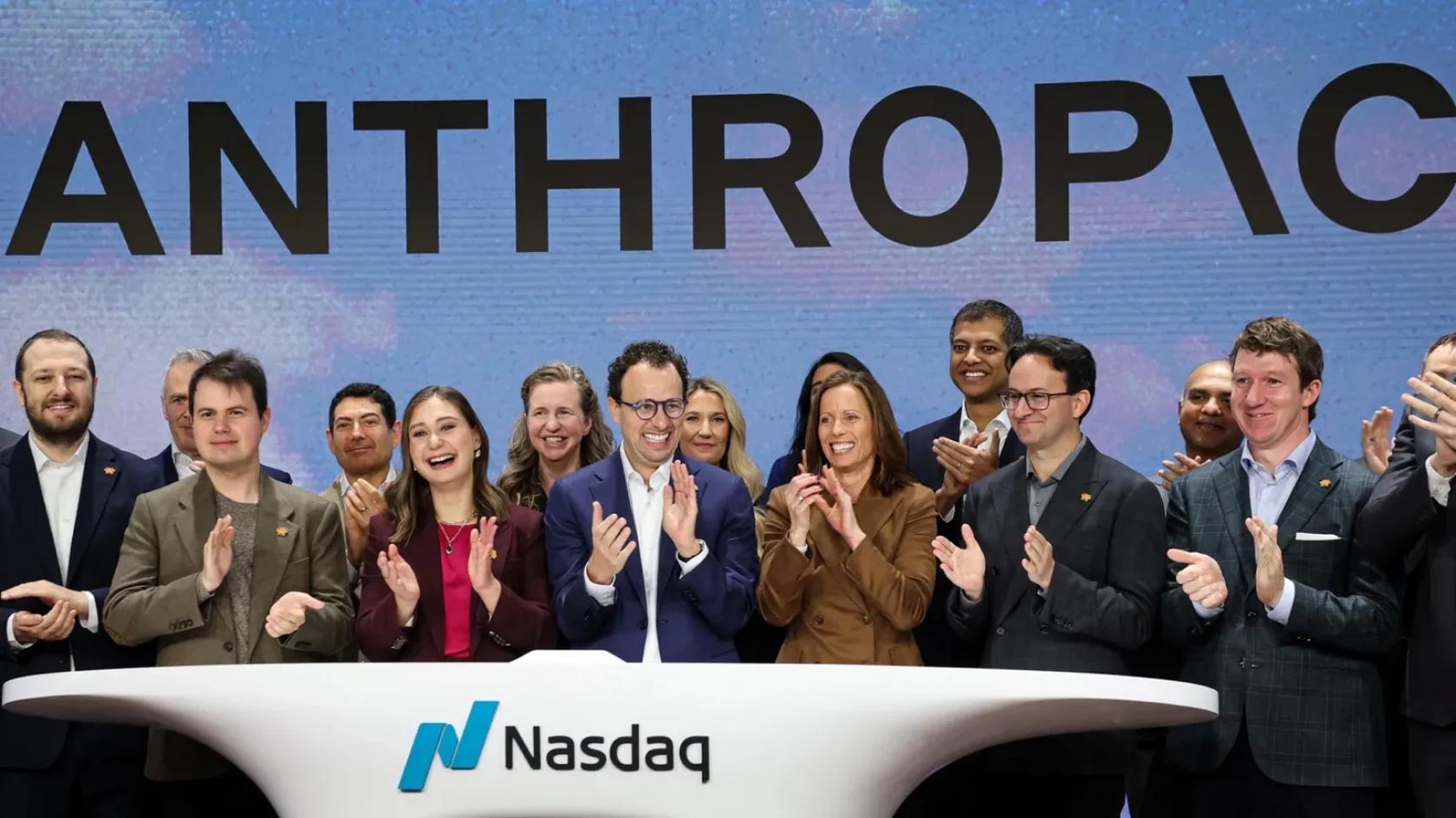
It's the largest share offering in history, beating the SpaceX record of about $75B set in June. Anthropic shares closed their first day 17% above the offering price, but the rest of the AI market tumbled the same day: the Nasdaq lost 2.25%, Nvidia and AMD slipped, and Bitcoin fell to a four-month low.
IPO Details
Anthropic sold 980M shares at $83, valuing the company at roughly $1.5T, counting all shares it could issue down the line. Trading opened at $111.50, the price peaked at $115, and the company's market cap briefly topped $2T. By the close, the stock had slid to $97.17.
The market hoped the listing would revive interest in AI after several weeks of selling. The opposite happened: Nvidia fell 3.3% and now trades 40% below its October peak, AMD lost 7.7%, and CoreWeave lost 6.1%. The S&P 500 fell for a sixth straight session, and the index's tech sector slipped into bear market territory, down more than 20% from its high.
What the Filings Show
In its filings with the U.S. regulator, Anthropic disclosed about $900.9B in commitments for compute purchases and leases. It doesn't have to pay the full amount tomorrow, since these are long-term contracts: roughly half, $451.6B, is due by 2030, and the rest stretches out to 2045.
Third-quarter revenue rose to $17B, but growth slowed: 47% quarter over quarter, compared with 144% in the second quarter. The company posted an operating loss of $567M, though its adjusted margin, which leaves out certain non-cash expenses, stayed positive. Compute costs ate up 58% of revenue, up from 48% the previous quarter, and lower model prices shaved about $600M off revenue.
The Financial Times calculated that, under certain financial assumptions, Anthropic would need about $600B in annual revenue to earn a 20% return on capital, more than Alphabet or Apple currently brings in. In October, its annualized revenue was just over $80B.
Alongside the IPO, Anthropic sold $26B worth of shares to strategic investors. Google and Nvidia bought $10B each, AMD $2.5B, Microsoft, Broadcom, and Micron $1B each, and TSMC $500M. Almost all of them sell Anthropic chips, cloud capacity, or memory.
NFT.RU Chief Editor's Take
The biggest IPO in history doesn't prove the AI market is healthy. If anything, it suggests the opposite. Where did investors find $81B in a single day? We suspect a large share of that money simply moved over from other AI stocks: funds dumped Nvidia, AMD, and cloud providers, sometimes at a loss, to buy Wall Street's new darling. There's no direct proof yet, but that's exactly what a sector-wide drop on a record-setting day looks like.
If so, the market is no longer growing. It's just moving money from one pocket to another. A year ago, investors bought anything with “AI” slapped on it. Now they're choosing who gets the money and who gets sold off to fund the next champion. And the industry may be running out not of prospects, but of the money to pay for all of them at once.
The $26B from suppliers is even more interesting. Nvidia, Google, and the others are investing in Anthropic, while Anthropic signs multibillion-dollar contracts with them for their own chips and capacity. There's nothing illegal about it, but it's unclear how much of the growth is paid for by real users of Claude and ChatGPT, and how much by the market players themselves, passing money back and forth. The same dollars become one company's revenue, another's expenses, and a third's investor expectations, and each of them reports massive growth potential.
Most importantly, we think the AI bubble's weak spot isn't demand but the cost of production. Models are getting smarter, tokens are getting cheaper, and users keep coming, yet a company with nearly a trillion dollars in commitments still posts an operating loss. The AI market can easily grow technologically while shrinking financially: Claude will get smarter, rivals will release new models, and generation will get cheaper, but none of that guarantees shareholders anything.
The first day of trading already shows this. Those who got into the IPO at $83 made 17%. Those who eagerly bought at the open at $111.50 were down almost 13% by the evening. Early shareholders have started handing some of the risk to new buyers, and buying stock in a great tech company isn't the same as making a good investment.
Investors seem to be realizing that AI really will change the world, but that doesn't mean every player in this revolution will become a trillionaire.
For the crypto market, the takeaway is unpleasant: Bitcoin fell again alongside AI stocks, and as long as the AI sector is looking for someone to pay its bill, that risk will weigh on crypto too. We wouldn't call the AI bubble burst just yet. But the question of how much of the money at this party comes from real, paying customers is louder now than ever.
Anthropic valuation: $1.5T Walmart valuation: $940B Anthropic revenue: $20B Walmart revenue: $725B https://t.co/5lX1ncWaM9
— Not Jerome Powell (@alifarhat79) November 19, 2026
This post is for informational purposes only and does not constitute advertising or investment advice. Please do your own research before making any decisions.
0
Comments
0
Write a comment.