A weak company AI policy won’t protect you; it can increase liability. Identify compliance gaps, vendor risks, and the controls a defensible policy needs.
“Shadow AI”, a newly coined term, loosely means employees using unchecked tools to speed up their tasks, sharing sensitive organisational info while they’re at it.
For small teams, solopreneurs, or even mid-scale businesses, it probably won't even mean anything. But for large corporations, specifically ones that deal with health, governmental identity, and financial tech, it's a ticket to blunder. Something that can potentially lead to “algorithmic disgorgement”.
When adoption is faster than governance and compliance, the future can feel a bit murky. And that’s exactly why company AI policies need to set their rails straight.
What's an AI policy?
Source: Reddit
AI policy, or “AI use policy,” are a set of rules that govern data input/output, employee responsibility, ethical use and approved use of AI in a workplace. These are the dos and don’ts of how to use AI for work.
Simple right? Not really.
AI itself is new, and the regulating policies, newer. Organisational readiness and employee awareness regarding these policies are all over the place, which is why devising them suitably is a challenge for AI-first organisations.
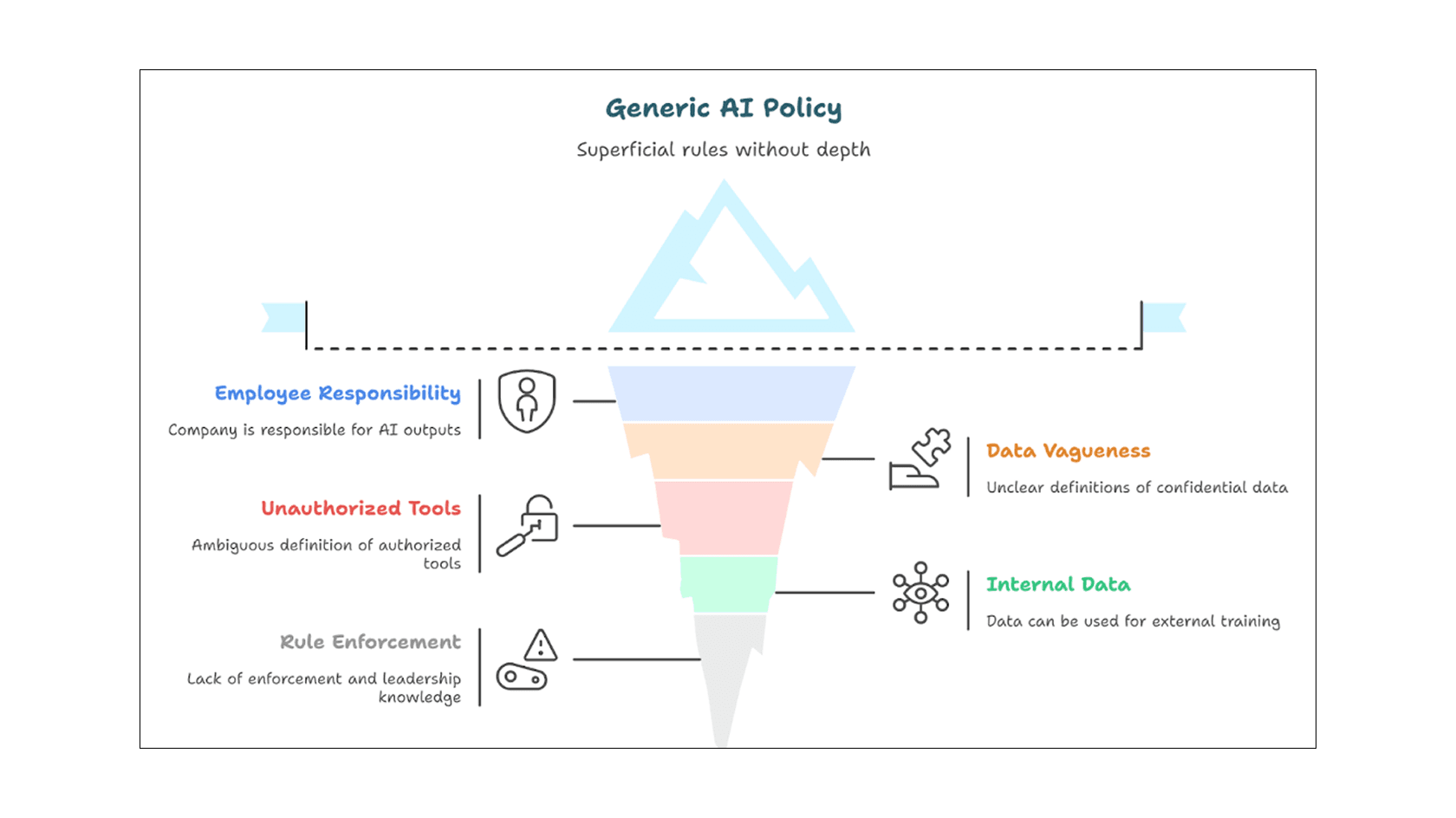
A generic AI policy brings with it hidden liabilities
Generic AI policy
“Responsible AI,” “Acceptable Use,” or whatever you call it, the nomenclature itself doesn’t equate to the practicality of the defined rules.
We get it. You wanna look cool by pushing copy-pasta rules sourced from Twitter, Reddit, or Slack AI policy docs, but the blame’s upon you if you don’t read, edit, and replace the common “myth” lines with facts.
Myth #1: "Employees are solely responsible for AI outputs"
Fact: It's not how this works. Say your company uses Microsoft’s Copilot or Google’s Gemini subscriptions for work. If any chatbot/tool defames your competitor, who then comes to know and calls you out for it in court, the judge won’t hear your “we told the new guy to check the facts” plea. As per the EU’s AI Act, you, the “deployer, " are the one responsible for “reasonable oversight.”
Myth #2: The “confidential” = “personal” ≠ “public” data vagueness
Fact: Do you really think your contractual marketing intern knows that a "customer contract summary" counts as "confidential data"? Can’t blame anyone for it really, cause about 70% of policy confusion spins around these two words. It’s upon you to word-for-word define these terms in simple, daily lingo so that teams don’t take your AI code-of-conduct for a gibberish rulebook.
Myth #3: “Employees shall not use unauthorised AI tools”
Fact: What’s “unauthorised”? What’s “authorised”? It all becomes a governance drama between IT and legal. There are many real-world company AI policy examples.
For instance, if your firm uses Microsoft 365 and has this rule in its company AI policy, then technically, everyone is violating it every day because Microsoft 365 now includes Copilot, which again uses OpenAI's GPT-4/GPT-5 models. If legal issues come up, such would come off as “unprofessional” rather than true policy compliance. Not cool for a firm’s reputation.
Myth #4: “Don’t worry. It’s internal.”
Fact: Say you’re running some pilot project that’s using customer data via some third-party tool/API. Or your company only relies on external vendors to provide AI services. But the ToS of the AI being used or the vendor's contract might have a teeny-tiny clause that your precious data can be used to train/improve their model/wrapper solution. As such, nothing remains internal unless your policy lists proper vendor governance rules.
Myth #5: Everyone follows the rules & leadership reluctance
Fact: Rules that merely exist on paper but aren’t enforced are thought of as namesakes. They’re of no use. Plus, often the leadership meant to control/oversee the enforcement themselves lack relevant AI and policy knowledge. This leads to lesser oversight.
Such reluctance, to a regulator like the US FTC, seems “intentionally reckless” and therefore chargeable. Setting up mandatory tool allowlists, single sign-ons, and activity logging can save your firm from getting called out on these grounds.
Studying AI before policing it (and where to start)
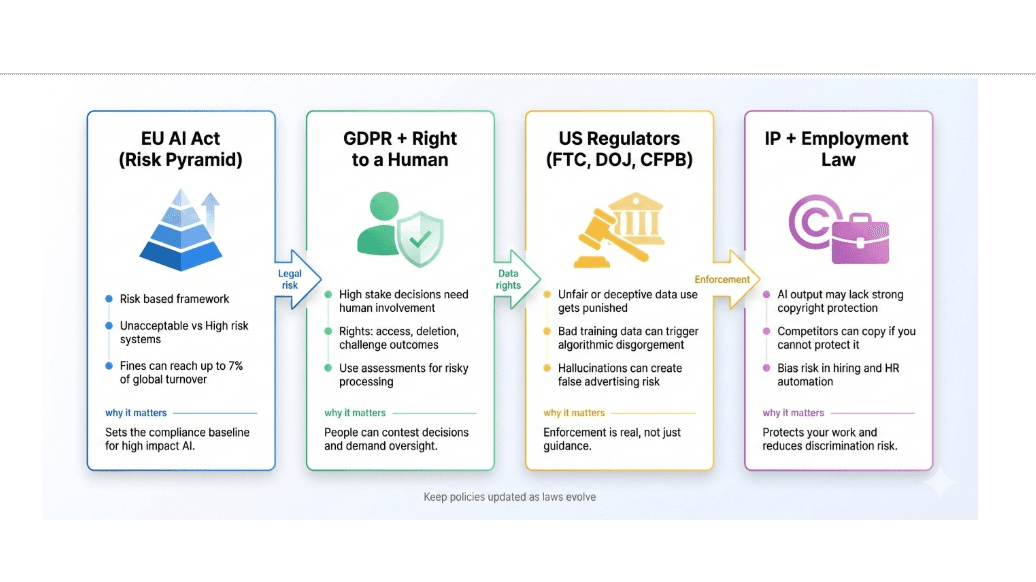
Keep policies updated as laws evolve
Being still nascent as it is, AI and policies/legalities circling it are evolving faster than you can imagine. A policy rulebook written two years back won’t fully fit the current day’s paradigm. Still, there are a few of the foundational readables that one should “study” before deciding the best AI policy fit for their organisation. These are:
1. The EU AI Act
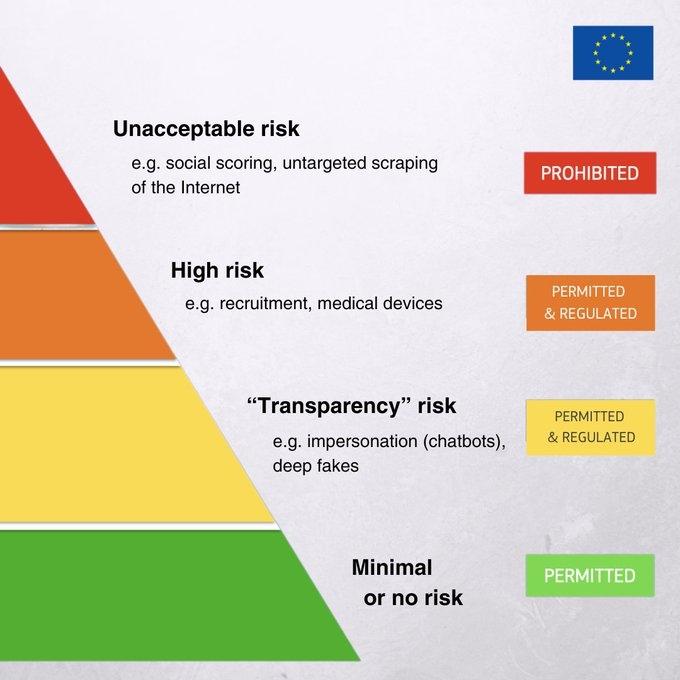
Source: Twitter/X
Think of this as the holy grail of AI-centric legal frameworks. While still in development, one of the core elements of this act is its “risk-based approach” or Pyramid of Risk, which helps lay out how to govern which types of AI risks. In this, the top cone (unacceptable risks) and the portion below (high risk) indicate the risk types that are of critical consideration.
Harmful manipulation, social scoring, and likewise, outright bannable offenses fall under the unacceptable category. On the other hand, sorting CVs and managing entire teams with only AI usually aligns with the high-risk category. Firms and corporations need to keep an eye out for any such felonies committed by them, their vendors, and/or customers. Ignoring these can rake up fines of nearabout 7% of global turnovers.
2. GDPR and the "Right to a Human"
As per both UK and EU GDPR, high-stakes decisions like loan approvals or recruitment (end-to-end) can’t be entirely AI-tailored and have to have some human jurisdiction set up. Specifically, when individual personal data and rights get involved, legally, you can’t process the data without conducting some sort of assessment, like DIPA, for example.
Another aligned aspect to this is the “right to human” law. It states that users at any point in time have the power to withdraw given consent, delete personal data, or even challenge any AI-generated outcome. If your firm doesn’t have anyone appointed to handle/oversee such mechanisms, you are basically treading on GDPR-violated ground.
3: FTC, DOJ, CFPB and likewise US regulatory body policies
Imagine some model that has been built on data that’s obtained using web scraper “bots” coded to scrape governmental databases and websites for collecting the info. That’s straightaway deceptive and unfair, something which can face the “death penalty” of Algorithmic Disgorgement, i.e., the trained algorithm itself should be deleted along with the data.
Next up, AIs have this little habit of “hallucinating” or coming up with fluff data to sound more persuasive. Such “prompt-biased” results, if publicly published without fact-checking, can put firms in vulnerable positions of false advertising lawsuits or consumer protection/unfair competition rules.
4: Intellectual Property (IP) "black hole" and employment laws
Legally, right now, there are no copyright protection laws for AI-generated work in the US and the EU. This simply means that any competitor of yours can outright steal your “product” if they have access to your AI-generated boiler code.
The “bias trap” stems from the habitual nature of AI to lean towards historical data. Considering automated employment processes, this can tilt towards discriminatory decision patterns, although such can be fought using FEHA and likewise anti-discriminatory laws.
Guide to devise a legally defensible AI policy
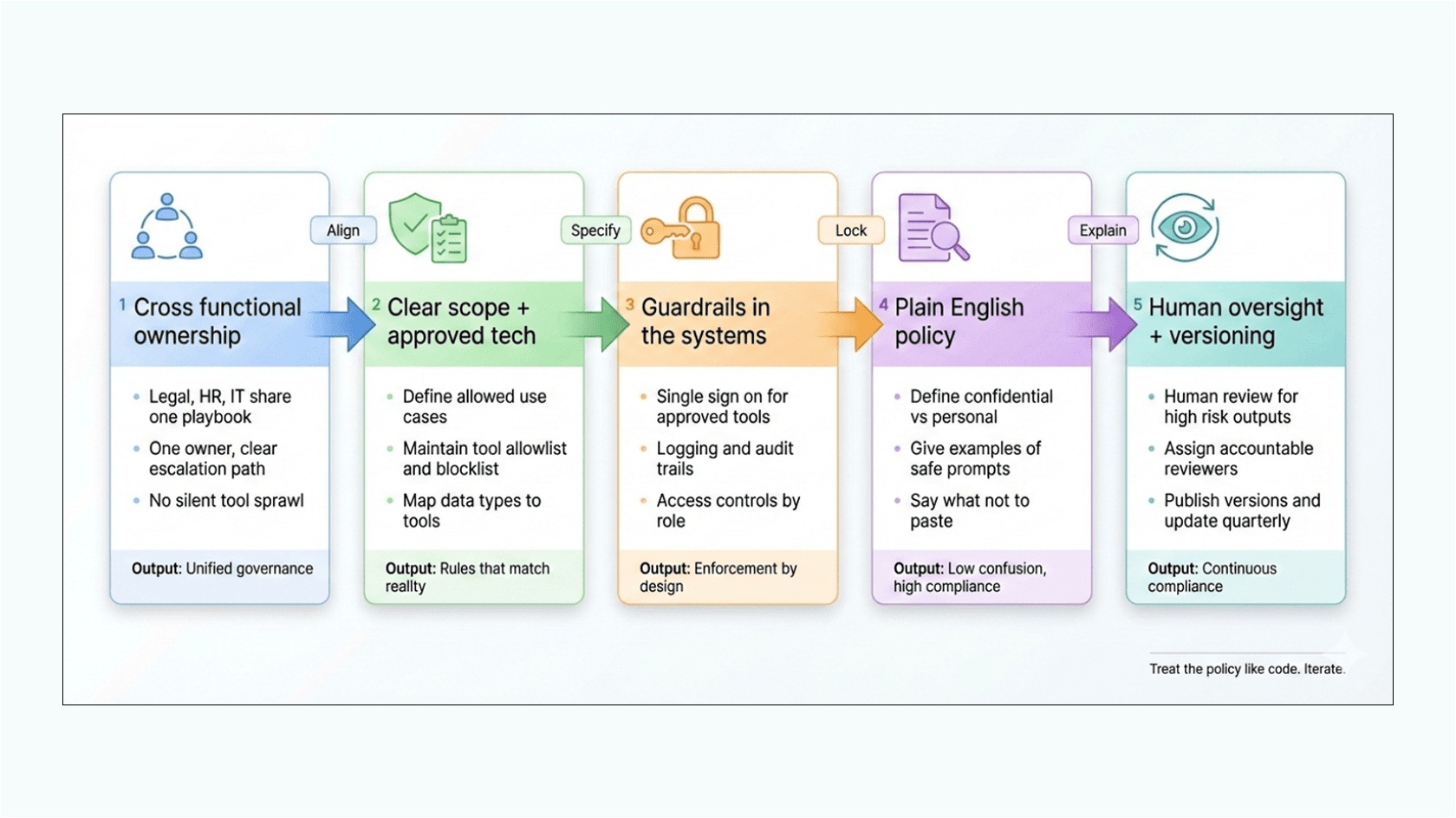
Threat a policy like a code. Iterate
Instead of treating it as a once-done and dusted 12-page manual, focus on how to make it actually enforceable. And for that, the vision needs to be “humane” and then AI.
Cross-functional ownership: All teams in the firm need to be in sync with each other, be it Legal, HR, or IT. It's like couples therapy. This way, the firm can make sure that none of the departments are using tools that go against the allowlist.
Clearly defined scope and tech: No need to introduce wave rules that would be of any help. Instead, simply use mechanisms like single sign-on so that unchecked tools aren't used. This frees the company from the scope of shadow AI.
Write in basic English: Define the exact use case of sensitive data and how exactly you want employees to handle it, so that no one “assumes” something. Your worded rules should be as execution-specific as possible.
Mandatory human oversight: All AI-generated output should pass human review. If you don't have someone competent like that in your C-suite, it's time to hire one.
Timely improvisation: Once again, it's not a done and dusted process. Treat your AI policy book as code. Publish versions of it and iterate over time.
What founders need to know
AI use at work won't slow down anytime soon. As the tech gets stronger, more and more people will use it, or they’ll fall behind. And the tools, laws and risks will keep shifting.
Ask yourself questions like:
If my regulator, customer, or competitor questioned my company’s AI use tomorrow, what would I point to?
What would be the real damage if you had no proof of oversight?
It’s the governance rules you adopted, your way of human review/intervention, and how prompt you are with policy iteration that’ll define your company’s fair AI use policies.