In early 2025, a fintech startup deploying a new payment gateway almost shipped a major bug to the production stage. The bug was buried deep in the authentication flow, and could have given attackers unhindered access to user wallets.
However, AI code review tools ran a semantic analysis and flagged the issue by identifying patterns similar to known authentication bypass patterns. A $50 million breach was prevented, thanks to the AI code review tool.
Also Read: The $1 Billion AI Stack Mistake Every Company is Making
AI code review tools aren’t an option for developers or companies to opt for. They are the most reliable layer of defence in software development today.
This article takes you through the kinds of code vulnerabilities and how AI code review tools prevent them.
Rising Cost of Code Vulnerabilities
AI has accelerated software development by miles. Developers use AI copilots and rely on a dozen other dependencies to ship faster. AI-generated code has a 45–70% vulnerability rate, depending on the language and prompt complexity.
This vulnerability rate is made worse by other human and structural factors, like
- Developers are under increased pressure to deploy quickly in small and mid-sized startups, especially in the Web3 space
- Multiple microservices, API, and multicloud environments today compose increasingly complex ecosystems
- Developers and agencies are blindly using AI-assisted coding by tools like GitHub Copilot, ChatGPT-generated scripts
- Many firms use code available in open-source libraries. This unvetted or unpatched reuse can lead to catastrophic vulnerabilities
Human reviews, SAST tools, and QA environments aren’t enough to keep the pace up. AI tools for code review cut the manual labour and checks by scanning syntax and calling known vulnerabilities, and reasoning about intent, data flow, and behaviour.
Fun Fact: OpenAI’s own internal red team found that AI-generated scripts for secure login flows often omit proper session checks, which can introduce logic bugs that traditional linters cannot catch.
Case Study: The AI Code Review That Prevented a $50M Hack
A firm did everything right before launching its cross-chain payments API. It followed every security measure, had been through code review, passed QA, and integrated seamlessly with MetaMask and Coinbase Wallet.
The startup team was exhausted yet confident. It was just weeks away from launching its dream project.
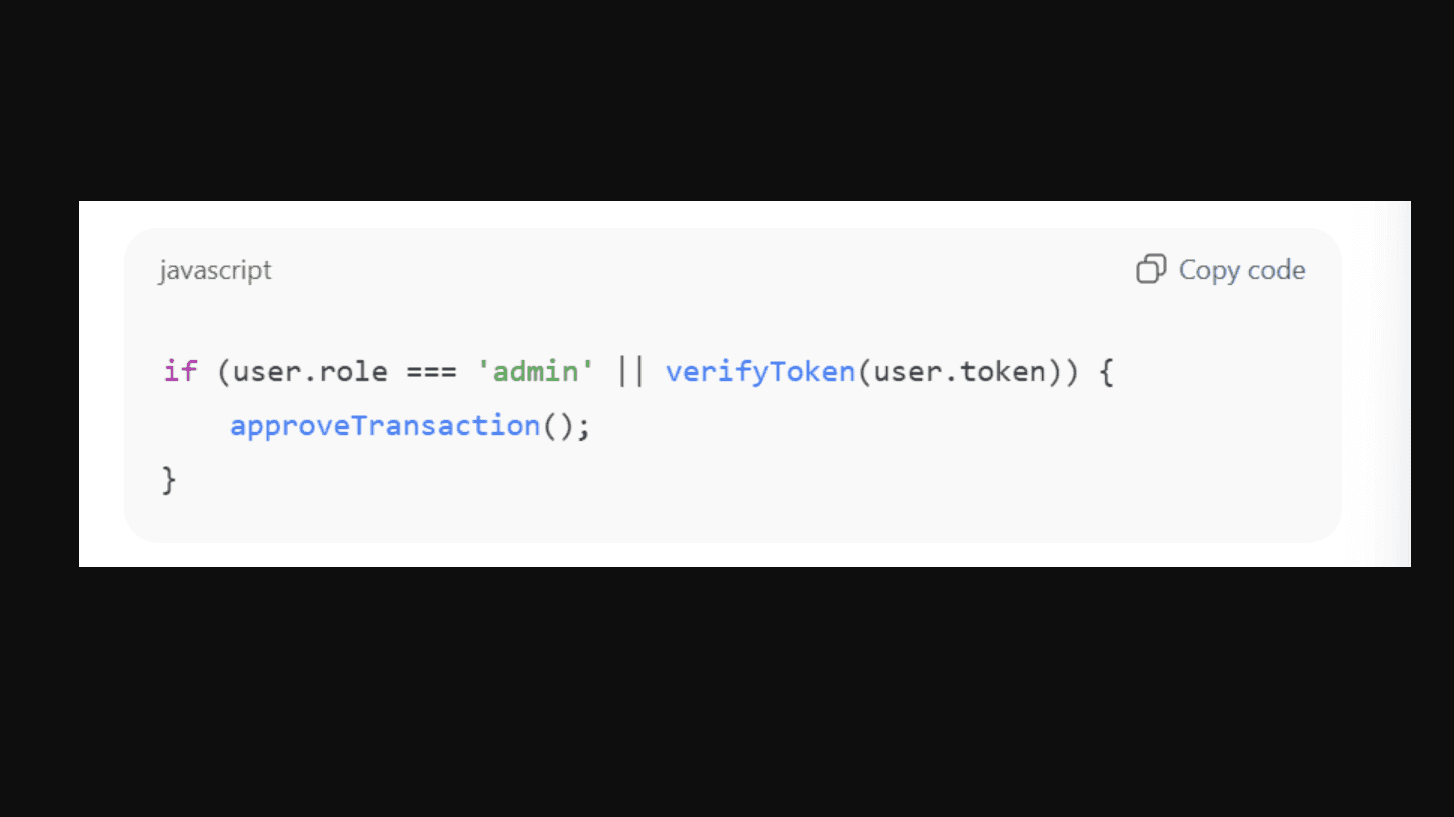
However, right before the team was pushing for the final build, a flag was found in the CI/CD pipeline. The flaw was a misplaced conditional check that could give attackers a path to skip token validation.
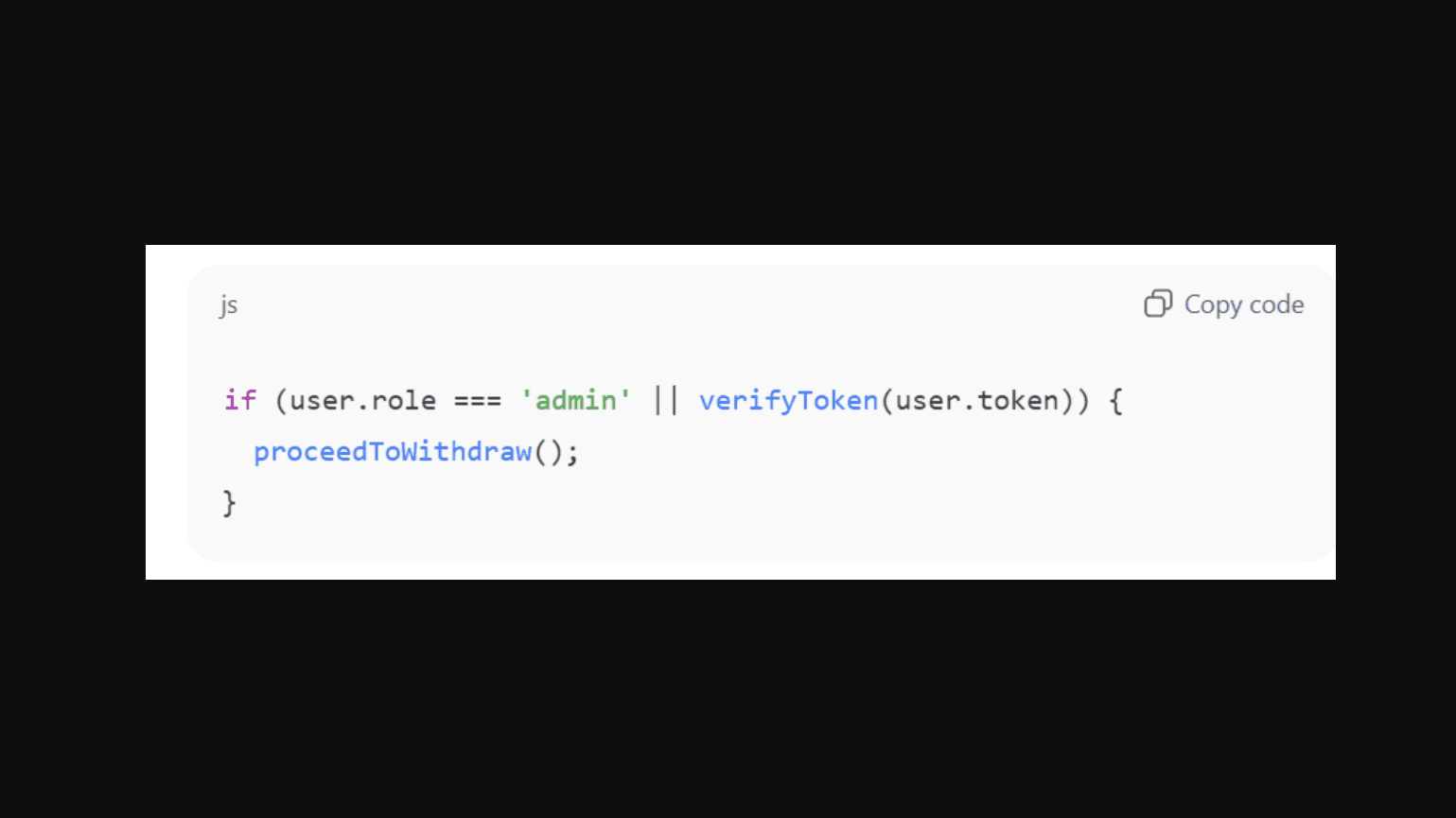
Here’s a simplified version of what the code looked like:
The AI code review engine had paused the deployment. But what was the reason? Wasn’t everything prepared and perfect?
The test wasn’t broken, nor was there any issue with the syntax. There was a subtle bug in a line of logic of the admin verification function that the human eye had failed to notice.
An attacker could force the role to 'admin' in their payload. If the system checked the role first and skipped the verifyToken() function, the attacker could bypass authentication completely.
It was the AI review tool that had picked up the flaw in the code by reasoning about the logic. It didn’t just match signatures. Instead, it compared it against OWASP Top 10 and labelled it as a critical risk. The code then correlated GitHub issues and CVEs with similar role-check vulnerabilities to suggest fixes.
By any chance, if the code had gone live untested, attackers could have impersonated admin users in the client payload and triggered high-value withdrawals via smart contract interaction. They could have stolen $50 million worth of assets across the staking pools and user accounts before any of the team members could have noticed.
Also Read: AI agents uncover millions in blockchain vulnerabilities
The error in the code was quickly fixed to decouple role checks and token validation by the team, and the code passed the AI check with flying colours this time. The team also made it a policy for every code to pass an AI-driven review.
The vulnerability never went live. AI saved the day for the startup!
How AI-Assisted Security Auditing Works
AI tools for code review don’t work like a spellchecker tool for identifying code vulnerabilities. The entire security auditing process goes beyond the regular ‘search and match’ process. A few components and levels of AI-led security auditing include:
- SAST scanning: Static analysis or SAST reviews raw code and configuration for risky patterns.
- DAST/Fuzzing: The AI tool tests a running app with deliberately malformed inputs for finding edge-case exploits.
- Dependency & supply-chain scanning: This component involves the AI tool reviewing all third-party libraries for known vulnerabilities, unsafe licenses, and outdated packages.
- Semantic AI review: This component includes LLM-based reasoning about logic flaws. Here, large AI models ‘read’ your code to understand what the code is supposed to do, and where it can go wrong.
- Self-auditing AI: These tools learn from your own codebase. Like most chatbot tools popular among the masses, self-auditing AI learns your naming conventions, frameworks, internal security rules, etc. Subsequently, there are fewer false positives and more relevant feedback.
Which Are The Vulnerabilities That AI Detects Better Than Humans?
AI doesn’t get tired like humans. It doesn’t err or skip deadlines or assume context while checking the code. AI models are known to consistently outperform human reviewers when combined with semantic code analysis and deep learning. These models can catch high-risk issues related to logic flaws, multi-file reasoning, and dynamic input handling.
AI is better adept at identifying certain vulnerabilities:
SQL Injection
AI code review tools can trace unsanitised user inputs being put into query functions. These tools can find them even when such inputs are hidden or obfuscated under multiple layers. It can flag the use of raw SQL strings, concatenation, and insecure ORM usage faster than most human reviewers.
Cross-Site Scripting (XSS)
AI understands input and output flow across files. It is effective at detecting reflected and stored XSS even in modern JS frameworks with different escaping rules.
Authentication Bypass
AI can point to cases where a human can easily sidestep role checks or token validation logic. It does so by reasoning about conditional logic paths.
Path Traversal
AI review tools can simulate directory traversal attempts. They can also link successful access patterns to source code functions behind insecure file access.
Command Injection
AI tools can find how system commands are constructed in code to detect cases where user-controlled inputs are passed unsanitised.
Cryptographic Misuse
AL-led static analysis can detect common cryptographic errors, like weak entropy sources, reuse of IVs ( or nonces), and broken hash algorithms.
Log Injection
AI can flag cases where user input is logged without sanitisation. If not removed, unsanitised input can become a vector for downstream log poisoning or alert tampering.
Reentrancy in Smart Contracts
AI tools can scan Solidity or Vyper contracts to model execution order and detect reentrancy risks in functions that update state after sending ETH.
Must-Follow Checklists For AI-led Code Reviews
Here are two comprehensive yet useful checklists you can follow for gatekeeping your code against security risks and code vulnerabilities:
AI Security Audit Checklist
Before merging or deploying code, use this checklist to double-check if all AI-assisted security checks are in place:
- SAST Completed with AI-enhanced static analysis
- Semantic Logic Review using LLM or reasoning engine
- Dependency & CVE Scanning (all packages + transitive)
- Secrets Detection in code, configs, and ENV variables
- SBOM (Software Bill of Materials) Generated
- Fuzzing/DAST Performed on critical APIs or endpoints
- Reentrancy + Gas Analysis for smart contracts
- Cloud Config / IaC Misconfiguration Scan
- LLM Validation Checks, e.g., hallucination, insecure patterns, etc.
- OWASP Top 10 Coverage confirmed via audit logs
- Audit Trail Logged output signed & stored securely
Deployment Security Gate Checklist
Use this as a gating mechanism in your CI/CD pipeline to block risky builds:
- Pre-Merge AI Review Passed
- Infrastructure-as-Code (IaC) Reviewed
- Cloud Misconfiguration Scan Complete
- API Authentication & Authorisation Tests Run
- No Secrets or Keys Committed to Repo
- Container Image Scanned (for known vulns)
- CVE Monitor Webhook Triggered
- SBOM Attached to Artifact Metadata
- Compliance Checks Passed (e.g. SOC2, ISO/IEC 42001)
- Deployment Rollback Plan in Place
Also Read: These 7 AI tools are secretly stealing your data (and 3 that actually protect you)
Which Deployment Safeguards Can AI Automate?
The real power of AI doesn’t come from running a scan once. The actual benefits of AI code reviews emerge when these tools are embedded into your deployment lifecycle.
Every time a pull request is opened, an AI reviewer checks it for syntax, logic flaws, dependency risks, and misconfigured policies. If the review fails, the merge is blocked. If it passes, it’s logged with a record of what was checked and why.
In more advanced setups, these tools also:
- Auto-generate SBOMs (software bill of materials)
- Detect secrets and API keys in code before they are pushed into production
- Monitor for cloud misconfigurations in all infrastructure-as-code files
- Run compliance checks for standards like SOC2 Type II or ISO/IEC 42001
All of this happens within your CI/CD pipeline when AI becomes part of the process.
Comparison of AI Security Tools
Here’s a comparative analysis of the top AI security tools popular among devs and software development companies.
Lessons Learned
We opened this article with a case scenario where an AI code review’s timely save prevented a $50 million exploit. These nearly missed flaws in the code aren’t an anomaly. But they have become the new normal as more and more developers and software production companies look to speed up the coding process.
Teams rely heavily on LLMs to replicate code from open source libraries so that the code moves fast into production. Automated CI/CD pipelines can often lead to missed issues. The attack surface also keeps shifting.
No dev is capable enough to cross out every logic flaw or cross-check all multi-file paths across thousands of lines of code. AI review catches what the human eye may miss, but AI review code tools can never fully replace human supervision.
The fintech company we talked about earlier did not get lucky. They prepped themselves up. They integrated AI into their development lifecycle and caught a bug that could have otherwise cost them everything.
A combination of human intuition and AI neutrality is what is needed to map issues and flag any suspicious activity. One-time scans aren’t enough. A secure SDLC is continuous, multi-layered, and context-aware.