Trenches: what they are, how to do them, and why (explaining the 2026 "degen" meta)
A specific overview of what the trenches mean in modern crypto. The summary details the rise of prediction markets, memecoin launchpads, and new degen behavior.
Trenches: what they are, how to do them, and why (explaining the 2026 "degen" meta)
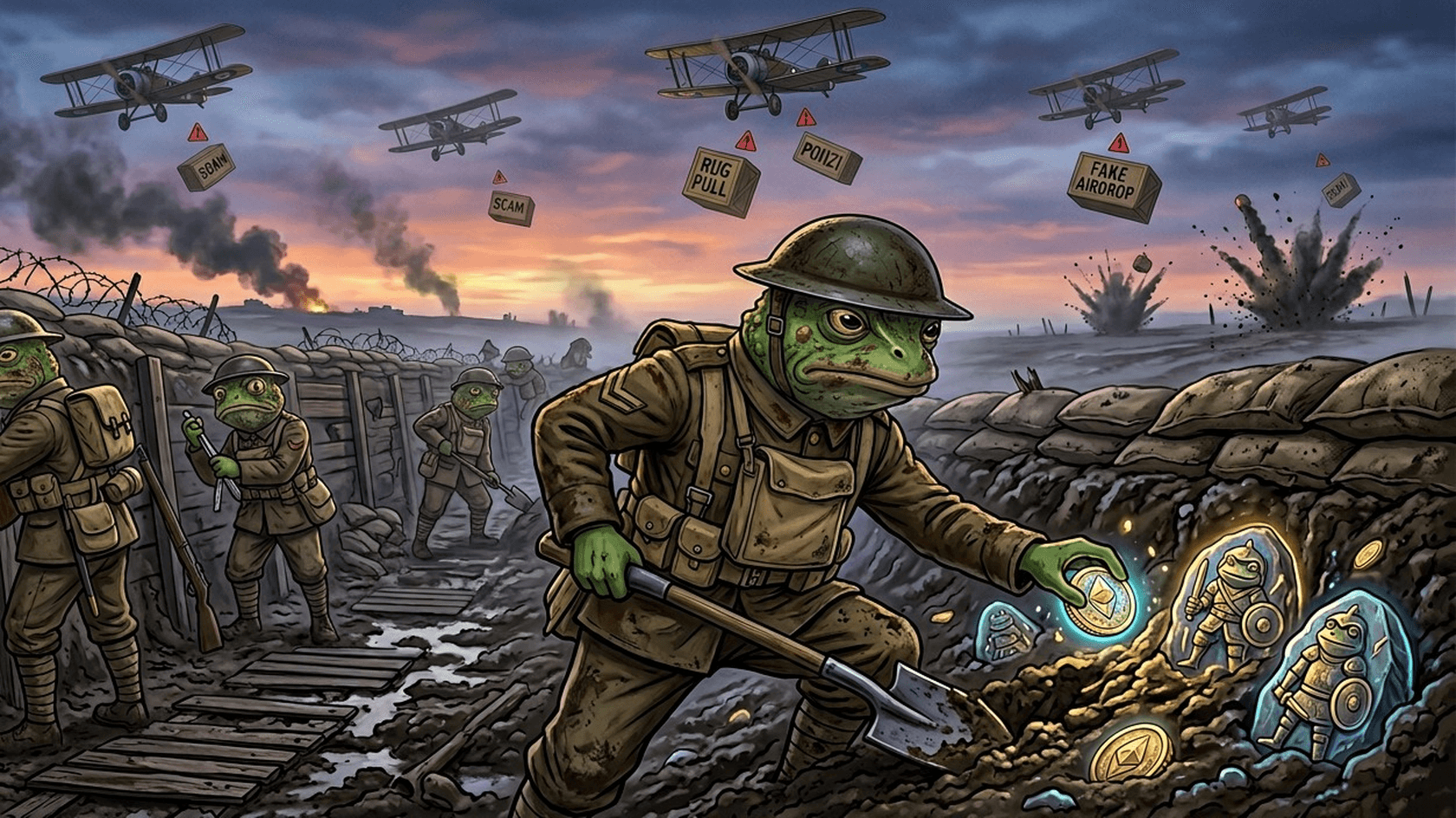
In the crypto world, the term “crypto trenches” refers to riskier corners of the crypto market, where prices move quickly, and traders are constantly chasing newly launched tokens and similar opportunities. Their goal is to find a way to turn a small amount of money into massive gains.
This approach is based on speed and timing, as well as on constantly paying attention for any new arrival to the market that might look like it has the potential to soar quickly. Reacting to such opportunities by buying early and selling as it reaches its peak is the basic crypto trenches meaning, and often enough, mere minutes can make the difference between massive returns and suffering losses.
The trenches are also closely tied to the 2026 “degen” meta, where speculation has become a round-the-clock activity. For traders, that means keeping an eye on crypto launchpads, meme coin platforms, and even any on-chain activity throughout the night.
The Fast Coin Economy and Tokenized Attention
Source: Pixabay
Known as the fast coin industry, this sector of the crypto market is based on the attention moving faster than fundamentals. Simply put, anyone can launch a token in minutes, and those who do typically do it without KYC checks, insider allocations, or gatekeeping through private sales. Instead, the token lifecycles are almost entirely permissionless, which enables the launch-first structure, which is partially what makes it all so appealing to early investors.
They don’t wait for the whitepaper or funding rounds, product roadmaps, or anything of the sort. Instead, they monitor the market’s reaction in real time, and decide their course of action based on what they see.
In a way, this normalized a new type of culture where tokens come before the product itself, and in a lot of cases, the coin is the narrative engine. Any future utility that may come will be built only after the project becomes popular enough to make it worth working on it. In other words, the market funds the idea before the idea was even established, simply basing what is popular on the vibe of the project in its bare-bones form.
There is a massive user base that is driving this approach, using platforms like Pump.fun, which sit at the center of this ecosystem. They attract massive traffic and fast launches, seeing millions of users. Pump.fun, specifically, is one of the biggest drivers of token creation in Solana’s ecosystem, with more than 13 million tokens going live since the platform was created.
What keeps it all running is tokenized attention, where memes, AI narratives, celebrity references, internet culture, and alike can be converted into tradable assets almost momentarily. Take projects like $ai16z as an example - it shows how some launches can evolve from being pure meme speculation into entering broader ecosystem narratives, combining speculative momentum with humor and tech themes.
How Traders Navigate the Trenches
While trading in crypto trenches is fast-paced, that doesn’t mean that traders primarily rely on intuition. The most important aspect is execution speed. Specifically, most traders rely on multiple tools that were made to help them spot new launches as early as possible, and to let them get orders through before the rest of the market catches on and joins the trend.
They will use token indexing APIs and launch trackers, which monitor new launches, as well as creations of new liquidity pools and unusual wallet activity on popular development chains like Ethereum and Solana. With these tools, traders can quickly spot any volume spikes or a rising number of holders for a new token, and join the project by buying its tokens early. This increases the early buy pressure, effectively inviting others who are monitoring the same things, and causing the chain reaction that pumps the token.
That way, traders can separate a potentially explosive launch from hundreds of useless clones that get minted every hour, trying to snatch some of the original project’s activity and popularity.
Then, execution moves to RPC endpoints, which are essentially gateways used to send transactions to the blockchain. If these gateways are slow due to lag, traders can miss early entries or end up buying after prices have already spiked, which is why speed matters more than anything in this type of trading. Faster private or premium RPC services are more popular among traders as public endpoints tend to lag when there is heavy traffic. Since this is a market built on reaction speed, every second counts, so lag can be seriously damaging for traders. In other words, it pays off to invest into proper tools.
Beyond that, more advanced traders might also use searcher and bundler services, which package transactions to improve priority and reduce the chance of being front-run. In addition, mempool relays help traders monitor pending transactions before they are confirmed on-chain, which is useful for seeing incoming buys, wallet movements, and alike.
Why the Traditional Meme Trenches are Losing Momentum
Source: Pixabay
The traditional meme trenches are thinning, and the common belief is that this is happening because the degen culture is maturing. As a result, the classic trench mindset, with its endless overnight punts on zero-sum meme coins, is starting to lose its grip since traders are evolving and becoming more selective with what they spend their money on.
Many are learning from their mistakes, and after enough rug pulls and failed launches, traders are slowing down and practicing the patient approach, rather than jumping blindly from one meme coin to the next and hoping for the best.
This shift is also quite visible when it comes to the numbers, as Blockworks data shows that Solana meme coin trading volume has gone down 38% month-over-month, hitting $19 billion. While this is still a massive figure, it does seem to be on the decline, suggesting that the market is slowing down.
These days, the capital is moving more and more toward structured strategies, with traders looking at systems with clearer risk frameworks. They are now interested in market-neutral setups, yield loops, and Bitcoin DeFi opportunities. For example, Bitcoin-backed lending or delta-neutral strategies that generate yield through funding rate differences instead of focusing on price speculation.
In other words, even though the trenches seem like they are losing momentum, the truth is that they are not disappearing - they are just evolving and going from pure meme velocity toward strategies that are based on yield and risk management.
The “New” Trenches: Prediction Markets and Narrative Trading
Even though the old trenches are slowing down, the new crypto trenches are emerging elsewhere. Namely, the most popular right now are prediction markets and narrative trading. This is because speculative trading is moving away from memecoins into event-driven contracts, with platforms like Kalshi and Polymarket seeing massive growth right now.
The two platforms’ combined volume has already reached $4.28 billion, and it is turning elections, pop-culture outcomes, and other major events into tradable markets.
The main reason why these markets are starting to get attractive is the new structure of the payoff. With meme coins, price action often gets influenced by things like rug pulls, liquidity removals, insider wallets, and the like. Meanwhile, prediction markets use a different system with binary outcomes and much cleaner catalysts. Specifically, a contract typically resolves to yes or no, settling at $1 or $0. This is simple, and it attracts traders who are after a more defined risk-reward profile.
Things like election odds, celebrity events, economic data releases, cultural moments, and similar events all provide catalysts that are easier to analyze than the noise surrounding meme coins, which is why traders are increasingly drawn to them. Speculating about such events feels less random, and it is definitely less exposed to scams. For the trader, the question is no longer if the coin issuer will dump on them, but what will happen to the real-world event that the bet is based on.
How do prediction markets compare to memecoins in 2026?
In 2026, prediction markets and meme coins both serve a similar speculative group of traders. However, the structure is different, as prediction markets offer binary and event-driven payoffs that have clear catalysts, while meme coins are open-ended bets driven by narrative momentum and are based on community hype.
How Blockchain Ecosystems Profit From Trench Activity
Source: Pixabay
Even though the trends surrounding the trench activity are changing, the blockchain still profits as trench trading adds spikes in transaction volume and fee generation, acting as a liquidity engine for both L1 and L2 chains.
Fast coin launches lead to an increase in crypto wallet activity, meaning more transactions are taking place, and decentralized exchange volume soars. All of these things directly boost demand for block space on chains like Ethereum and Solana, as well as their scaling layers.
This activity results in a positive economic flywheel, meaning that more launches and speculative trading directly lead to more transactions that are competing to be executed. This generates higher maximal extractable value (MEV) opportunities for builders, validators, and searchers, and a considerable share of validator income comes from MEV-related payments.
The profits made this way are recycled into the network through validator revenue and staking rewards. In fact, higher transaction activity can even directly cause staking yields for the chain’s native coins to go up.
Conclusion
Crypto trenches are not dying out - they have simply evolved and changed shape somewhat. They may have started as a culture of sleepless meme coin sniping, but now, they are turning into a larger and broader ecosystem, preferring structured speculation and narrative trading in event-driven markets instead.
Traders themselves are changing, taught by their experiences thus far, which have made them more selective. They are leaving the risky opportunities of endless zero-sum punts and are seeking different markets - those with clearer risk frameworks and cleaner catalysts.
The underlying mechanics have not changed much, and the most important factors are still speed, liquidity, and attention. However, in modern trenches of 2026, meme coins are no longer the hottest sector - prediction markets, Bitcoin DeFi, and ecosystem economics are.