When a customer contacts a company today, their first conversation may not be with a real person. A lot of companies now employ AI customer support systems that can greet customers instantly and identify their problem, paving the way for the big human vs. AI support debate. Depending on the nature of the problem, the AI can suggest a fix or pass it on to a human agent if the issue is more complex.
By the time an employee joins in, the system will have already gone through several steps that customer support agents used to do. AI-first support isn’t about faster replies or better answers. It changes who meets the customer first, and who decides when a person steps in. Sometimes, human judgment is necessary, and what makes an AI good is the ability to recognize when the human needs to step in.
AI-First vs. AI-Assisted: Who Meets the Customer First?
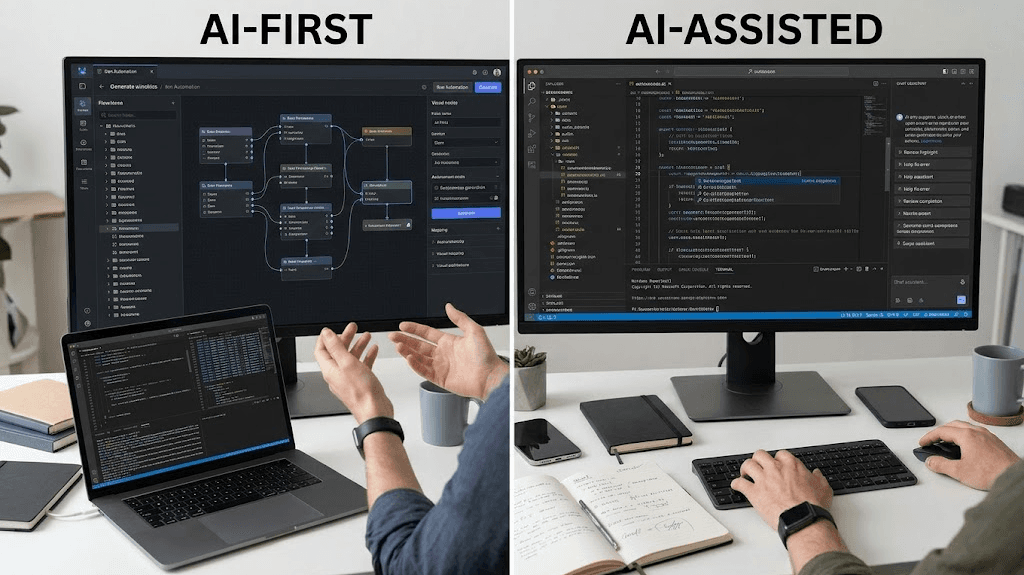
When it comes to customer support automation, it’s important to compare AI-first vs. AI-assisted approaches. AI-first support puts AI before the queue of customers in need of help. It handles first contact and replies to initial requests. In some cases, if it recognizes that a problem that the customer is facing goes beyond it capabilities, it can decide that it is best it receives human attention right away.
AI-assisted support is fundamentally different because it still keeps humans in the lead; it just allows them to use AI to suggest answers or find information. AI can also be used to summarize tickets, all of which can speed things up significantly while still employing human over machine judgment.
From Intent Detection to Resolution
The AI workflow tends to follow five steps: intent detection, triage, auto-resolution, escalation with context, and analysis. Basically, the system identifies what a customer wants and it prioritizes the issue. It will try to fix what it can. Any unresolved issues are passed along to a human operator, alongside the conversation history, so that the employee can learn the context of the problem. The final step is analysis, which helps teams spot common issues and improve AI responses moving forward.
Deflection Is Not the Same as Resolution
A customer who stops chatting with a bot hasn’t necessarily had the problem fixed. This is called deflection, and it often happens when a user realizes that they are speaking with a but, and the interaction did not get them to a human employee. Do not mistake the fact that they have left with resolution, which is when the issue actually gets fixed.
The distinction matters because vendors may claim that their customer support interactions are up to 80% automated. This might only describe how many interactions were handled by AI, not how many problems were fully solved to the customer’s satisfaction.
Gartner’s 2024 survey of 5,728 customers found that only 14% of customer service issues were fully resolved through automated service, which went up to 36% for issues that were described as very simple, confirming that just because AI can lead a conversation, it doesn’t mean it can solve every problem.
Why Support Teams Are Restructuring Around AI
Support teams need to be restructured around AI because AI is great at some things, but unable to handle others. For example, it is very useful for simpler tasks that demand speed and availability. It is perfect for things like answering routine questions or talking to users in multiple languages. It can also keep the responses consistent; it doesn’t tire of repeating itself, and a sudden surge in requests doesn’t faze it.
Capabilities like these make AI a valuable asset, even if it can’t solve every problem. The fact that it can handle simpler work and let a human operator deal with complex problems is a huge time saver. That is also why there is so much pressure to adopt it. Gartner reported in February 2026 that 91% of customer service leaders felt pressure to implement AI that year. The company also made a prediction that agentic AI will be able to resolve 80% of common service issues by 2029 all on its own. Whether this prediction ends up being true or not still remains to be seen.Measuring Outcomes Instead of Activity
AI changes what teams should measure . It would be easy to make the support operation seem extremely efficient if its success is being measured by the number of closed tickets or the average handling time. However, these are no longer reliable metrics, at least not when it comes to AI.
It would be more reliable to measure the resolution rate and the quality of escalations, or the cost of resolution and repeat contacts. It is also important for the bot to pass the customer to a human operator together with their conversation history; otherwise, the human operator has to start from scratch, which takes more time. Not to mention that it is always frustrating for the customer to have to repeat themselves.
The Real Cost of Automation
There is a common misconception that automation is cheaper than paying a human support, which is not the case. Gartner’s January 2026 report estimates that by 2030, the cost per resolution for GenAI will exceed $3, making it higher than many B2C offshore human agents. Gartner also identified three drivers of cost:
- Rising data-centre costs
- Vendors shifting to profitability
- More complex use cases that consume more tokens and need expensive talent
Separately, Gartner also predicted that by 2028, regulatory changes related to AI, including rules protecting customers' right to speak with a human agent, will increase assisted service volume by 30%.
Another Gartner prediction states that by 2027, half of companies that attributed headcount reduction to AI will start rehiring staff to perform similar functions under different job titles. An October 2025 survey of 321 customer service and support leaders has found that only 20% had actually reduced agent staffing because of AI.
Finally, Gartner’s March 2026 report has predicted that more than 50% of customer service organizations will double their technology spend by 2028 without an equivalent reduction in talent. As Gartner explained it, “talent needs are evolving, not disappearing,” which indicates that AI adoption will not eliminate the need for human staff, but the roles employees perform will have to change.
Where Humans Still Win
There are plenty of areas where humans still win over AI, and as such, cannot be completely replaced, even by the most enthusiastic pro-AI businesses. For example:
Money Lost or Fraud
The value of the human element in the human vs. AI support case quickly becomes evident when money disappears or fraud is suspected. In such situations, customers need someone who can commit to a next step. If someone reports an unauthorized bank transfer, a human agent is needed to assess urgency, explain what the next steps are, and take responsibility for getting the case to the right team. This is mainly because each case is different, and if AI finds itself in a situation it wasn’t trained for, it won’t be able to resolve it.
Hardship and Undocumented Situations
Then, there are situations where a customer and their problem do not fit into existing categories. Someone struggling to pay a bill after losing their job may need an atypical payment arrangement, or a customer whose account was wrongly suspended might have no way to describe their problem using the available menu. A human agent can ask follow-up questions and recognize when a situation needs a different approach.
Exceptions and Goodwill
Rules are useful, since they provide consistency. However, they cannot be used blindly in all situations. Doing so can turn a small problem into a big one, or result in a loss of customers.
For example, if a loyal customer misses a payment deadline because they did not receive documentation in time, an automated system would stick to the policy, while an employee can review the circumstances and approve an exception. This approach preserves trust and creates a loyal customer, rather than an angry one who will never use the company’s services again.
Regulated Conversations
Sometimes, interactions require careful explanations and well-documented decisions, or the use of highly specific safeguards. For illustration, imagine a customer wanting to dispute an insurance decision. They would need a clear and detailed explanation that would state their reasons, and an available appeal process. AI can be used to retrieve information and potentially prepare responses, but the business would still need someone to review the case and make a decision, or else it could deal with serious consequences.
A Correct Tone is Not the Same as Empathy
If a customer gets frustrated because of the difficulties in getting the system to recognize their problem, AI can spot it. It will even produce a sympathetic-sounding response, but that is just an automated response. Just because it is capable of matching the user’s tone, it doesn’t mean that it understands the consequences of their problem, or that it cares about it.
A human agent can take responsibility and make a different call. Sometimes, it is necessary to break the usual rules if the circumstances allow it to prevent injustice and the creation of a larger problem.
When Automation Gets It Wrong
The Commonwealth Bank of Australia’s experience is a good way to understand why a bot cannot be allowed to make staffing decisions relying solely on its own assumptions. In August 2025, the bank cut 45 call-centre roles after launching a voice bot, only to reverse the decision and apologize and call the redundancy assessment an “error.”
Finance Sector Union’s report said that the bank reversed the decision because its call volumes skyrocketed, and it even offered overtime. Even its team leaders ended up on the phones resolving issues. The bank itself announced the reversal of the decision, saying that initial assessments did not adequately consider all relevant business considerations and apologised. Contrary to the finance union’s claim about the rising call volumes, the bank claimed that the bot had cut calls by about 2,000 a week.
How to Build the Hybrid Model
The fact is that AI is here to stay, but it cannot operate alone, which is why a hybrid support model is the best middle solution. It needs to be reliable, and the first step in making it reliable is finding where AI needs to stop and a human operator should take over. Before they deploy the model, businesses should establish a checklist:
- Set confidence thresholds: Escalate if the system struggles to verify an answer or detects conflicting information
- Define categories that the bot should never handle: Fraud reports, major complaints, vulnerable customers, and sensitive regulated matters should immediately involve a human agent
- Context handover: Pass the conversation history so neither the agent nor the customer has to go through the same steps
- A visible route to a human: Give customers an easy and clear way to reach a human agent instead of trapping them in repetitive menus
- Human review of AI answers: Have human reviewers check accuracy and spot recurring mistakes. Update responses when policies or products change.
Prepare the Team for Different Work
If you are using AI to handle easy, routine work, your human agents will get a greater share of more complex cases. They will have to deal with unusual account issues and more complicated complaints, and it is not unusual for conversations to quickly escalate and become emotionally charged. Just because AI is handling a lot of easy work, it doesn’t mean that there will be less work for human agents.
It might also be good for teams to add new roles, like AI trainers who will improve the system, and conversation designers, who will work on monitoring and shaping interactions.
One downside of automation, however, is that Junior agents will lose easy tickets where they can learn to interact with customers before they progress to more complex ones. AI may reduce entry-level positions, with some claims saying that it now stands “19% below where it would be had it kept pace with that of their less-exposed peers.” This is why companies need to come up with a new way to train new employees.
Measure Whether Customers Actually Get Help
As mentioned previously, companies will need to start paying attention to different metrics to measure the efficiency of customer support. Ticket volume and handling time can still provide useful information, but they can’t establish whether the hybrid model is working.
Instead, track resolution rates to see if the problems are getting solved, and escalation rate to understand how often AI needs human help. Meanwhile, repeat contracts can tell you how often problems don’t get resolved when the customer reaches out for the first time.
Cost per resolution can also be a valuable metric, and it should include both the cost of AI tools and human interventions, not just the price of the initial automated interaction. Finally, measure customer satisfaction after escalation. If the handover was smooth, it is more likely that the users will be satisfied with the service.
Conclusion
If you decide to implement the AI-first approach, keep in mind that this means relocating human employees to different positions, not eliminating them. It is true that the AI-first customer support changes the way customer service teams work, but there have been many attempts to exclude humans from the equation, with very limited success.
Human judgment is important, especially for more complex issues. AI can answer routine questions and speed things up during busy periods, but in situations where customers face financial loss or unusual circumstances, a human agent remains essential. Put people where they add the most value, and design the handoff before switching on the automation.