Compliance, the word itself and its intent, comes off as something mellow and voluntary. Especially, digital compliance.
But just imagine…a world where every app and software suddenly turns non-compliant. Those big techs scoffing at GDPR, CPPA, and CPRA. It’d take seconds for hackers to steal/mimick/exploit digital data. The world would turn into a literal dark dystopian nightmare like those shown in shows like Black Mirror.
Privacy laws aren’t chains. They are the rails guarding your online footprint. And as a dev in 2026, if you wanna ship something for the masses using privacy-focused development tools, abiding by them is the safest and optimal bet that you can take.
Why Should Data Privacy Matter?
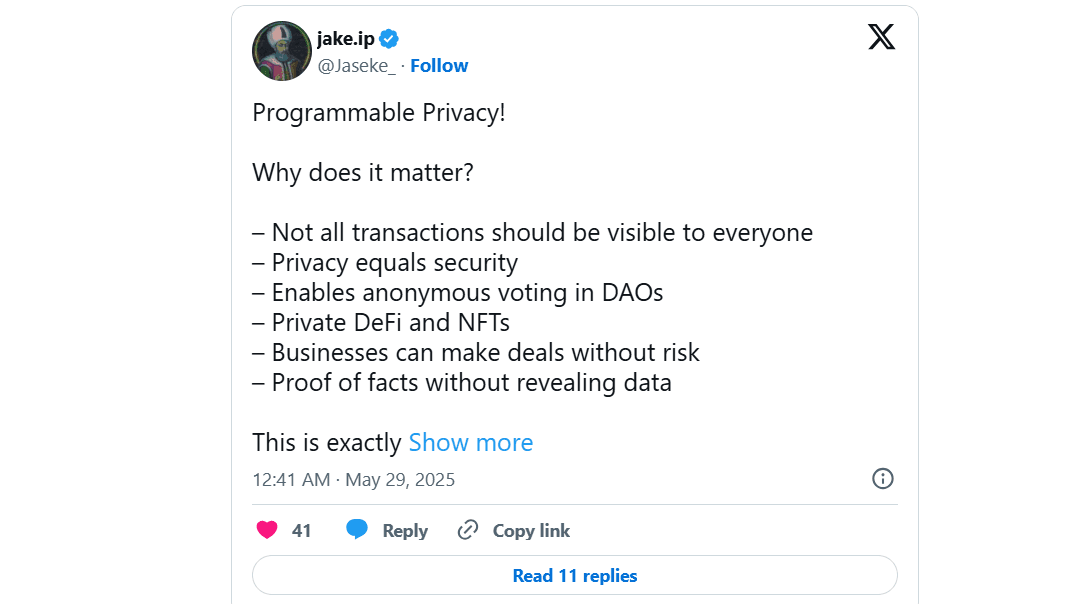
Source: @Jaseke_ on X
Privacy matters because it defines the long-term direction of anything that you build. And especially in DeFi, given how seriously governments and corporations try to find their way around it, it's more important than ever.
But the core ethos of privacy contradicts that of transparency. Anything that’s fully private can’t be transparent, or vice versa. Hence, maintaining a healthy balance is where the real debate lies.
And the funny thing is, in DeFi and blockchain, white-labelling runs the major money. Instead of spending time and tech, white-label solutions can be launched within weeks, costing 60-80% lesser than core private labels. Such calls for even more focus on personal data privacy.
The principle behind choosing the right privacy-focused development tools
Choosing the right privacy-focused development tools
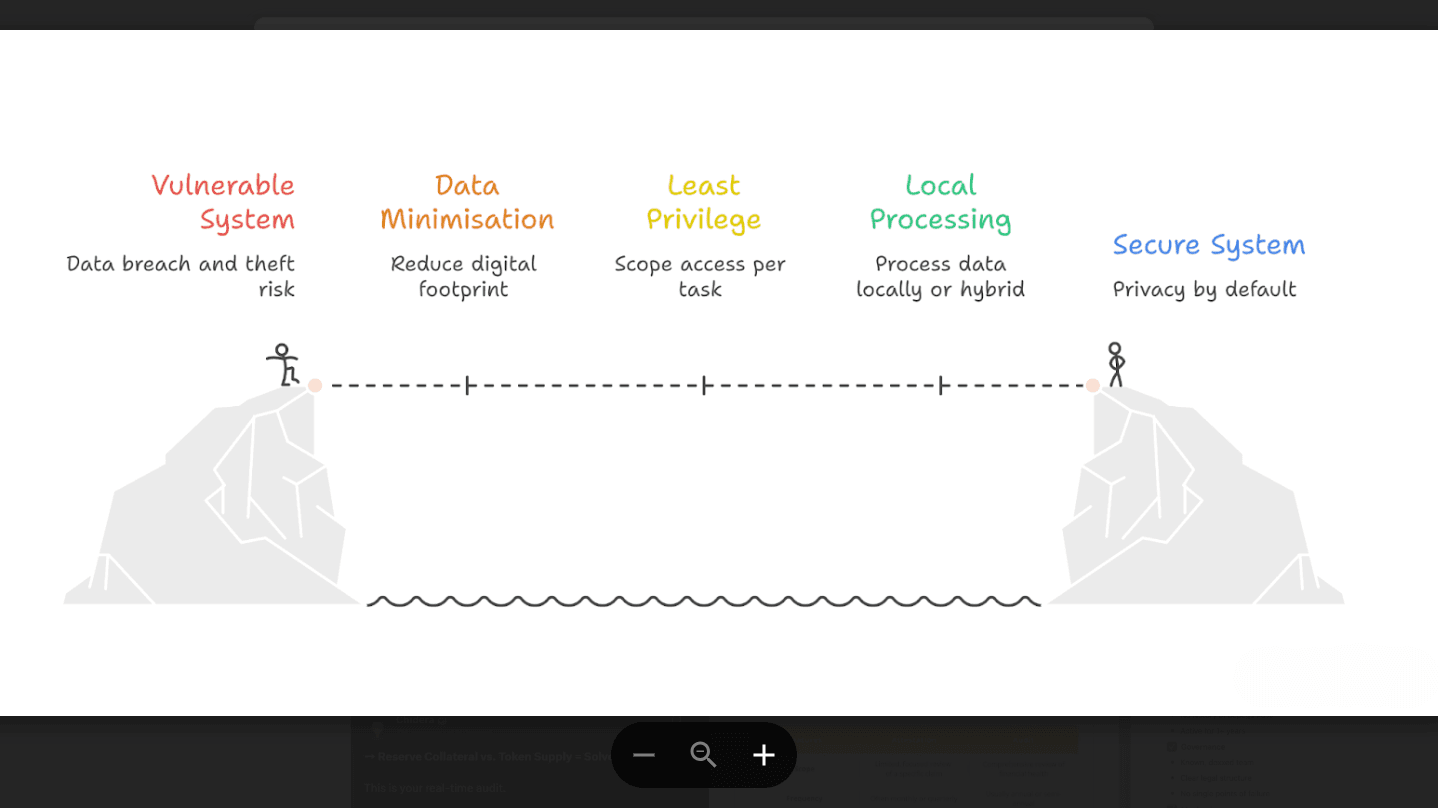
When building something from the POV of a privacy and security-first architecture, a diluted understanding of the core principles is a must.
Data minimisation equals attack surface reduction
The lesser the collected digital footprint, the better the security. It’s essentially a proactive course. Every extra entry in the data field increases the likelihood of a potential breach/theft. Plus, it adds to the hassle of log management and compliance.
If the aim instead is kept on data discovery > classification > timed retention…the focus shifts more to strengthening the actual product. And with AI, you can automate all this in seconds, but please pay heed to tools that ask for even more data to set up such automations.
Practising least privilege instead of boasting cloud-native IAM
Identity and Access Management (IAM) matters only so much in DeFi, cause often…it's some insider with malicious intent and access to user-linked data like emails, KYC footprints, device IDs and IP/wallet connect logs who steals.
Least privilege merely means scoping that access per specific task, time and/or dataset. For this, you need to assign separate permissions for analytics, engineering and support. Following JIT access and monitoring each and every log, redacting data, and keeping note of every read, export and view is what should be the norm for securing privacy.
Local vs. centralised data processing
Let’s say you’re an AI-savvy dev and you use it to pull all sensitive texts for processing. But most of the time, that happens in the core server by default. Instead, what you should aim for is to either process everything locally, self-hosted or practise hybrid processing with a cloud fallback. Edge computing setups are great, but only if telemetry and usage data are kept in strict check.
Privacy should be the “by default” setting, not something optional
Your ideal customer is very busy and forgetful. An optional toggle setting should not decide whether their data is secure or not. Plus, as a responsible dev, you need to sort this right before your release.
Redacted logs, monitored session replays, scoped data retention and permission required for reviewing code reviews are things that your privacy-focused development tools should offer by default instead of you having to search the wiki and how-to docs.
A typical tool selection checklist should hence tick:
It starts wherever data exists: disks, databases, backups everywhere. Even in transit data that moves via API calls over networks or during in-memory processing. Although at rest and in transit data is easier to encrypt, when it comes to data being used, encrypting gets trickier and calls for confidential processes and improved access control supervision.
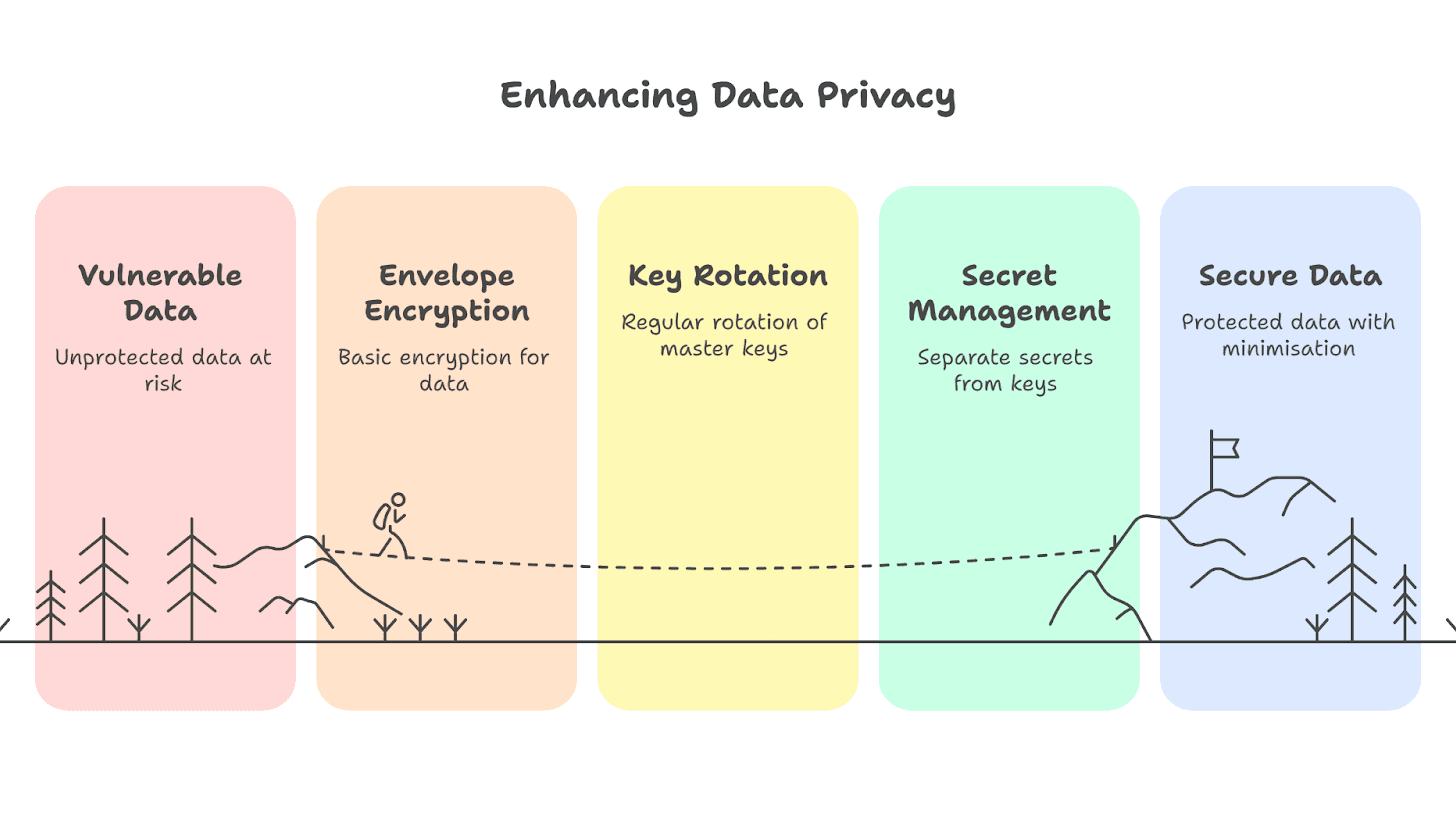
Envelope encryption is not enough
Storing off-chain data and sensitive info in KYC files, emails, and wallet connect session logs using “data keys” for faster read/write is elementary. A “master key” hidden somewhere in KMS might help guard the data further. But without timed key rotation such is of no practical use.
You needed to rotate the master key with small data keys for separate product, support and analytics environments while relocking those every time you rotate. It’s mandatory cause encryption policy and access rules are something that’s centralised. Also, re-encryption of the whole database is practically not feasible if you wanna build and deploy fast.
The benefits of this strat are lessened damage during data leaks and better compliance monitoring cause every decrypt action stays audited in the logs.
Tokens must be scoped to specific actions like balance/position fetches, account data exports, every 2FA action and likewise.
Mixing up all these usually results in data leak/theft, cause someone with overprivileged access can get their hands on them.
Encryption doesn’t solve privacy
Yes, it protects stored data, but that doesn’t still fit the case if your app/product overcollects it. Chain activity in crypto is usually free for the public. The moment when off-chain metadata connects a wallet to an identity, data can get copied to multiple systems. Massive collection of IPs, emails, device IDs and whatnots…however much you track and log, can get leaked through crash reports and analytics.
Your real lookout should hence always be minimisation, with a layer of encryption.
Tool examples by category and when to pick which:
Category
Problem
When
Check
Example tools
Data discovery and classification
Find PII
Many systems or KYC
Coverage, accuracy
Amazon Macie, Google Sensitive Data Protection (Cloud DLP), Microsoft Purview classification, and BigID discovery and classification
Privado privacy code scanning; Gitleaks secret scanning; TruffleHog secret discovery and verification; Nightfall developer platform for DLP-style scanning
AI and LLM privacy tooling
Stop prompt leaks
LLM features
Redaction, guardrails
Microsoft Presidio for PII detection and anonymisation; NVIDIA NeMo Guardrails; garak LLM vulnerability scanner (includes data leakage probing); Nightfall coverage for GenAI data exposure controls
Mapping compliance to tech controls (without hating them)
In DeFi, compliance translates to identifying a wallet owner via their off-chain data that can’t be erased. To maintain compliance:
Practise transparent engineering: Develop flows for user data access, correction, deletion, or restriction across all storage systems along with your core database.
Automate retention: Goes without saying, but by default set up expiry dates for docs and raw events so as to keep linkages with on-chain activity and the user partial.
Modern privacy-enhancing tech has come a long way ahead of what we had pre-Bybit or FTX. But as they say…precaution is always better than cure.
And rightfully so.
Rather than wasting time determining on a one-for-all tool to handle privacy, think of an efficient stack that can help you balance data discovery, collection, governance, and automation.
Isolate compute environments, practice differential privatisation, bet max on auditability and trail monitoring if your goal is to ship something that should last the regulatory waves. Consider open-source local setups and DevSecOps approaches for limited access spread. Last but not least, tie back to minimisation.