RWA 2026: From Bonds to Stocks — How Retail Users Can Trade Serious Assets From Telegram
The total value of tokenized real-world assets on public blockchains reached $31 billion as of July 2026. Six separate asset categories, including US Treasuries, private credit, gold, real estate , equities, and other commodities, each now exceed $1 billion on-chain.
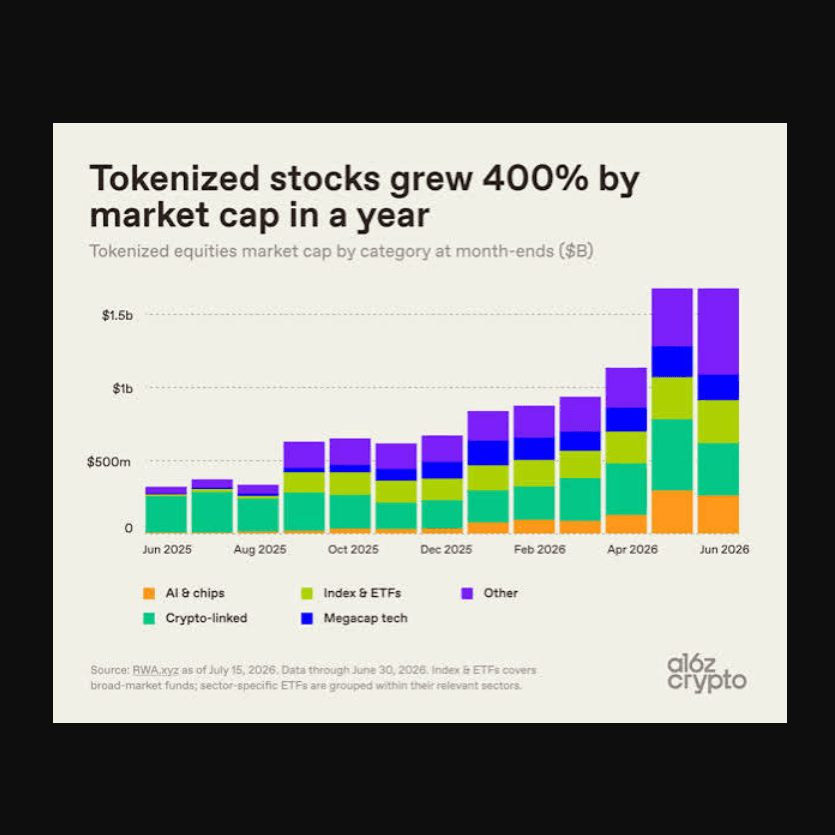
RWA tokenization trends 2026 tell a different story. Earlier stablecoins were behind the sector’s growth. But in 2026, tokenized stocks alone saw a jump of more than 400%. From a mere $20 million market cap and 1,800 users in 2024, tokenized stocks crossed the $1 billion mark with over 185,000 users by March 2026.
The total value of tokenized real-world assets on public blockchains has increased by more than 400% from the start of 2025
Most of the 400% jump has been due to xStocks becoming available to retail users via Telegram by the end of 2025. More than a billion people use the app daily. Since late 2025, a growing number of them can open a ‘Stocks and ETFs’ section inside their built-in wallet, select Tesla or Nvidia, enter an amount as small as $1, and confirm.
This article explains what is actually available inside Telegram, how it works under the hood, how to access it, and what the risks are that the partnership press releases leave out.
How do Tokenized xStocks Compare with Traditional Brokerages
What are xStocks and Who Issues Them?
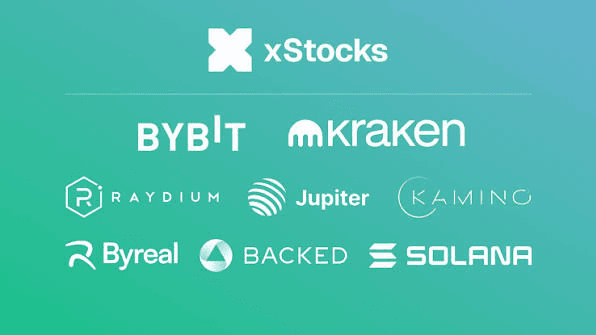
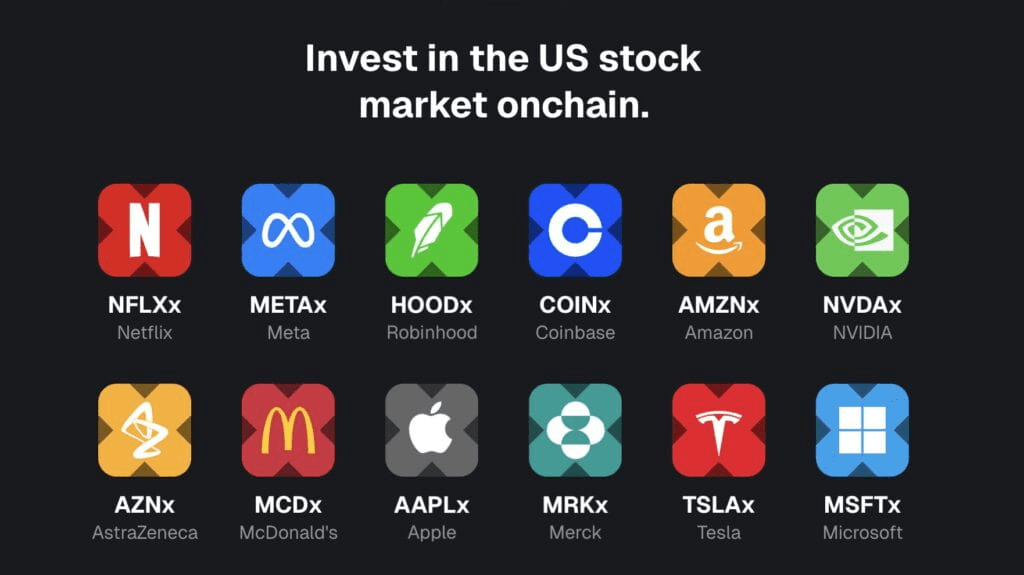
xStocks are price-linked tokens issued by third-party custodians like Backed Assets (JE) Limited. Each token is collateralised 1:1 by the corresponding underlying share, held in segregated custody accounts at Clearstream Banking and InCore Bank.
xStocks are tokenized representations of traditional stocks
Backed Assets Limited is an entity registered in Jersey and regulated by the Liechtenstein Financial Market Authority (FMA). Kraken acquired the Swiss company Backed Finance, which built the infrastructure backing them.
An xStockholder receives creditor rights to the collateral in the underlying company. They do not get any shareholder or voting rights, nor do they get any legal claim if the company is wound up. That’s because the token tracks the price and economic value of the share; it is not the share itself.
The Access Gap xStocks Fill
For many users, especially outside the U.S. or EU, this is the first time equities are one tap away: no broker account, no complex onboarding, fractional by default.
xStocks of entities such as Tesla, Nvidia, and the S&P 500 are readily available to users inside the Telegram app. They can access it through Telegram’s TON wallet and start trading with as low as 1 USD. As Dadybayo points out, tokenization has made the once inaccessible traditional stocks akin to ‘a native internet object.’
Varies widely; US brokers unavailable to most non-US users
Non-US persons in supported jurisdictions globally
Shareholder rights
Voting rights, direct legal ownership
None — creditor rights to collateral only
Custody model
DTCC (custodial)
Custodial Wallet in Telegram OR self-custodial TON Wallet
Available assets (2026)
10,000+ equities
60+ US equities and ETFs (TSLAx, NVDAx, AAPLx, SPYx, etc.)
Fees
0–0.4% (US brokers often zero-commission)
Commission-free through end of 2025; standard fees on withdrawals
How Tokenized Shares Handle Stock Splits and Dividend Reinvestment
The Multiplier Mechanism
If you are wondering how tokenized shares handle stock splits, you must know this bit is one of the most technically profound advantages of blockchain automation over traditional settlement methods.
You would have come across innumerable examples of tokenized real-world assets in 2026, and how each one ponders the impact of corporate events on tokenized stocks. But the answer is simple for xStocks–an on-chain variable called the Multiplier.
Each xStock represents the value of one share underlying it, and has a multiplier of 1.0. When a corporate event occurs, Backed Finance updates the Multiplier. This way, the effective economic exposure adjusts automatically. There’s no user action required, ever.
Here’s how the multiplier effect takes place on different chains:
On EVM chains like Ethereum, Arbitrum, etc., the token contract adjusts displayed balances automatically via rebasing.
On Solana, raw on-chain quantity stays constant. The Multiplier gets applied at display level via the Scaled UI extension.
The effective multiplier gets published on-chain before each corporate event and activates at midnight UTC on the payable date. Trading venues pause briefly around each activation timestamp to avoid any unexpected settlement behaviour.
How Dividend Reinvestment Works in Practice
FYI, dividends are never paid in cash. Instead, the custodian receives the dividend payment. The custodian then reinvests the payment into additional shares of the same stock and updates the Multiplier accordingly. The token quantity remains the same. But the user’s effective exposure to the underlying equity increases proportionally.
Note: The withholding tax deduction is non-negotiable here. A $1.00 gross dividend per share becomes a $0.70 net reinvestment per token after the 30% deduction. For users comparing the after-tax yield of xStocks against a traditional brokerage account with a tax treaty in their jurisdiction, the difference may be significant.
Stock Split: The 2:1 Example
The Multiplier increases proportionally when there’s a stock split. When a reverse split happens, the multiplier decreases. Total economic value remains preserved both ways.
Check this example:
There are 5 TSLAx tokens and the Multiplier is set at 1.0. Each token is valued at $10. The total value of the tokenized stocks is $50. Suppose Tesla announces a 2:1 forward split. The multiplier doubles from 1.0 to 2.0 at midnight UTC on the payable date. The balance in the user wallet is now 10 TSLAx, each token valued at $5. The total remains $50.
No tokens are created or burned.
The holder isn’t required to do anything.
A reverse split works identically in the opposite direction. The Multiplier halves, as does the displayed balance. Each token is worth twice as much, while the total economic value stays preserved.
How to Buy: KYC, Funding, and Executing an On-Chain Order
Here’s a quick step-by-step guide on how to buy xStocks on your Telegram app:
Step 1: Access the Stocks and ETFs Section
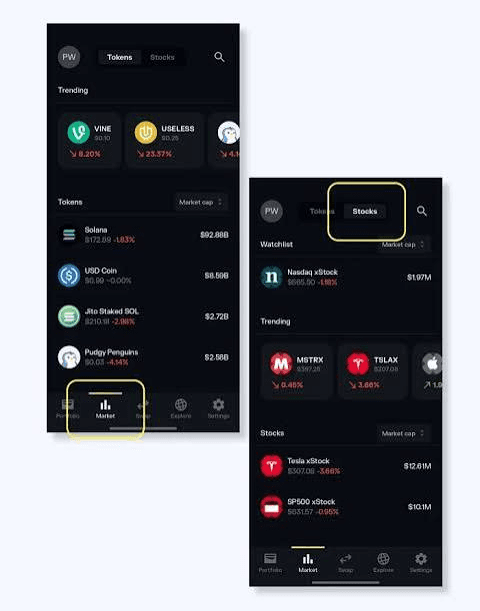
Open the Telegram app, tap the menu, and select Wallet. You can access xStocks via the custodial wallet operated by the Open Platform, or via the self-custodial TON Wallet. TON Wallet is accessible via the TON Space tab inside Telegram.
xStocks can be accessed under Markets in the Telegram App
Open Platform launched its dedicated Stocks and ETFs section in October 2025, initially with 35 tokenized assets. TON Wallet started with XStocks in December 2025, extending access to nearly 100 million existing TON Wallet users without requiring a custodial account.
Note: You can access xStocks on Telegram only if you reside outside the US. The Liechtenstein FMA prospectus under which they are issued explicitly excludes the United States and jurisdictions where such activity is prohibited.
Note again: Bitcoin ETFs aren’t included in the list of ETFs. But you can purchase Bitcoin as a crypto asset via Telegram.
Step 2: Complete KYC Verification
A. For a custodial wallet:
If you are using a custodial wallet, you need to comply with the KYC and AML requirements to access any regulated products. However, the requirements are lighter compared to a full brokerage account:
You must provide the following information:
Your full legal name.
Date of birth.
Country of residence.
You must also submit a government-issued ID document. MiCA regulations require KYC for all fiat on-ramps, including SEPA transfers, as of 2025. In other regions, including Brazil and Turkey, you must undergo full ID verification for P2P trades above $1,000 per month.
B. For Non-custodial TON Wallet:
It is permissionless for on-chain transfers. KYC is needed only for fiat on-ramps and direct issuance or redemption with the issuer.
If you want to directly redeem your xStocks with Backed and convert them into the underlying share or cash, you need a $5,000 minimum transaction and full KYC as a qualified investor. In practice, retail users exit via the secondary market. There is no issuer-set minimum in secondary markets.
Step 3: Fund the Wallet
There are three ways you can fund your wallet:
P2P market: Buy USDT or TON directly from other users inside Telegram using local fiat currency. Telegram allows many payment methods, and there’s no platform minimum in most regions.
Bank card via MoonPay: Buy TON or USDT with a debit card through the integrated MoonPay partner. However, the integration is available in supported jurisdictions. iOS users can fund their wallet via Apple Pay.
Crypto transfer: You can also receive USDT via the TRC-20 or TON network, TON, or BTC into the wallet address from an external exchange. Note that TON-to-TON transfers carry zero fees.
Pro Tip: USDT is supported for funding the wallet but not accepted directly for xStocks purchases. Convert to USDC or USD within the Kraken interface before executing the trade.
Step 4: Execute the Order
Select the asset, enter the dollar amount, review the You Pay/You Receive confirmation screen showing exactly what is spent and what arrives, and confirm. Settlement is near-instant on TON. Transaction fees are under $0.01.
Source: Binance | The current list of xStocks spans across 60+ US equities and ETFs
The current asset list spans 60+ US equities and ETFs. The most actively traded since launch have been Tesla, Nvidia, Circle, and the S&P 500 ETF (SPYx). SPYx ranked third across the entire xStocks lineup by number of holders as of early March 2026, suggesting index-tracker demand is at least as strong as single-stock speculation.
Risk Assessment: De-Pegs, Liquidity, Issuer Backing, and Leveraged Positions
Risk 1: Off-Market Price De-Pegs
Since xStocks live on the blockchain, they trade 24/7. But the underlying equities trade 6.5 hours a day on the NYSE. The difference in timeline creates a structural pricing problem. During the US market hours, Backed's authorised market makers arbitrage the primary redemption channel against the secondary order book.
But when the primary market closes, that arbitrage mechanism disappears. Weekend earnings reactions, overnight macro events, and Asia-session moves all price through Telegram's order book against no underlying reference.
A few xStocks have experienced de-pegs of 3–5% before the underlying market reopens.
The cross-chain version of this problem also exists where the same xStock token on different blockchains can show 1–3% pricing differences due to oracle latency and fragmented secondary market liquidity across chains. Moving capital between chains to arbitrage this adds 2–5% friction of its own, which often makes the gap unprofitable to close.
Risk 2: Liquidity Gaps on the Secondary Market
The xStocks secondary market is spread across Solana, Ethereum, and TON. Together, these blockchains hold $180 million+ in assets across approximately 50,000 wallets. This AUM is enough to sustain reasonable liquidity for small trades. However, it is only a fraction of the underlying equity's daily trading volume. Larger positions encounter liquidity gaps which secondary markets cannot solve.
Direct redemption is possible only through Backed Limited, and the transaction has to be above $5,000. Retail exits happen entirely on the secondary market. In illiquid conditions, such as thin order books, off-hours, and high volatility, the bid-ask spread widens significantly. Subsequently, the exit price may diverge substantially from the mark price.
Risk 3: Counterparty and Custodian Concentration
The concentration risk has increased since Kraken agreed to acquire Backed Finance in December 2025. Unifying issuance, trading, and settlement under a single entity reduces coordination counterparty risk between parties.
However, it creates a single point of failure if Kraken itself encounters regulatory or financial difficulty. Users who were comfortable with Backed as an independent issuer face a structurally different counterparty profile post-acquisition.
Risk 4: Perpetual Futures and Isolated Margin Liquidation
Kraken offers xStocks-linked perpetual contracts, and this product type may extend integrations to Telegram wallet over time. For anyone considering leveraged exposure to tokenized equities, four mechanics require clear understanding:
Isolated margin: Each position draws only on the margin allocated to it, and losses are capped at that allocation. The rest of the wallet stays protected. This is the safest leverage configuration available but still carries full liquidation risk on the allocated position.
Mark price vs entry price: liquidation is triggered by the mark price and is derived from an external price index. During volatile or illiquid periods, mark price and last traded price diverge. Liquidations can be triggered at levels that seem inconsistent with what the order book shows.
Automated deleveraging (ADL): when a losing position cannot be liquidated at a price that protects the platform's insurance fund, the system forcibly reduces it against profitable counterparty positions. ADL is involuntary and can occur without warning.
Weekend gap risk: since xStocks trade 24/7 but the underlying market closes on Friday, a significant macro event over the weekend can produce a large gap move at Monday open, after which a leveraged position may be liquidated before the user can intervene.
Tokenization as Invisible Financial Infrastructure
Chainalysis' recent report “The New Rails: How Digital Assets Are Reshaping the Foundations of Finance” states that “𝘳𝘦𝘵𝘢𝘪𝘭-𝘭𝘦𝘢𝘯𝘪𝘯𝘨 𝘤𝘢𝘵𝘦𝘨𝘰𝘳𝘪𝘦𝘴 𝘭𝘪𝘬𝘦 𝘤𝘰𝘮𝘮𝘰𝘥𝘪𝘵𝘪𝘦𝘴, 𝘴𝘵𝘰𝘤𝘬𝘴, 𝘢𝘯𝘥 𝘢𝘤𝘵𝘪𝘷𝘦𝘭𝘺-𝘮𝘢𝘯𝘢𝘨𝘦𝘥 𝘪𝘯𝘷𝘦𝘴𝘵𝘮𝘦𝘯𝘵 𝘧𝘶𝘯𝘥𝘴 𝘵𝘦𝘭𝘭 𝘢 𝘥𝘪𝘧𝘧𝘦𝘳𝘦𝘯𝘵 𝘴𝘵𝘰𝘳𝘺: 𝘵𝘩𝘦𝘳𝘦 𝘪𝘴 𝘮𝘶𝘤𝘩 𝘣𝘳𝘰𝘢𝘥𝘦𝘳 𝘱𝘢𝘳𝘵𝘪𝘤𝘪𝘱𝘢𝘵𝘪𝘰𝘯 𝘧𝘳𝘰𝘮 𝘭𝘦𝘨𝘢𝘤𝘺 𝘤𝘳𝘺𝘱𝘵𝘰-𝘯𝘢𝘵𝘪𝘷𝘦 𝘸𝘢𝘭𝘭𝘦𝘵𝘴 𝘵𝘩𝘢𝘵 𝘸𝘦𝘳𝘦 𝘢𝘤𝘵𝘪𝘷𝘦 𝘰𝘯-𝘤𝘩𝘢𝘪𝘯 𝘭𝘰𝘯𝘨 𝘣𝘦𝘧𝘰𝘳𝘦 𝘵𝘩𝘦𝘪𝘳 𝘧𝘪𝘳𝘴𝘵 𝘙𝘞𝘈 𝘵𝘳𝘢𝘯𝘴𝘢𝘤𝘵𝘪𝘰𝘯.”
Though tokenized stock trading volume might be a fraction of what legacy stocks witness, the transition is already underway. Besides xStocks, Coinbase has introduced 24/7 perpetual futures for major tech and bellwether equities. New York Stock Exchange has pursued regulatory approval for a private blockchain platform to enable 24/7 trading of tokenized securities and ETFs. Hyperliquid already offers S&P Dow Jones-licensed 24/7 perpetual futures to its non-US users.
xStocks carry all the good bits of a blockchain asset, but they come with an added advantage. The Telegram interface is intentionally simple, which makes trading them accessible and seamless.
The technology has become the plumbing, while the product itself is now access. The entire tech stack operates below an interface that asks only for a dollar amount and a confirm tap.
However, the risks are real and remain many. But they require more of your understanding than a complete skip of the product. The ‘once inaccessible’ stocks landing in your inbox are a tech feat, but they are also an opportunity for you to go beyond and diversify.