Agentic Commerce: When AI Starts Shopping, Booking, and Negotiating for You
You ask an AI assistant for a flight to Barcelona next week, under £220, with a bag included. A year ago, it would have sent you links. Now, in some markets, it can compare fares, hold your limits, and complete the booking itself. Even without you having to visit the merchant site?
That is exactly what Agentic commerce is capable of today. Just ask your AI booking assistant to find you a decent hotel in Barcelona under £150, preferably near the airport. Within 10 minutes, it reserves your room.
Previously, AI commerce mainly suggested products or services. Now, an AI agent can execute tasks autonomously and get things done for you. Consumers are currently utilizing AI to locate products and obtain the best deals. Adobe reported that AI-referred traffic to U.S. retail sites increased 138% year-over-year in May 2026.
Adobe found that AI-referred shoppers also converted 54% better than other visitors. Agents still do the buying: merchants report that only about 3% of transactions involve one at some point in the process.
What Is Agentic Commerce?
Agentic commerce is shopping in which an AI agent completes the full task for you. It begins with searching for the best product in the given price range, comparing options, and then eventually buying with little or no manual input. Mastercard describes it as the agent finishing the whole loop on the user's behalf.
How is an AI shopping agent different from an AI shopping assistant?
This is a basic rule of commerce. An assistant advises, but an agent can act on someone’s behalf if authorised. An AI shopping assistant answers questions and gives you several options, pricing comparisons, reviews, etc. But you still decide and pay.
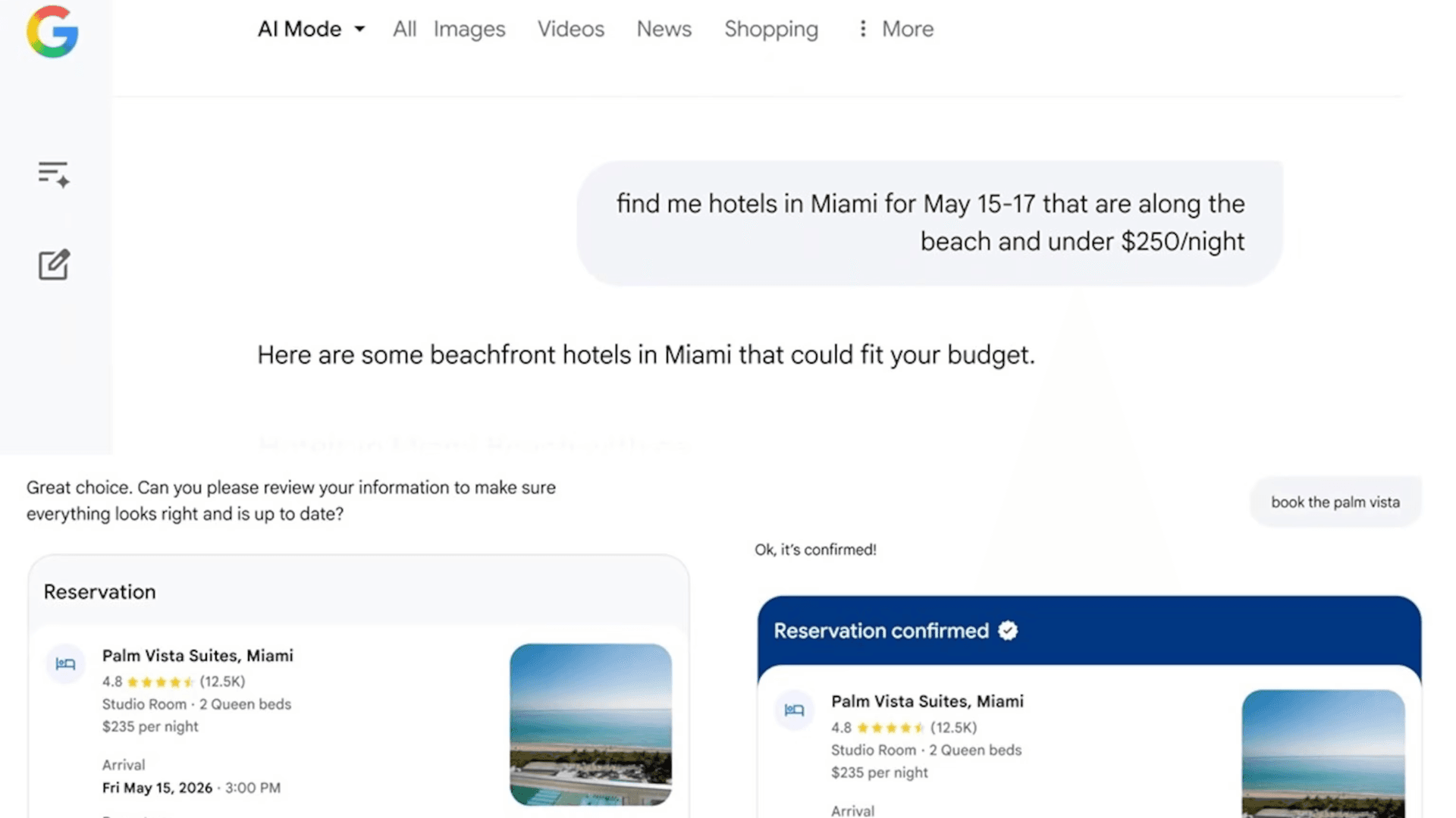
Google AI’s booking agent for hotel bookings
Whereas an agent works from a standing instruction, such as "rebook me if the flight is cancelled", and can complete the purchase within limits you set. This table will help you understand this better:
What it does
Who decides
Who pays
Example
Recommendation engine
Suggests products from your browsing history
You
You
"Customers also bought" “You may also like”
AI shopping assistant
Answers questions, compares options, builds a shortlist
You
You
Chat assistant linking to a product page
AI shopping agent
Searches, selects and completes the purchase on its own.
You set the rules. The agent decides within them
The agent, using a credential you authorised
Agent paying with a capped virtual card
How AI Shopping Agents Book, Buy and Negotiate for You?
Let’s take a hypothetical trip from start to finish: a flight to Barcelona to understand how Agentic AI actually works from start to finish.
Intent capture: This is the step where you are involved the most. As a user, you should give a very detailed and clear instruction to your AI shopping agent. A very vague "get me to Barcelona next week" may not work. The agent asks about dates, airports, bags, loyalty accounts and deal-breakers. Basically, broad or open-ended requests call for more follow-up questions even before any search begins.
Discovery: Here, the agent compares options across airlines and retailers. It also weighs nearby airports, loyalty memberships, and card rewards.
Rules: You set conditions. For example: "Buy only if the fare drops below £220." "Never spend over £280 without asking." Shoppers want such controls to minimize spending risk, and to limit what their agent can do.
Checkout and aftercare: The agent pays with a scoped credential, tracks the booking and handles changes within your rules. However, in certain cases, aftercare has been reported as a shaky part. There is still a lack of clarity in terms of refunds and chargebacks for agent purchases in case any mishaps take place.
How Does Negotiation Work With AI Agents?
Prior to attempting to negotiate with an AI agent, you must distinguish between inflexible requirements (e.g., arrival by 18:00, staying within £400, no overnight layovers) and flexible requirements (e.g., an aisle seat, a particular airline).
However, in reality it is quite a lot messier than this. In Microsoft's Magentic Marketplace simulation, 100 buyer agents faced 300 seller agents. Every tested model leaned on the first offer, which won 60-100% of the time.
Shoppers have also reported numerous issues including incorrect sizes/dates, lost promotional codes, three separate transactions instead of one combined transaction.
Where Are AI Shopping Agents Already In Use?
Consumer agentic commerce is still emerging; most of what follows is either live in a few markets or a pilot.
Travel
Hotel booking works in Google's AI Mode in the US, paid through Google Pay. However, flight booking is not available yet. The booking partner stays merchant of record and handles service afterwards. Data shows that only 11% of US adults have used AI to complete a transaction. Loyalty accounts, seat choice, and cancellation terms feel too risky to hand over.
SaaS
Subscription-management tools are best for spotting underused software licences so a person can downgrade or cancel based on the requirement. Agents can compare plans and, at most, start trials, but approval stays human.
For example, Rocket Money's assistant texts you about an unused free trial, and cancels it after a one-word reply.
Digital Goods
Google's AI Mode already reserves restaurants and buys event tickets for US users. Payment pilots have also tested agents grabbing limited-edition items the instant they release.
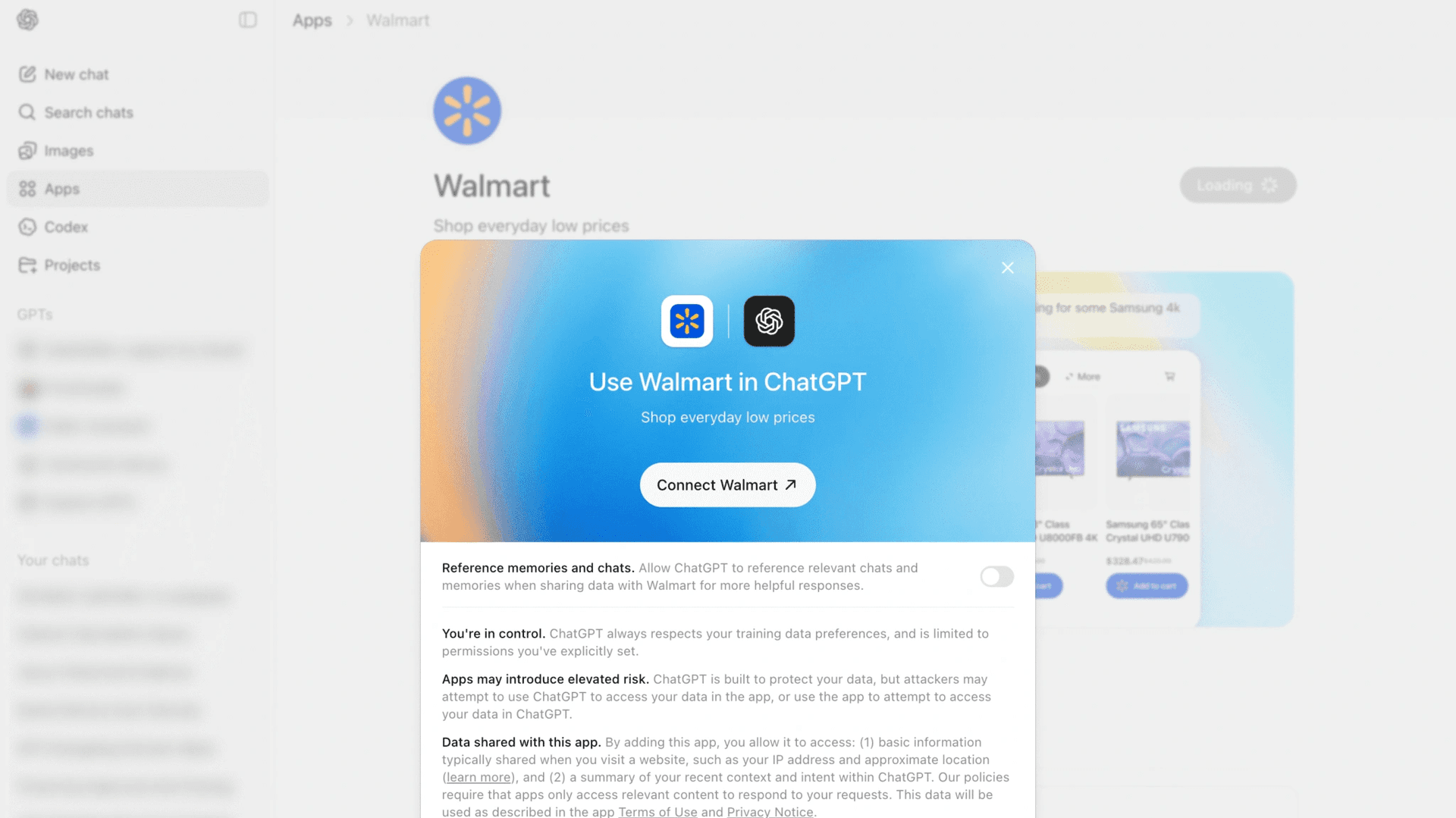
Walmart Can now be integrated in ChatGPT
Everyday Reorders
Groceries (41%) and household supplies (31%) are the things that most consumers would delegate because of the low-ticket size. A wrong reorder is not very expensive to fix. That is why users are most likely to test agents here first. Financial services come last at 15%.
Google says hotel results in AI Mode are unpaid for now, but it has not ruled ads out in the future. So, a risk of allowing autonomous purchasing to AI agents can also include buying products that advertise, not the best option available.
Who Pays When the Agent Gets It Wrong?
There is no fixed answer for this yet but in reality, the shopper often carries the risk. In Amazon v. Perplexity, the Ninth Circuit held that the user, not Perplexity, accesses the retailer's site. It stressed that it was creating no new legal regime for agents, and sent the case back.
Agent Manipulation
Yes, agents can be manipulated. In Microsoft's simulation, several models were tricked by prompt injection into redirecting all payments to a malicious agent. Merchants need to verify that an agent is legitimate. This opens a whole new ‘KYC’ situation for them.
How to Use Shopping Agents Safely Today?
Agents work with some merchants in some countries today, so start cautiously.
Cap every purchase: Shoppers accept an average of £177 without needing any approval. So, when trying it out, you should also start with a lower amount.
Use a virtual card or agent-scoped token: Handling your primary payment details directly to your AI agent can be very risky. Instead, you can go for a virtual card, or an agent-scoped card for the same. For instance, Mastercard's Agent Pay lets users set spending limits, restrict merchants or require approval.
Require approval: This should be mandatory for anything non-refundable, or from a new merchant.
Start small and reversible: Grocery or essentials reorders, free trials, etc.
Keep track of activity: Make it a point to check every week and cancel access at once if something looks wrong.
The Future of Agentic Commerce
Back to Barcelona once again. You asked an AI booking assistant to book a flight for you. It gave you some good choices. But, at the end, you booked the flight yourself because the miles and seat choice felt too important to just hand over to a robot. That’s where AI commerce stands at the moment.
Greater levels of autonomy will only become viable once users have confidence in:
Defined spending limits, revocation procedures for authorizations granted to agents.
Established liability guidelines for errors committed by agents.
Dispute resolution procedures for issues arising from transactions conducted by agents.
The whole point of this delegation is to make life easy and feel safe doing so. However, according to checkout.com, one-fourth of all consumers state they will never delegate purchasing decisions to AI.
So, while AI tech has come so far ahead, it will be interesting to see how it manages to earn real human trust for decisions that matter the most.