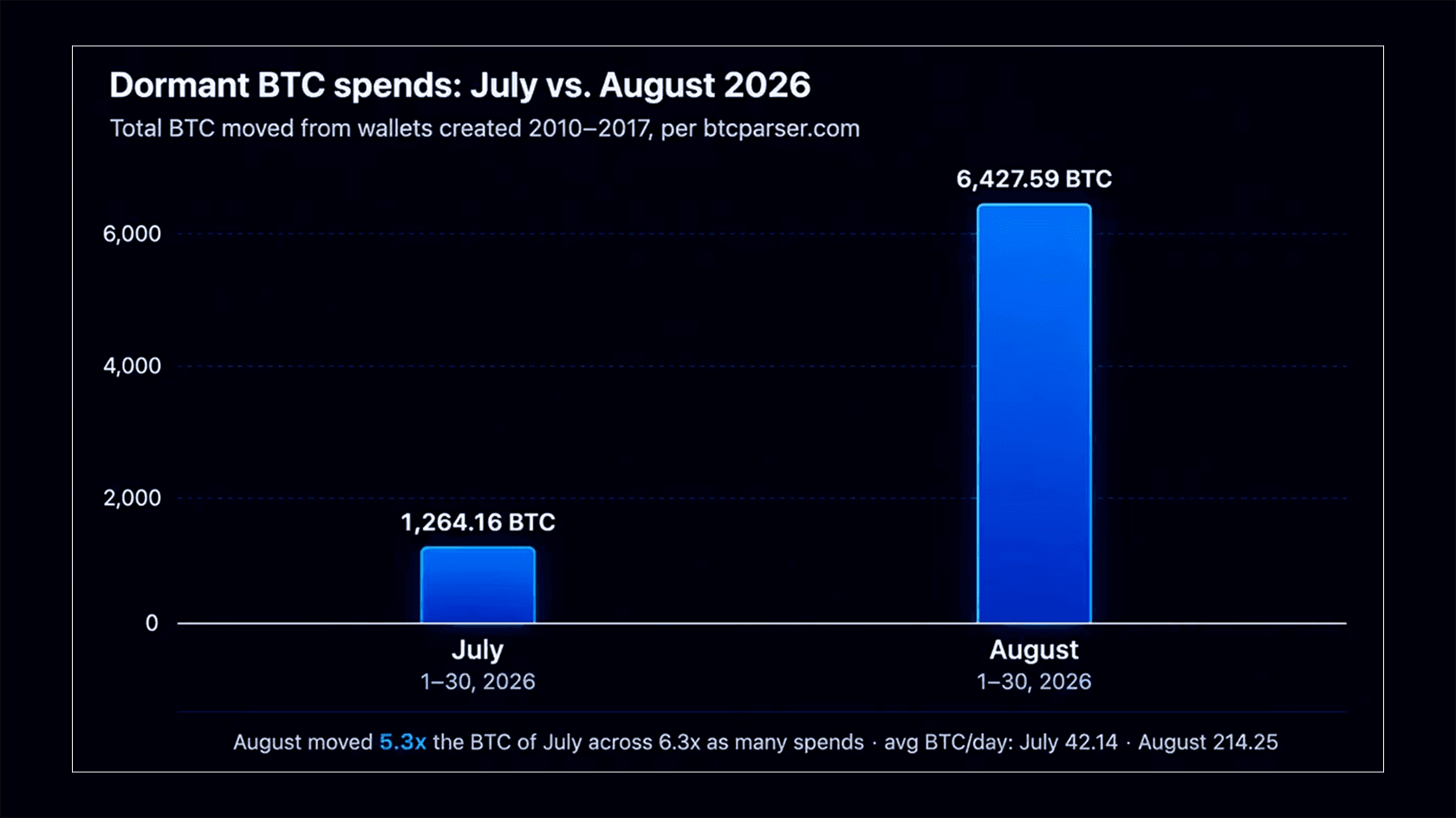
In August 2026, activity among old Bitcoin wallets increased noticeably. From August 1 to 30, owners of bitcoin that had not moved for years carried out 188 transactions totaling 6,427 BTC, according to Bitcoin.com, citing the on-chain analytics platform Btcparser.com.
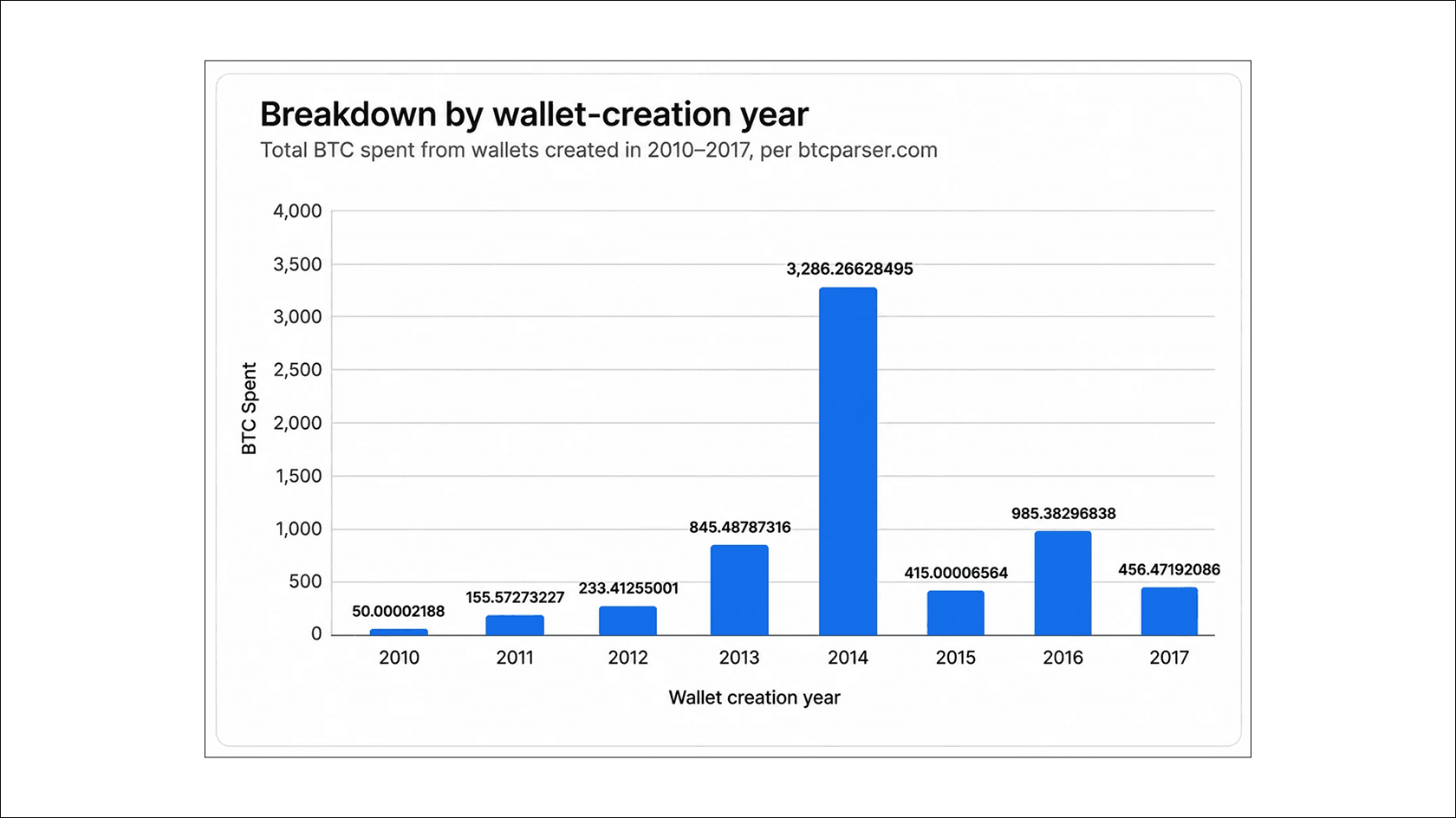
The largest volume came from addresses created in 2014: 3,286.26 BTC across 94 transactions. Two groups stand out.
The first group includes 64 addresses created between January 27 and February 4, 2014. A total of 1,672 BTC was moved from these addresses. Most of the activity took place over 11 separate days, from August 3 to 13, followed by several later transfers. The amounts ranged from 0.31 BTC to 33 BTC.
The second group includes 25 addresses created between November 30 and December 26, 2014. These addresses moved 1,514 BTC in almost equal batches of around 50 BTC each. Twenty-two of the 25 addresses were emptied on August 19 within roughly one hour.
According to Bitcoin.com, this level of synchronization makes it unlikely that different holders carried out the transactions independently.
“More likely, a single custodian or key holder carried out a batch operation using a script,” the analysts said.
The remaining roughly 100 BTC came from other 2014 transfers outside these two groups, bringing the total for 2014 addresses to 3,286.26 BTC.
Addresses created in 2016 ranked second, with 29 transactions totaling 985.38 BTC. Addresses from 2013 accounted for 16 transactions involving 845.48 BTC.
Addresses created in 2017 moved 456.47 BTC across 26 transactions, while those from 2015 moved around 415 BTC. Addresses from 2012 accounted for another 233.41 BTC.
Analysts also recorded eight transfers from addresses dating back to 2010 and 2011: two 2010 transactions involving 50 BTC and six 2011 transactions totaling 155.57 BTC.
August Activity Far Exceeded July Levels
In July, wallets created between 2010 and 2017 carried out 30 transactions and moved around 1,264 BTC. The average daily volume was about 41 BTC.
In August, that figure rose to roughly 214 BTC per day. The increase in activity followed the Coldcard firmware incident, which prompted reports of losses starting on July 30. The total losses eventually reached around 2,000 BTC.
During the same period, SafePal and Trezor reported customer data leaks involving names, email addresses, phone numbers, delivery addresses, and other information.
Analysts do not establish a direct link between these incidents and the movement of old bitcoins.
“The increase in activity may reflect long-term holders reconsidering how they store their funds, but the blockchain does not reveal the exact reasons behind the transactions,” the article says.
This post is for informational purposes only and does not constitute advertising or investment advice. Please do your own research before making any decisions.