• markets
  • security
  • news
  • 4 hours

DOJ Starts Payments for OneCoin Fraud Victims

Victims of Ruja Ignatova's scam can apply for compensation from a $40 million fund until the end of June.

0

nft.eu
  • rating +26
  • subscribers 113

U.S. authorities have launched the official process of returning funds to investors of one of the largest crypto Ponzi schemes in history. According to the U.S. Department of Justice (DOJ), over $40 million seized from OneCoin organizers has been allocated for compensation.

The remission procedure covers everyone who invested in the project between 2014 and 2019.

A Billion-Dollar Lie

Headquartered in Bulgaria, OneCoin was marketed as the "Bitcoin killer," but in reality, it operated as a multi-level marketing network. Founders Ruja Ignatova and Karl Sebastian Greenwood sold dreams of wealth to investors using aggressive marketing.

According to DoJ documents, no real cryptocurrency or blockchain ever existed, and total global damages exceeded $4 billion.

The compensation fund was established through criminal asset forfeiture. Jay Clayton, U.S. Attorney for the Southern District of New York, emphasized that while the $40 million collected is only a small fraction of the total losses, the office will continue to track and seize the assets of those involved.

How to Get Compensated

Victims can apply a petition for remission through a portal. The deadline is June 30.
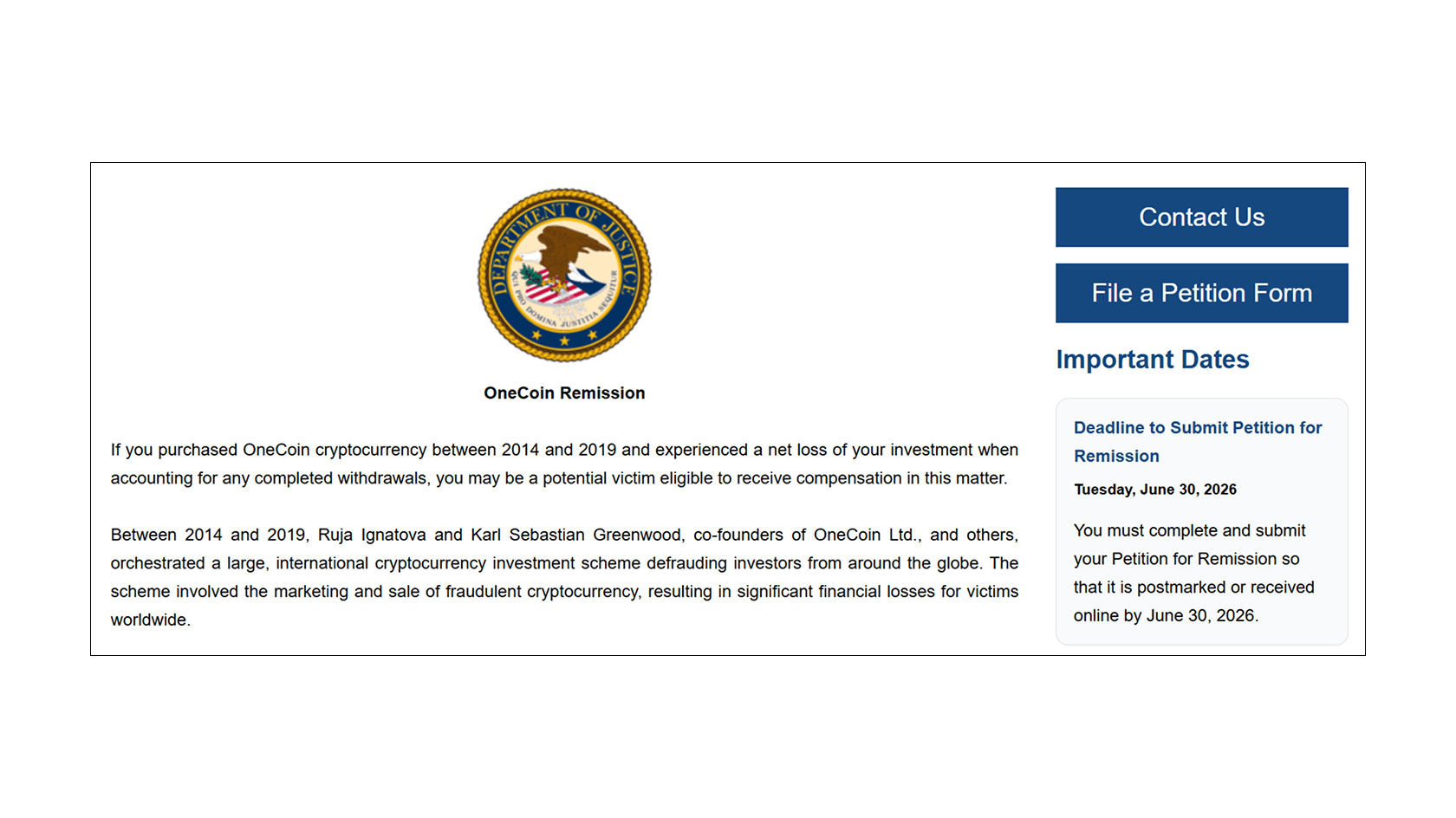
Refunding users affected by OneCoin. Source OneCoin Remission

The DOJ’s Money Laundering and Asset Recovery Section is overseeing the process, with Kroll Settlement Administration handling the tech administration.

At the same time, the FBI and the IRS-CI are still searching for Ruja Ignatova, who remains on the list of the ten most wanted fugitives.

Her partner, Karl Greenwood, has already been sentenced to prison, and New York courts have handed down sentences to several other key OneCoin figures.

Asset Recovery

Law enforcement acknowledges that recovering funds is a complex process, as money was funneled through a tangled web of shell companies worldwide. Nevertheless, since 2000, the DOJ has returned more than $12.5 billion to victims of various crimes through asset forfeiture programs.

In OneCoin's case, the agency urges anyone who believes they have been victimized not to delay in filing a claim and to review the eligibility requirements on the program's official website.

Also Read: Top Crypto Rugpulls And What Are The Signs To Look For To Avoid Investing In Rugpulls?

This post is for informational purposes only and does not constitute advertising or investment advice. Please do your own research before making any decisions.

0

Comments

0