Remember 2020’s March and May? It was when Solana and Polkadot launched, riding the ever-gimmicky hype tag of “Ethereum Killers,” promising to dethrone ETH from its long-standing legacy soon.
It’s been almost 6 years since then, and apparently, people are still waiting for Ethereum to get “killed”. In reality, though, ETH right now is stronger than ever, with settlements kept on L1 and execution tied to its L2s. Not only this, but even so-called rivals like Celo have migrated to ETH L2, giving up on their adamant dream of curating an independent L1.
In this read, we’ll explore why this false narrative is still making rounds in web3 publication houses, and what the actual future looks like for the faster vs cheaper debate.
What are Ethereum killers?
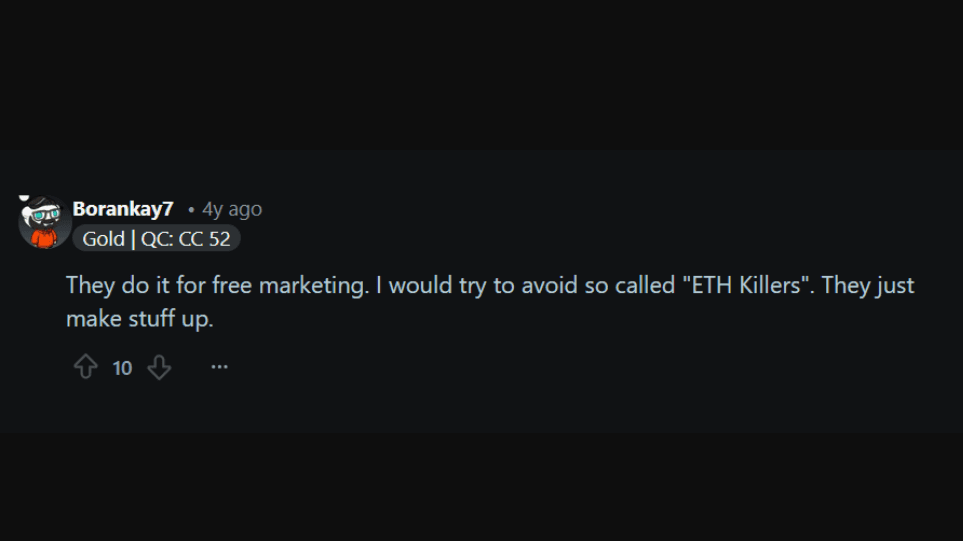
Source: Reddit
The term “Ethereum Killer” was dubbed while the mass market got frustrated with Ethereum’s ever-notorious high gas fees and scalability limitations.
Essentially, it's simply a marketing tactic (among many) for newer cryptos and chains to gain some hype. The claim is that these coins would soon outperform and “kill” Ethereum’s run.
Some of the OGs in this list of ethereum killers include SOL, ADA, and XRP. Newer entries are EOD, BSC, TRX, ICX…almost any other chain/coin that desires some of that limelight to push their word among the crowd.
Note: Some also feel this steers innovation in the space, claiming that the same was the case for Ethereum when it was dubbed to be the “BTC killer” when the focus used to be merely on market cap.
Ethereum’s structural advantage vs. its “killers”
Marketing doesn’t always run the show. Leaving the hype bubble aside, just consider ETH’s current reputation in the market.
Largest developer base? Check.
Own a complete DeFi ecosystem? Check.
Institutional trust? Check.
Not only this, in his latest tweet, Vitalik pointed out the current state of ETH and how close it is to solving the infamous blockchain trilemma, via zkEVM rollups, Fushka data sampling upgrade, and secured scaling tech.
He particularly mentioned how, via PeerDAS, L2 networks can send data “blobs” to L1. In plain language such simply means that now nodes store only small parts of the data while simultaneously checking their full existence to, over time, raise data capacity for the L2 to get cheaper and better.
The rollups can run proofs to confirm if an entire batch is correct or not, instead of re-running every transaction.
The benefit? Added privacy and potential cost-effectiveness for the L1 data.
Likewise, since the birth of the chain, the architecture has constantly been evolving to meet the demand surge, maintaining a sweet momentum that’s tougher than a nut to crack/sustain.
Key reasons why liquidity and users still keep hoarding Ethereum
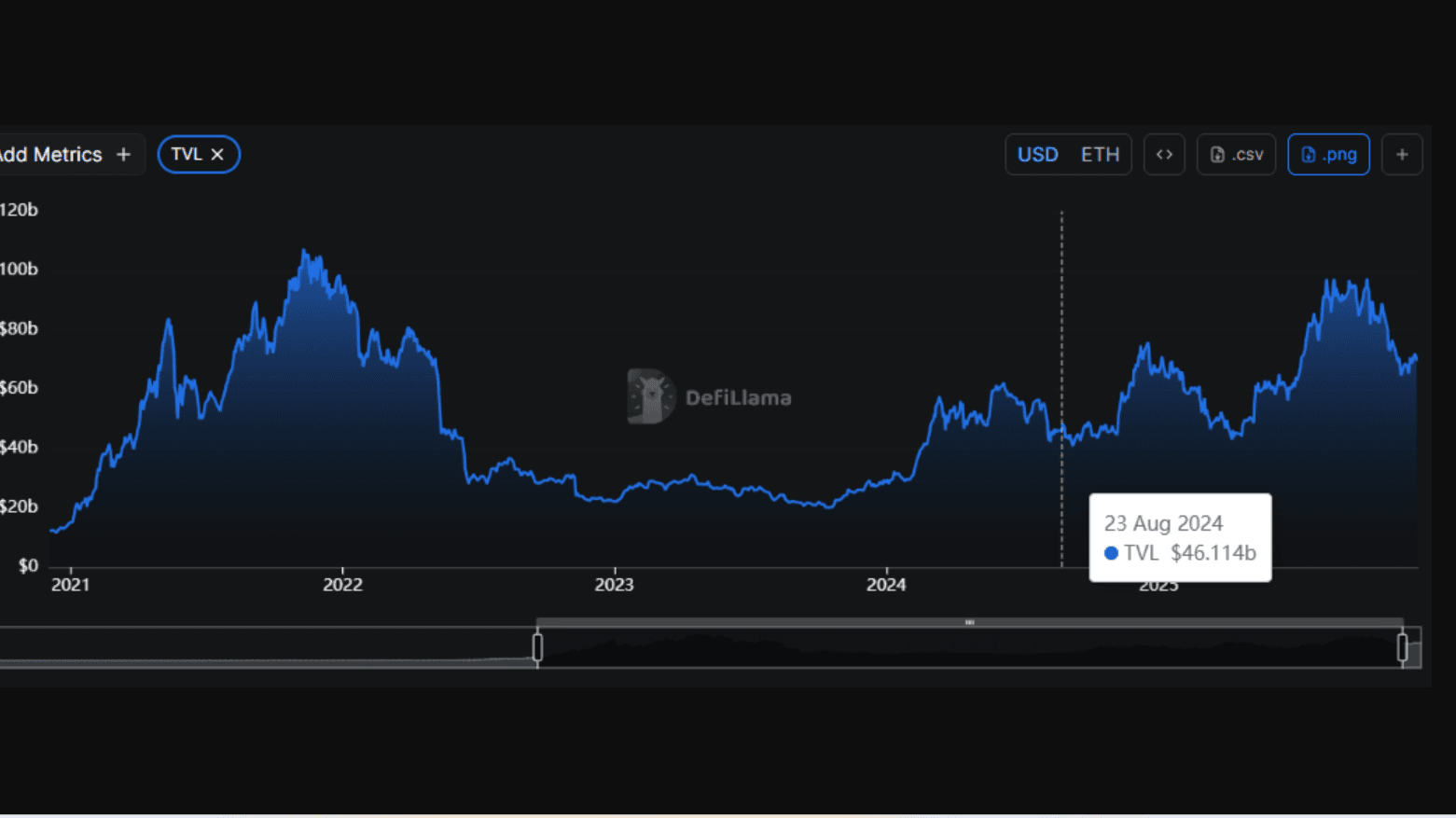
Source: DeFiLama
The following reasons are why ETH is still the most institutionally favoured blockchain, something which the top Ethereum killers have apparently failed to achieve.
Biggest ecosystem till date: Real DeFi capital and activity still belong to ETH. Example-wise, around mid 2024, the total TVL held by the chain was around $46.04B. In terms of support, right now nearly 4500+ dApps run on the network, a momentum that took years, and was literally built from zero.
Biggest ecosystem till date: Real DeFi capital and activity still belong to ETH. Example-wise, around mid 2024, the total TVL held by the chain was around $46.04B. In terms of support, right now nearly 4500+ dApps run on the network, a momentum that took years, and was literally built from zero.
The “trust” of the safest chain: If you were a new customer looking to transfer money on-chain, whom would you trust the most? Obviously, the most used, safest, and interconnected network that gets recommended by word-of-mouth. That’s what Ethereum still is.
Demand calls for supply, and the suppliers:ETH’s active dev base right now is the largest compared to any other blockchain that exists. And it’s cause the majority of the users are aligned to the chain. Thousands of dApps, audits, tooling integrations, and whatnot are getting built every day. Also, it doesn’t make sense to restart building elsewhere when the majority stack exists on the same platform.
Improved scaling in the same ecosystem: Everyone at the end of the day prefers whatever’s cheap. Ethereum came with its L2s, a practical boon for its community, making transactions even cheaper, removing even the tiniest scope of migration to other chains.
zkEVMs nullified the “killer” hype: Who wouldn’t love the combo of higher throughput, lower fees, and a trusted chain such as ETH as its base layer? Once daily activities on the L2s started increasing, what was potentially called its weakness got a boost via the rollups, limiting the urgency to look for other options.
A mini-snapshot of how Ethereum compares to its challengers:
Platform
DeFi TVL (2024)
Monthly Devs (2024)
Approach
Ethereum
~$46.04 billion
~8,865
Base L1 + Layer 2 rollups
Solana
~$4.698 billion
~2,500 to 3,000
High throughput L1
Polkadot
~$0.46 billion
~2,400
Multi-chain L1 (parachains)
Avalanche
~$0.912 billion
~1,706
EVM compatible L1 + subnets
Cardano
~$0.119 billion
~635
Research-driven L1
Institutional backing: Ethereum's biggest trust signal
In crypto, Ethereum has always been the “safe default”, which, although some perceive as boring, is essentially an indicator of the chain's stability. And when the “trust” comes from the largest players, the common crowd is bound to follow:
Proof #1: Spot Ether ETFs got approved in the US.
In May 2024, US regulators said yes to the asked rule changes for spot Ether ETFs, which led to normal funds trading from the next month. This signals how the market, even the top decision makers, feel about the chain. Keeps things less fringe and within the safety net of governmental regulation.
Proof #2: BlackRock’s association with Ethereum
BUIDL, BlackRock’s first tokenised fund, was launched on Ethereum two years back in March, shocking the entire crypto space. This move established Ethereum as one of the most trusted and secure chains worldwide, cause why else would one of the largest asset managers choose a public chain for its fund release.
Proof #3: J.P. Morgan Asset Management trusted Ethereum
They announced MONY, a public tokenised fund, publicly. This strengthened people’s faith in the chain, who previously were feeling a bit dicey due to the “killer” gimmick that was prevailing. J.P. Morgan's initiative led the path to many other fintech initiatives collaborating with the Ethereum blockchain, placing it at the forefront of global money bases.
Ethereum “killers” still exist, just not as “killers”
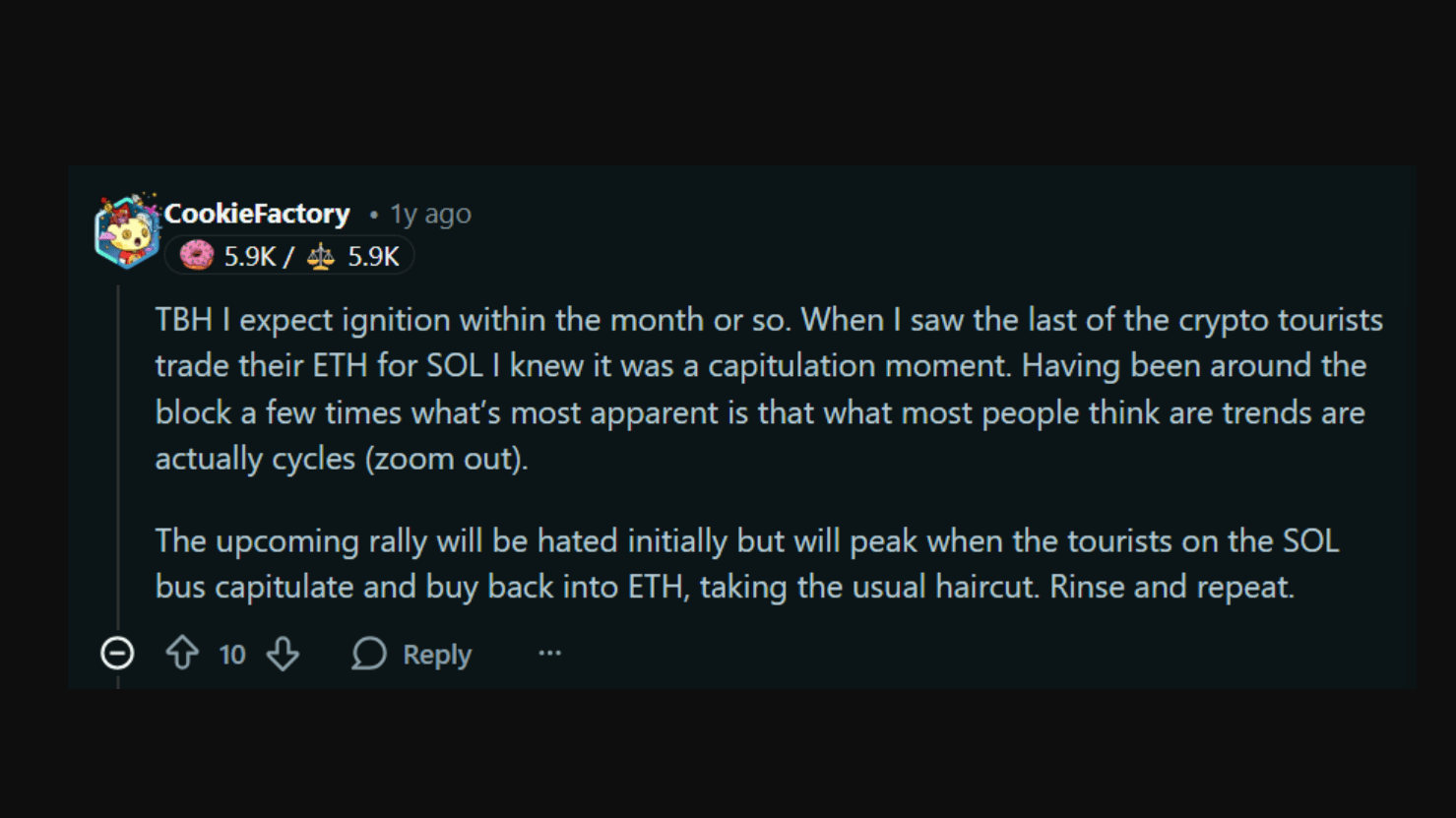
Source: Reddit
Dubbing some chain Ethereum of China or Korean Ethereum is one thing, and actually performing like Ethereum is another. Reddit discussions around eth killers crypto are filled with funny banter and leg-pulling of the “killer” hobbyists, yet they paint a clear picture of the mass notion about the chains that were meant to dethrone Ethereum.
Be it Solana, Cardano, EOD, TRX, or any potential Ethereum killers, none can truly dethrone Ethereum, given their current TVL, TPS, or security. Many of them have already faded or are on the verge of becoming irrelevant.
The ones like Solana and Cardano or Polkadot or Avalance for the matter, are still relevant because of their focus on singular attributes like speed, eco-friendliness, interoperability between chains, or throughput and scalability. Tailored to specific use cases like memecoins, research, or business cases, they might still find some footing. Yet, as of now, none of them practically have what it takes to rank up the TVL charts.
Alignment and coexistence are the only viable strategies
Instead of posing as the differentiator, the focus needs to be on coexistence. Celo is the best proof of this. They “adapted” and migrated in March last year. A secondary approach would be to keep pushing the specialisation route as Avalanche did for customised ecosystems by coming up with their custom networks or “subnets”. But that’d need constant marketing backing, and investments can anyday stretch too thin before they come to any substantial results.
Instead of slowing momentum, solving for the community would be the best bet for the future. No killing or slaughtering or racing for the first place, but focusing on interoperability, innovation, and need-based development. That way, there’d be room for all in the cryptoverse.