On December 31st, the night before New Year's, suddenly, this idea clicked in my head.
How are those meditation and zen music channels that upload 10-hour-long tracks making money? Are they really composing the stuff, or are they using top AI composition tools throughout? I went down a rabbit hole of what to and what not to.
And that's when I learned about AI music generators, the various tools available, how they work, the pros, cons, and all the other stuff.
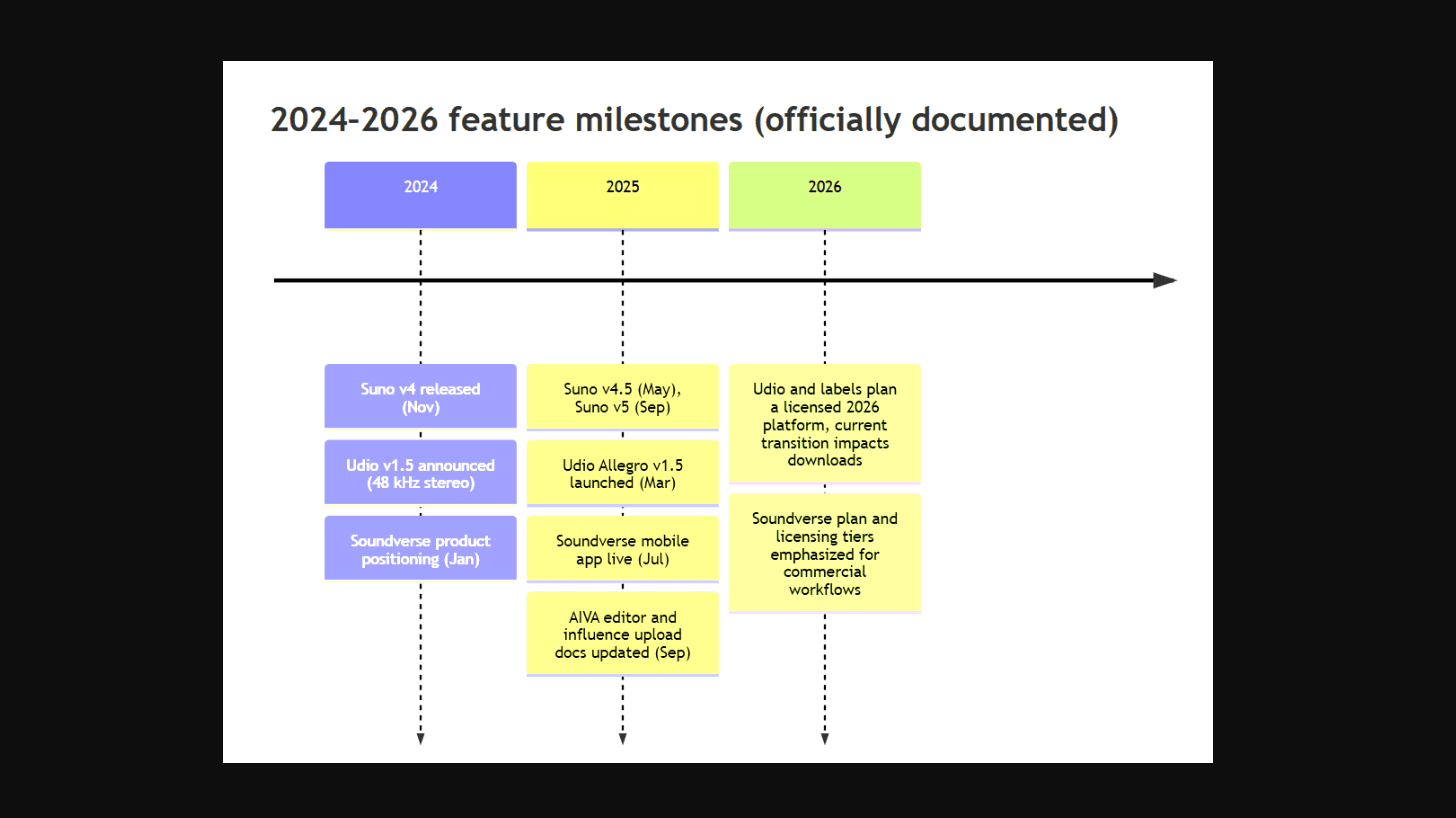
As of March 2026, these tools have evolved a lot. Instead of funny-sounding lyrics or unsynchronised tunes, tools like Udio and Suno can now output high-fidelity full-length songs from just one prompt.
The copyright scenario has also evolved. A recent stat suggests nearly 90% of the artists want their licenses protected against supposed AI-tune mimicry. This brings up discussion about artist compensations, how these models are now trained, and which platform you should look for in case you wanna make something out of this AI capability.
The thinking shift that the AI music neural engine took in 2026
That's massive if you think about how fast a soulless machine can learns this craft of music-making that took us humans years and years to master.
The MusiCoT deal-breaker
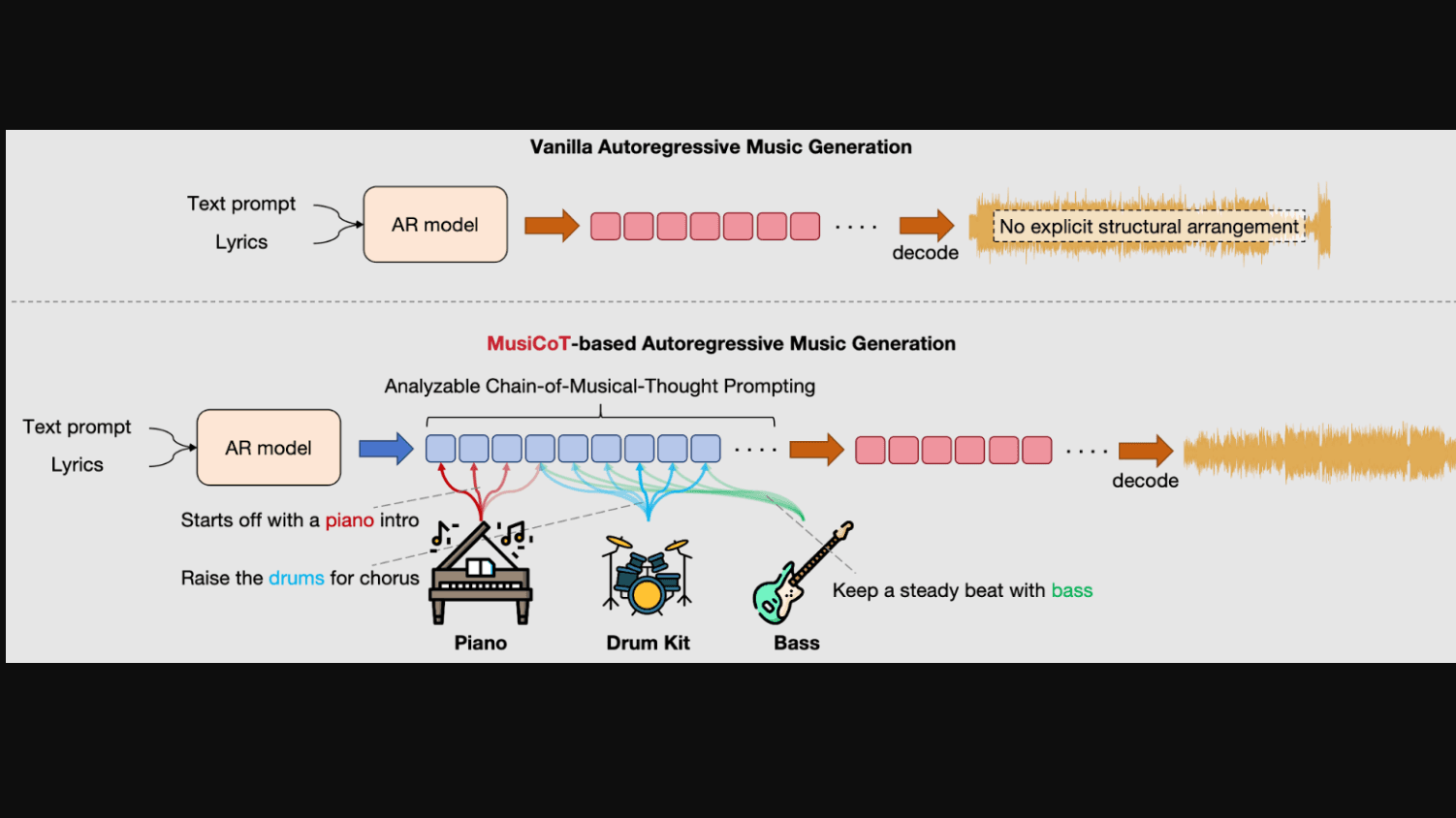
The previous architecture of these engines was to produce outputs in blobs of 10-15-20 sec, sample by sample. This changed with the coming of MusiCoT, or music chain of thought. Now these tools go through a step-by-step process to create a long, structured, finished piece.
- Step 1: Before thinking of arrangements or progression of notes, a symbolic high-level map is generated.
- Step 2: Using CLAP, or Contrastive Language-Audio Pre-training, a chain of these musical thoughts is produced to near-align with the prompter's decision-making or thought process.
- Step 3: Instead of drifting to a different tune, beat, or snare, the melody coherence is maintained throughout the entire piece.
Why are diffusion models needed as an additional layer
Break music in two parts, and you get logic and texture. The logic part is MusiCoT handled, while diffusion models regulate texture for high-fidelity synthesis. Basically, anything that was noise first, using diffusion models, you can now carve into music.
These engines can break score from timbre, keeping compositions intact. They can figure out sound based on loosely worded prompts. Via latent mapping, they can now tell from audio, text, or visual inputs…which helps match the final output to the prompter’s expected mood.
Advanced human nuance in AI music
Think of these platforms and their underlying models like this. They’ve grown in age, experience, and learned many things, and now they're capable of doing things which they couldn't before.
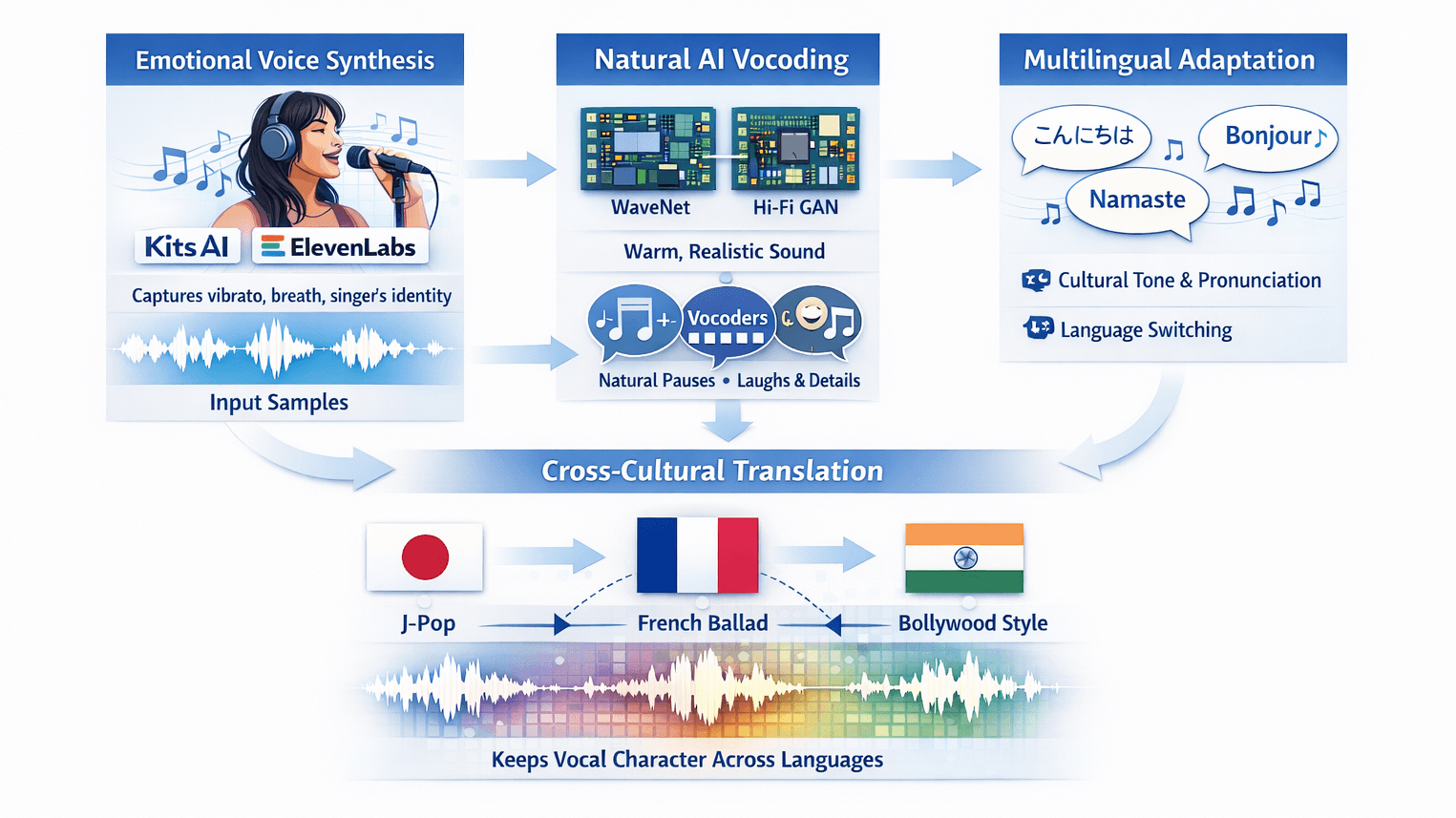
Instead of just voicing lyrics in a soulless format, they can root emotional intelligence within. Sites like Kits AI or ElevenLabs now have voices, each of which has a unique identity, vibrato, and breath patterns. Or one can just imitate so from a few secs of reference input.
Called neural vocoders, like WaveNet or Hi-Fi GAN…these can generate near-natural and warm performances. Those imperfect parts, natural pauses, maybe a light chuckle, to increase the richness of the output. Multilingual capabilities have also developed. The prompter's cultural tone, pronunciation, pauses, and fillers…these AIs can replicate to near-perfection.
Models can translate a Japanese pop to a French ballad or Bollywood song…all the while keeping the actual piece’s vocal traits unchanged.
From short blobs to a full-length emotional arc
Previously, these models couldn't differentiate that much the overall macrostructure of what is to be generated. For example, every song has this intro element, then segments of build-up, followed by chorus sections, bridges, and then an outro.
But now, they get the motive behind the composition that the user wants.
Likewise, they can shift the energy levels using “semantic tokens” up or down the complexity of the composition, create bridges to signify the gaps between the main theme and the chorus, and finally fade into outro portions.
The five best AI music generators in 2026
To be very honest, there are plenty of tools, some proprietary, some open source. But the below 5 are the top AI music generation tools 2026 that today’s creator economy is making the most use of:
Also Read: What are music NFTs and how do they work?
Suno v5
The Suno v5 is for content creators, intermediate composers, and producers who're looking for fast, prompt-to-song speed. It includes a MIDI-based post-work along with the stem in a Digital Audio Workstation. The latest version is much snappier, includes 12 different stem workflows, along with MIDI export options and tempo-locked WAV. It also includes a different studio workflow.
Three tiers of pricing: Free, Pro, and Premier, with the first one giving 50 daily credits, Pro having 2.5k credits monthly, and Premier having 10k credits monthly. Pro is $10 monthly and annually $8. Premium is $30 monthly and $24 if you opt annually.
Pros include polished quality full song outputs, along with better separation improvements. More export options, including MIDI, WAV, and stems. Studio-level exports now align with DAW workflows.
But there are also certain cons. For example, sometimes the output might sound flat or too polished. A bit of drift in styles is also here and there, and commercial rights are subscription-only, which is a boon if you consider ethical use.
Udio (Allegro v1.5)
If you're someone who remixes, extends, and edits day-n-night…basically keeps at it to get the most high-definition output, and want more export options, Udio is for you.
The Allegro v1.5 model is faster and, as announced, gives 48 kHz high-fidelity outputs. Because of a partnership change, currently, you can't download audio, video, and stems, which limits DAW workability.
There are three tiers. Free has a daily cap of three full-length songs, gives 10 daily credits with a total of 100 credits max a month. Standard has 2.4k credits a month, and Pro gives around 6k credits a month. Standard is around $10 monthly, and Pro is around $30 monthly.
Again, the pros are 48 kHz stereo generation, Allegro mode being much faster, and a prospective fully licensed platform launch to cater to major-label licensing.
Cons include official machine-readable export specs being very unclear, the current transition making the commercial use case possibilities very blurry, and the disabled downloads aspect.
AIVA
If MIDI export and editability are more of your game, and you're someone who's into short films, gaming, streaming, and content scoring, then AIVA is for you. Best feature of 2026 is you own the copyright if you're on Pro, with added features like 16-bit, 48 kHz, WAV, MIDI (reduced), and stems export range.
The pricing is of four tiers this time. Free has a 3 downloads/month cap with MP3 and MIDI exports. The standard is €11/month, but there are monetization limitations. The Pro tier is €33/month and gives you full monetization rights. The enterprise version is custom (as per what they mentioned in their EULA).
Pros include stems and MIDI first workflow with 48 kHz WAV, full copyright to the user at pro plan, and offline workflow via desktop app.
It's not an AI pop singer tool. You still need to arrange and mix pieces. So, not really a one-shot prompt kind of output. Monthly pricing for monthly billing or quarterly billing exists as per many reviews, but that’s dynamic, as it seems.
Soundverse
Don't wanna commit to a DAW-first mindset, yet need royalty-free sample usage? Soundverse gives you full ownership of the output generated. Suited for content creators, it features token-based exports, export plans for WAV and STEM, plus a tier-based licensing regulation. Another plus element is their custom AI models and DNA styles, basically full-on customisation that they provide.
There are five total plans. The Free tier features 1,000 tokens, is non-commercial, and MP3 exports are limited. Creator and Pro plans are listed at $9.99/month ($119.88 per year) and $24.99/month ($299.88 per year) when considered annually. The other two tiers are Max and Enterprise, with the first one starting at $60/month, different in specific regions, and the latter one being custom, as per what you can negotiate with sales.
The pros feature a crisp quality licensing model with sample usage options, frequent model and software updates, platform updates, and WAV slash stem exports for DAW-like workflows.
The cons are, ironically, the price variability specific to regions, certain licensing restrictions, the cause of AI-only distribution ethicalities in different regions, and audio spec technicals like sample rate and bit depth, not made transparent in the pricing page.
Loudly
Last but not least, this one's for those who're more into marketing. Best for ads, podcasts, and social snippets. Loudly assists with royalty-free instrumentals, and the distribution is made specific to a drag-and-drop DAW-style workflow. There are licensing guarantees as well.
Three total tiers are there: Free, Personal, and Pro, with prices ranging from $8 to $24, billed annually. But if you're someone who's looking for enterprise-level work, then API pricing is something custom and different. As for audio export scopes, 44.1 kHz output and stems can be exported in both WAV/MP3 formats.
The pros would be the worldwide royalty-free licensing element, API enterprise API integration possibilities, and DAW-oriented functionality.
Cons would be that it's more aligned towards instrumentals than vocals. Free tier is basically a laughing stock.
Using AI to make music? It's fine. Just say it.
The biggest AI ethics in the music space this year is Apple Music's AI disclosure tags. Basically, labels can mark their songs, compositions, videos, or artworks, whether they've used AI to create them or not.
On the training side, we all know how Clay signed AI licensing deals with Sony, Universal, and Warner last November. In essence, ethical AI in music means straightforward disclosure and a cleaner process so that in the future, no one can copy something and claim it as their own without getting called out for it.
If it's properly maintained, attribution, artist protection, along with royalties and compensation for scraped unlicensed data, can be monitored and accounted for so that both AI and human talent can coexist.