Most people trading cryptocurrencies tend to go to their favorite exchanges without giving it a second thought. However, this is not possible for large players who aim to move massive amounts of money for one simple reason - size exposes them. Working with large amounts would cause slippage, signalling, and front-running, and the market would react instantly.
Instead, they engage in Over The Counter (OTC) trading as the “private highway” for large capital flows, rather than dealing out in the open. Here, whales negotiate directly with liquidity providers, agree on a price, and settle things quietly across banking rails or custodial wallets. As a result, there are no major order-book footprints, signalling, and the market reacting or following their lead. In other words, OTC is not a choice for whales, but the only way to keep large transfers clean and invisible.
Who The Whales Are and Why They Avoid Exchanges
To be clear, the whales in OTC trading are not mysterious players but the same institutions that run global markets. That means hedge funds, market makers, corporate treasuries, miners, venture funds, and high-net-worth individuals.
They all use OTC channels for their own reasons. For example, hedge funds use them to build or unwind positions without giving competitors a hint of what they are doing, while market makers use them to manage inventory without disrupting their books. Treasuries use them to move large amounts of stablecoins or convert funds, while miners sell block rewards to buyers directly, at a price they negotiate privately.
Venture funds use OTC for treasury management and token unlocking events, and even high-net-worth individuals use them for privacy. In other words, they all use them for their own specific purposes, but the motivations are mostly the same - anonymity, depth, and settlement flexibility.
How a $1B OTC Trade Actually Happens
Source: Pixabay
So, how does a massive $1 billion OTC trade actually happen?
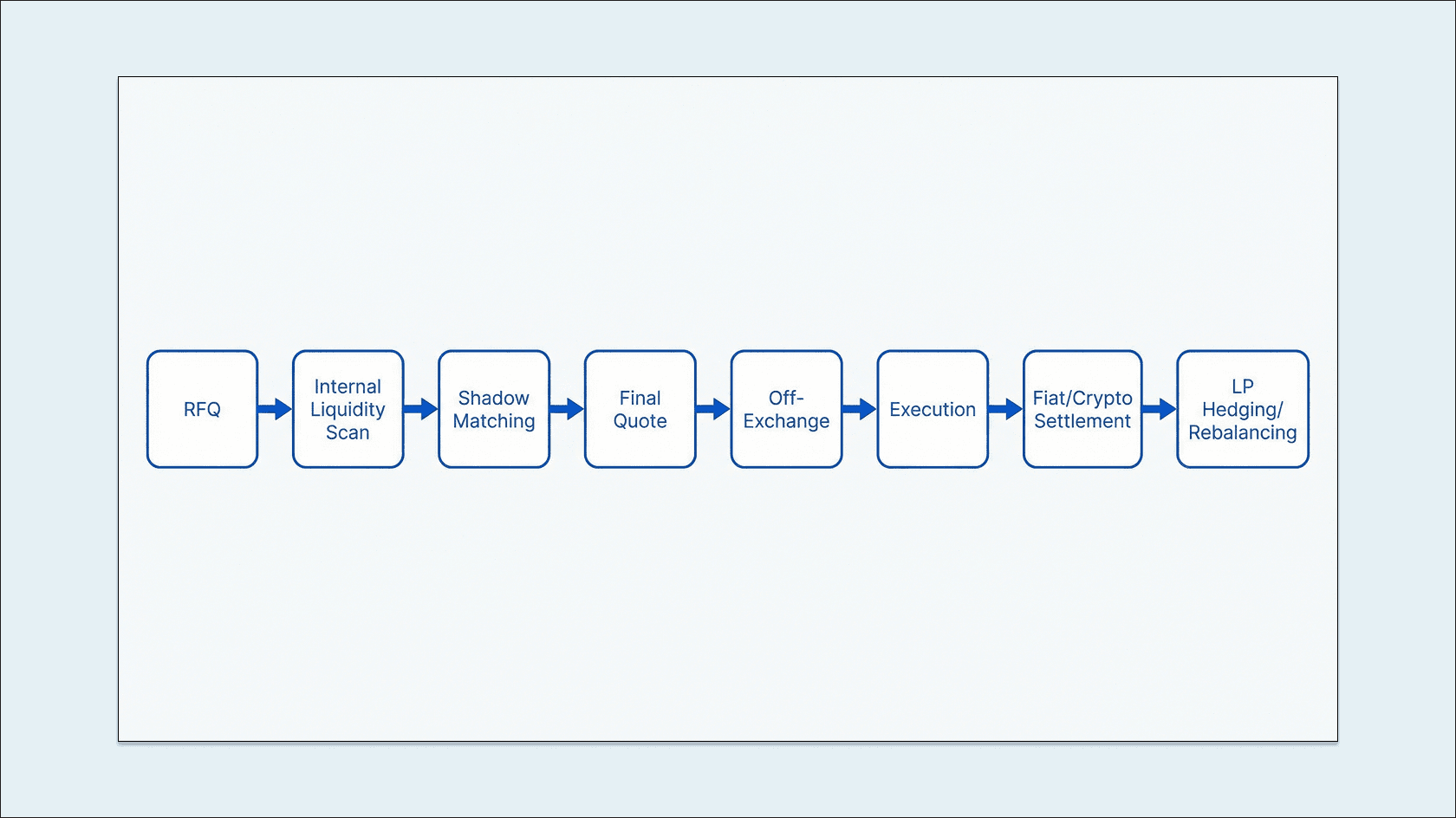
It starts with a simple request for quote (RFQ), where one of the mentioned financial institutions (like a fund or a treasury) contacts an OTC provider and explains their intention to buy $1 billion worth of Bitcoin, and then they negotiate the price. The OTC desk will consider multiple sources to find places to get the funds from.
It will check its internal liquidity pool, partnered market makers, exchange inventory, and the like. This is called internal routing, and it lets the desk see where the liquidity can be found, without revealing the identity of the client.
The third step is shadow matching, where the OTC desk combines liquidity from multiple places, often using 10 or even more providers. The idea is to do it without sending visible orders to exchanges to avoid disrupting the markets and signaling to regular traders that something is happening. On the buyer’s side, they only see a single offer by the OTC desk, but in reality, the offer was combined using liquidity from a variety of sources, and they propose a price.
If the financial institution accepts the offer, the trade is executed at the agreed price. The execution happens off the exchanges, directly between the client and the OTC desk, so the public order book doesn’t show that anything has happened. There are no sudden shifts in supply or demand, and the everyday trading proceeds as usual.
Then comes the post-trade settlement, where fiat money moves through traditional banking, such as wires, SWIFT, and instant networks, while crypto moves through wallets and custody services. After the transaction is complete, the OTC desk typically goes to multiple exchanges to buy small chunks of BTC to make up for the large $1 billion sale they just made, which can happen over several days to avoid disrupting the market.
In diagram mode, the whole process looks like this
Mechanics That Reduce Price Impact to Near Zero
As explained in the previous segment, OTC desks have their methods that can keep price impact close to zero, even when massive billion-dollar transactions are conducted. The main OTC trading strategies include pulling liquidity from different sources at once, rather than just sending one massive order to a public exchange.
If they did that, slippage would be unavoidable. Instead, they collect the full amount by drawing funds from multiple sources, like market makers, pools, partners, and even their own internal inventory. And, since trade is negotiated directly with the client, there are no signs that something is happening in the order books.
Beyond that, OTC desks also break the transaction down into smaller segments across multiple counterparties, where each provider offers a smaller amount. The client doesn’t see where the funds came from, or that they were combined into one big quote; they simply see a single amount offered by the desk.
After the trade is completed, desks also engage in hedging on exchanges, but this is also done quietly. Instead of rushing to the market, they break the hedge into smaller chunks as well and execute them on multiple platforms. In the end, if all goes well, the public will have no idea that a transaction was even made, as everything goes through anonymous execution pools and RFQ tools.
Institutional Tools and Technology
Source: Pixabay
Institutional OTC trading depends heavily on the right toolset. Using tools built for speed, privacy, and reliability can ensure that the whole process goes without complications or issues, and that it goes quickly and smoothly. RFQ systems are where it all starts, so it is no surprise that they sit at the center of the process.
They allow desks to reach out to liquidity providers and request quotes on behalf of their client, but without revealing their identity. They connect the desk through multilateral and bilateral trading platforms that make offers, including the price at which the trade will eventually be executed.
Then, there are low-latency pricing engines that reach out to exchanges to pull the price information, as well as liquidity APIs, which ensure quotes do not lag, even when the markets move quickly, which happens often in the crypto industry.
When it comes to custody, there are multiple tools used for added security, such as multi-sig wallets, insured storages, and signing processes secured via hardware. Communication is also encrypted using military-grade encryption to protect the client’s anonymity and terms of the deals. In other words, the entire infrastructure is wrapped in anonymity layers.
On top of that, some platforms add “speed bump” logic, introducing tiny delays that prevent high-frequency participants from exploiting quotes. Meanwhile, real-time quoting tools make sure that liquidity providers will keep updating prices constantly, preventing trades from using outdated information.
What Tools Do Whales Use For OTC Crypto Trading?
Whales and OTC desks rely on a variety of tools for crypto trading, such as RFQ platforms, bilateral trading systems, deep-liquidity APIs, multi-sig custody, encrypted communication channels, and more. The entire setup was created to ensure the trades will be fast, anonymous, and that they won’t disrupt day-to-day market movement.
Counterparty Screening
Operating in the crypto industry comes with plenty of risks as it is, which is why institutional OTC desks don’t take anything at face value, including counterparties. In fact, they apply the same screening process as banks do, when assessing their own clients.
The risks involved with using cryptocurrencies are many, starting with regulatory uncertainty, settlement risk, identity risk, and risk of price manipulation. For those participating, this is a rather large collection of risks, and a single failed settlement can lock up millions for a long time until the details are resolved. In other words, it is in everyone’s best interest to ensure this doesn’t happen, which is why desks run full compliance checks upfront.
Businesses evaluate OTC counterparties by checking their licensing status, financial stability, and historical performance during past settlements. They also verify if the counterparty is using audited systems, whether it follows KYC and AML rules, and how it handles custody of digital assets - if the custodian is qualified, ensured, and alike.
Desks will also often request proof of reserves as part of their checks, and those who cannot prove that they are compliant, use secure storage, and enforceable contracts are typically filtered out and not considered further. Simply put, whales don’t want any surprises during the process, and the only way to ensure that is for OTC desks to use professional and reliable counterparties.
Where the Real Risk Lives
Source: Pixabay
While the whole process comes with a variety of risks, the biggest danger in OTC trading emerges after the client, the desk, and liquidity providers all agree on the price. In other words, it happens during the settlement stage.
This is because things in OTC trading work differently than on standard crypto exchanges. On trading platforms, trades are completed instantly, and it all happens within one single system. As mentioned previously, OTC desks reach out to multiple providers, and the process includes both crypto transfers using blockchain and fiat transfers that go through traditional banking channels.
Crypto usually settles near-instantly, while banks take a bit of time, especially during cross-border settlements, and that results in differences in timing. Speed and efficiency in traditional banking are nowhere near what the crypto industry offers, with regular bank delays and technical errors that can lock up funds in limbo.
This is why many desks use third-party escrow agents who won’t release the assets until both sides have delivered. Others may employ different solutions, like using collateral and defining strict settlement terms. These terms can include T+0, meaning instant settlements, or T+1, or next-day settlement.
OTC Trading Risks You Should Know About
OTC trading carries risks in settlement delays, counterparty default, and regulatory uncertainty, since trades happen off standard exchanges and rely heavily on both blockchain and banking rails. Other associated risks include identity misrepresentation, price manipulation, and custody failures.
Risk Management Frameworks Used by Professional OTC Traders
Considering the risks they face, professional OTC desks have to apply strict management frameworks to safely move massive amounts of money without disrupting markets. That is where regulatory alignment and KYC/AML requirements play a large role, as they ensure that everyone involved complies with the local rules. This also serves to reduce the chance of legal problems.
Next, they use multi-signature wallets, which increase the security of funds. They also use multiple sources for price verification to ensure that the price is fair and in accordance with the current market.
They also use different sources for liquidity, as diversification also helps ensure that the market would not be disrupted, and it prevents them from being overly dependent on a single provider. Lastly, all agreements must be backed by formal legal contracts, similar to ISDA frameworks, which detail all the terms and obligations included as part of the settlement.
Moving $1B in BTC Without Moving the Market
If a whale wants to acquire $1 billion worth of Bitcoin without affecting the market and causing major disruptions in price, they would not go to a crypto exchange to place an order. Instead, they would approach an OTC desk.
The desk then turns to various liquidity providers and pulls liquidity from them. It uses an RFQ process to aggregate prices from all sources at its disposal, and calculates the final execution price based on the state of the market and prices from multiple sources. With the funds coming from multiple sources in smaller chunks, this does not alert the market that a massive transaction is underway.
The trade gets executed, and the desk then hedges exposure on multiple exchanges, seeking to get back the assets that were sold to the whale, while the whale receives the BTC they wanted with no public signals.
Conclusion
Institutional OTC trading allows large investors - whales - to move billions discretely, without alerting or disrupting the market. They rely on OTC desks, which, in turn, use a variety of sources to acquire the funds. This is done through tools, sophisticated risk-prevention frameworks, and it is all done in such a way that the whale’s identity, and even the fact that the transaction is taking place, is kept private.
The combination of these practices ensures that the whales get the crypto they want, while the market doesn’t notice anything. That way, the demand from the whales doesn’t cause major price disruption, and the trade continues as usual.