Scalability in blockchain refers to a network’s ability to handle large transaction volumes without slowing down. It's crucial because it affects how many transactions a blockchain can manage over time.
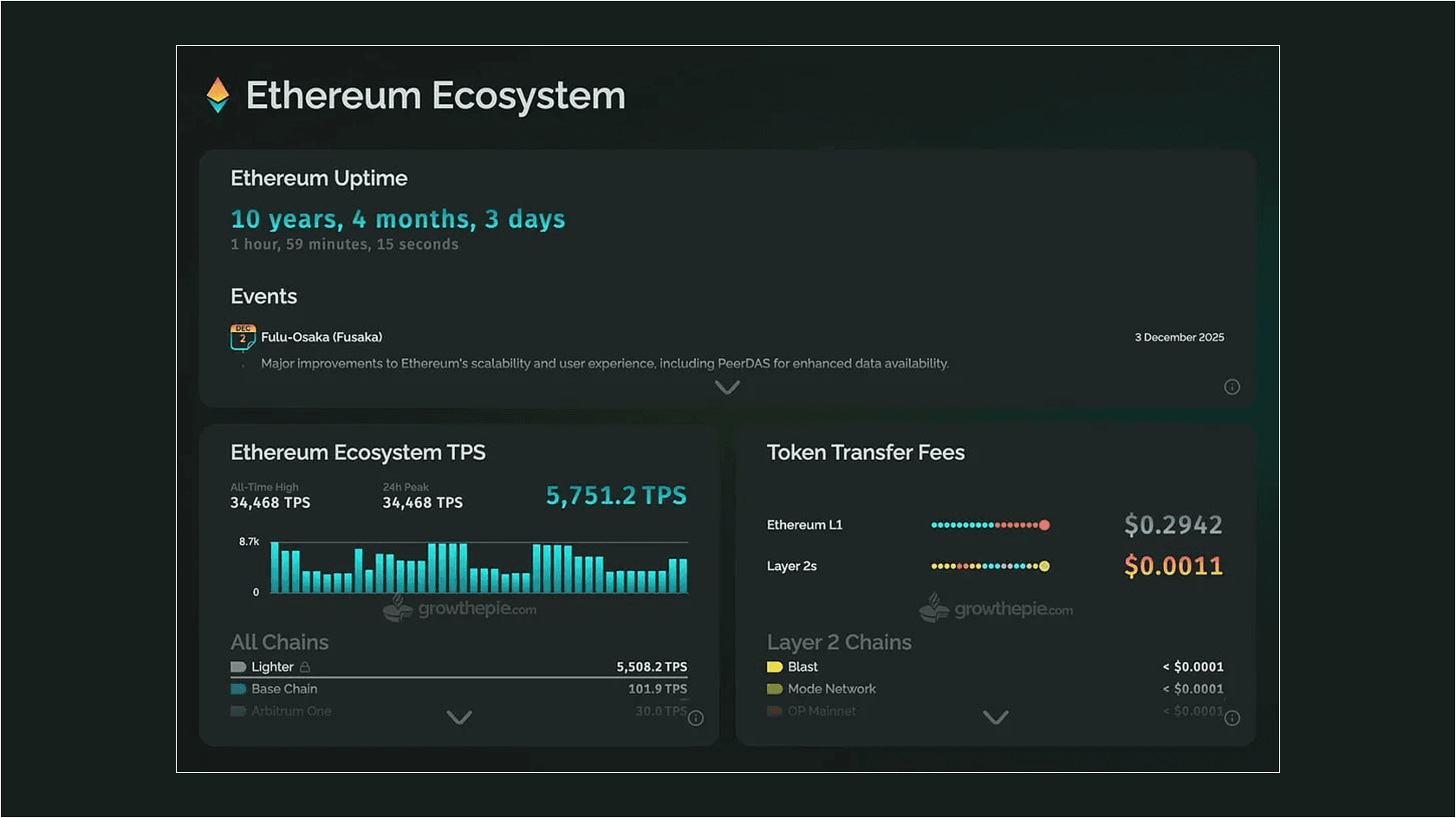
For instance, Ethereum, which was often criticised for high gas fees and network congestion, underwent a series of upgrades in 2024 and 2025. The next upgrade, Glamsterdam, is targeting 10,000+ TPS across the ecosystem.
Source growthepie.com Ethereum ecosystem stats as of 3rd December 2025
The importance of scalable Layer 1 and Layer 2 networks lies in their role in making blockchain suitable for broader applications. When a blockchain can scale effectively, it becomes more viable across sectors like healthcare, finance, and supply chain management.
Let’s explore how scalability impacts the potential of blockchain technology and how we can maximize its benefits.
Become a part of the community
Subscribe to our newsletter to be in-loop with all news from the crypto world
What Is Blockchain Scalability?
Blockchain scalability goes beyond just layer technologies — it’s about a system’s ability to adapt to heavy transaction loads smoothly. While we often think of scalability as handling growth, it also applies when demand drops; an efficient system should adjust without wasting resources.
In the business world, scalability often means leveraging economies of scale, as seen with SaaS companies. They invest heavily in development initially but can later support thousands or millions of users with minimal extra cost. For organizations, scalability also includes managing growth in workforce size without falling into chaos, which requires a strong culture and leadership.
In blockchain, scalability is usually measured by transactions per second (TPS). This makes it easy to compare networks but doesn’t tell the whole story about a blockchain’s performance under fluctuating demands. For mass adoption, a blockchain must scale to handle millions of transactions, yet many blockchains struggle here. Centralized services like Visa can process 24,000 TPS since they don’t need multiple nodes to verify transactions.
Noteworthy scalable blockchains include post-Fusaka Ethereum, Solana, and Arbitrum. Ethereum's base layer doubled to 15-30 TPS following the Fusaka upgrade in December 2025, with L2 networks collectively hitting a record 32,000 TPS, as per Arkham Intelligence.
However, achieving scalability in blockchain isn’t simple. As transaction volume grows, so does the time and energy needed for each transaction, which can slow down processing.
Blockchain scalability also involves a balancing act with decentralization and security. Focusing too much on scalability may lead to fewer nodes, weakening decentralization and, potentially, security.
This balancing act is known as the Blockchain Trilemma, introduced by Ethereum’s Vitalik Buterin. He suggested that blockchains can realistically optimize only two of three factors:
Decentralization;
Security;
Scalability.
Examples of how the trilemma plays out in blockchain technology include:
Bitcoin: Highly decentralized with strong security via proof-of-work, but lower scalability.
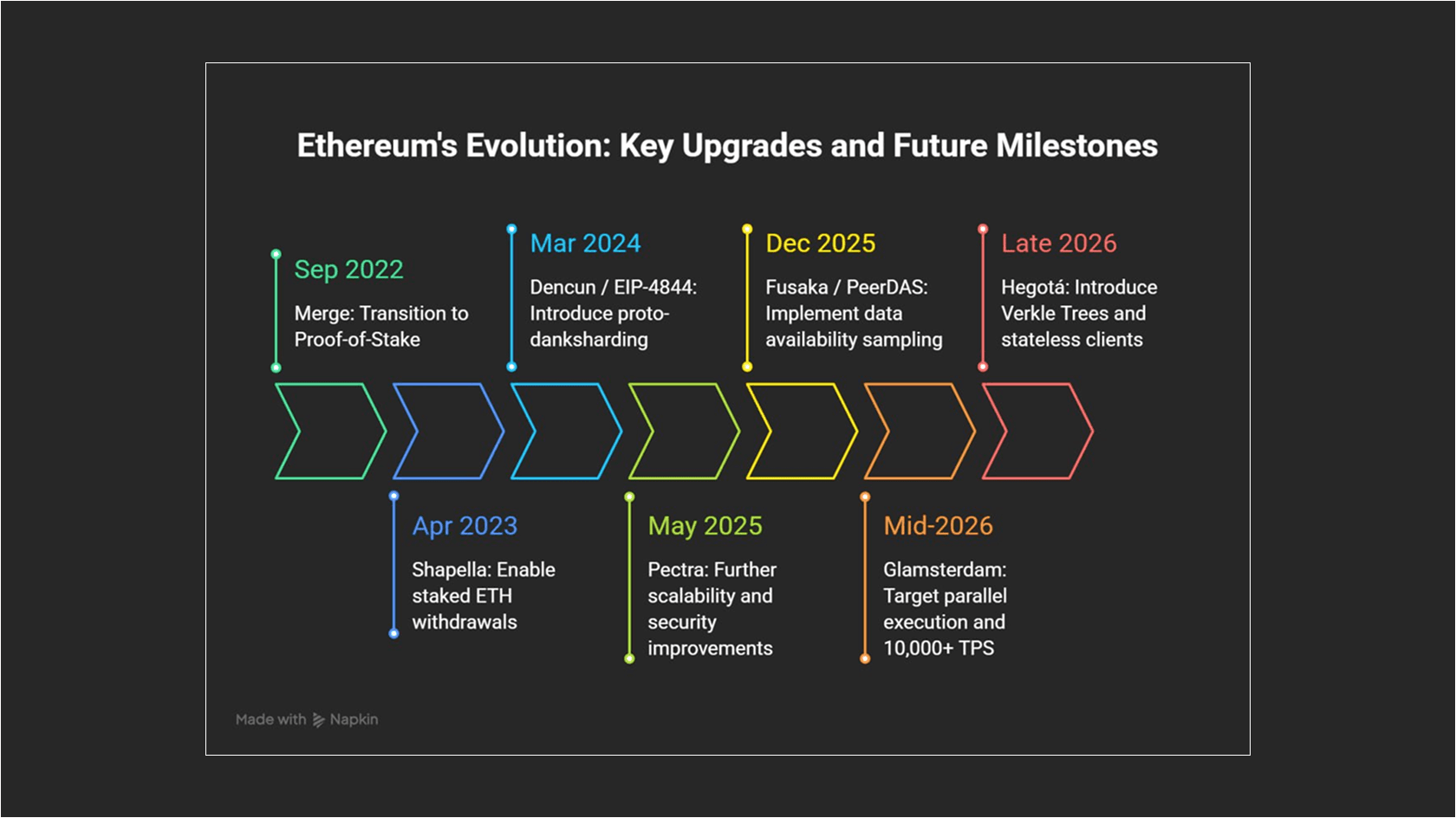
Ethereum: Broadly adopted due to its smart contract. Following the Merge in September 2022, Dencun in March 2024, Pectra in May 2025, and Fusaka in December 2025, Ethereum has made substantial gains in scalability while maintaining decentralisation through its proof-of-stake validator set.
Ripple: Efficient for cross-border transactions but more centralized, which raises concerns about security and long-term viability.
The Blockchain Trilemma remains a core challenge for blockchain developers, who continually strive to balance these factors for the most effective network.
What is Layer 1?
Layer 1 (L1) solutions focus on making changes to the main blockchain architecture itself. These adjustments are complex and take time, as they require redesigning parts of the primary network. For example, Ethereum’s transition from an energy-intensive Proof of Work (PoW) system to the more efficient Proof of Stake (PoS) on September 15, 2022, is a Layer 1 upgrade.
Fusaka (December 3, 2025) doubled the block gas limit to 60 million and deployed PeerDAS to scale data availability for rollups.
Ethereum was introduced in 2015, with low fees and a limited user base. But as its popularity grew, the network faced scaling challenges, leading to longer transaction times and higher fees. Ethereum is now undergoing a series of upgrades, all a part of its scalability roadmap.
Validators select transactions with the highest gas fees from the mempool, a waiting area for pending transactions, so a higher gas fee can push your transaction through faster. However, even with more miners, Ethereum’s transaction speed remained capped to control inflation, leading to stable but limited throughput.
To improve scalability, Ethereum shifted from PoW to PoS with the Merge, enabling sharding and rollup-centric scaling. Rather than splitting into 64 shards as originally planned, Ethereum's roadmap evolved to prioritise rollups (Layer 2 networks) as the primary scaling mechanism. Blobs, introduced by EIP-4844 (Dencun), give L2s cheap data slots on the base layer. Fusaka's PeerDAS expanded blob throughput by 8×, with further increases planned through 2026's Glamsterdam upgrade.
Ethereum’s Scalability roadmap
What is Layer 2?
Layer 2 (L2) solutions serve as enhancements to the main blockchain, designed to move certain processes off the primary network. This shift helps reduce transaction costs and boosts efficiency by lightening the workload on the main chain. One well-known Layer 2 solution is the Lightning Network (LN) for Bitcoin.
Bitcoin's high fees and slow transactions have long been a challenge. Although forks like Litecoin (LTC), Dogecoin (DOGE), and Bitcoin Cash (BCH) attempted to address these issues, the Lightning Network remains the most widely supported scaling solution among Bitcoin developers.
The Lightning Network acts as a secondary payment layer that allows transactions to happen directly between network nodes, bypassing the main Bitcoin blockchain. Within the LN, transactions are instant and cost only a fraction of a cent. Users can open a payment channel on this layer, allowing them to perform unlimited transactions without involving the main blockchain — only the final balance is recorded once the channel is closed.
The Lightning Network aims to solve Bitcoin’s scalability issue, making it ideal for microtransactions that would otherwise be expensive and slow on the main chain. For instance, small transactions — like paying for coffee or sending a few dollars to a friend — become practical, fast, and low-cost with LN. Lightning Labs, the team behind LN, developed the Strike app, making it easy for users to send and receive Lightning payments in Bitcoin.
Key benefits of the Lightning Network include:
High transaction capacity: Lightning Labs claims that LN can handle up to 25 million transactions per second — unmatched by any other blockchain or payment system.
Network relief: By processing transactions off-chain, LN reduces the strain on the main network, leading to faster speeds and lower fees.
Despite these advantages, the Lightning Network faces challenges. Limited adoption has made it hard to test its full potential, and managing funds within payment channels can sometimes be tricky. Once a channel is set up, the amount of BTC within it cannot be adjusted, which could require additional liquidity.
Though still evolving, the Lightning Network holds the promise of revolutionizing digital transactions. However, some analysts caution that the creation of hubs, where nodes hold large BTC balances, might introduce centralization risks over time.
Layer 1 vs. Layer 2: Key Differences
In blockchain technology, Layer 1 (L1) solutions refer to direct upgrades to the main network. For Bitcoin, a key example of this is the Taproot upgrade from November 2021, which enhanced privacy and efficiency. Similarly, Ethereum’s London hard fork (EIP-1559) adjusted its fee system, added token burning, and laid groundwork for future Proof of Stake (PoS) adoption. Both of these are L1 solutions since they make changes directly to the blockchain’s core.
Layer 2 (L2) solutions, on the other hand, are designed to enhance scalability by building on top of the main blockchain. Take the Lightning Network (LN) for example: it’s an L2 solution for Bitcoin, enabling faster, cheaper transactions through off-chain channels while keeping the core network intact.
Key Benefits of Layer 2 Blockchains:
Enhanced Scalability: Layer 2 solutions allow networks to handle more transactions per second by offloading some of the workload from the main chain. For example, while Ethereum processes about 15 transactions per second, a well-designed L2 network can double or triple this capacity.
Faster Transactions with Lower Fees: By scaling transaction processing, Layer 2 networks can confirm transactions faster and at lower costs. This is ideal for activities like microtransactions where main network fees might be prohibitive.
Reduced Load on Layer 1: L2 solutions help "declutter" the main chain, moving smaller transactions to secondary layers. This lowers congestion on Layer 1, resulting in faster processing and reduced fees for larger transactions.
Interoperability and Customization: Many Layer 2 solutions on Ethereum are compatible with the Ethereum Virtual Machine (EVM), allowing developers to create chains tailored for specific uses like gaming or yield farming. These L2 chains can also interact with each other seamlessly, supporting a wider range of applications.
Improved Security and Decentralization: By distributing transactions across multiple L2 networks, blockchain ecosystems become more decentralized and secure. If one network experiences issues, other L2 chains can continue operating without disruption.
Layer 1 and Layer 2 Networks: Performance Comparison
The table below provides key data for evaluating L1 and L2 networks for investment and usage decisions. All figures are sourced and dated for accuracy.
Source: DeFiLlama | A comparison of top L2s and Ethereum
Layer 1 solutions provide a solid foundation for advancing blockchain projects. By implementing upgrades directly into the main blockchain, these solutions allow for seamless integration of new tools and features that improve functionality and performance. This makes Layer 1 enhancements crucial for long-term project growth and adaptability.
Drawbacks
However, Layer 1 upgrades can be time-intensive and complex to execute. Unlike Layer 2 solutions, which operate on top of the main chain, first-level changes require considerable planning, development, and testing. This complexity often means that implementing Layer 1 upgrades takes significantly longer than second-level alternatives.
Advantages of Layer 2 Solutions
Layer 2 solutions operate independently of the main blockchain, providing flexibility and easy removal if adjustments are needed. They effectively address the blockchain trilemma, balancing scalability, security, and decentralization, without requiring extensive modifications to the main network. Additionally, implementing Layer 2 solutions is typically more straightforward than deploying Layer 1 changes, making it a faster option for scaling and enhancing blockchain efficiency.
Drawbacks
However, Layer 2 solutions can complicate blockchain compatibility. Adding new chains on top of existing ones can create communication challenges between networks, potentially limiting interoperability. There’s also a risk to security; some developers argue that Layer 2 solutions don’t offer the same level of security as the primary blockchain. Lastly, Layer 2 doesn’t fully resolve core blockchain issues. It helps alleviate certain limitations but doesn’t tackle the root problems directly.
When to Choose L1 vs L2
Use this decision matrix to match your use case to the right network:
Liquidity: L2 tokens have lower liquidity, wider spreads, and greater slippage risk on large exits
Lock-up periods/bridge risk: Optimistic rollups have a 7-day challenge window for withdrawals back to L1. Assets are locked during disputes. ZK rollups have faster finality but higher computational cost
Sequencer centralisation risk: As of mid-2026, all major L2s still use centralised sequencers. A sequencer failure can halt all transaction processing.
Bridge hack risk: Cross-chain bridge exploits total >$2.5B in losses since 2021 (Chainalysis 2025 data). Bridging from L1 to L2 introduces smart contract risk not present in pure L1 holding.
TVL as risk indicator: Higher TVL correlates with higher target value for exploits.
Real-World Applications
Layer 1 blockchains, like Bitcoin and Ethereum, form the core of the blockchain world, independently managing transactions and deploying smart contracts. Yet, they often face the “blockchain trilemma” — struggling to balance decentralization, security, and scalability. Layer 1 solutions handle essential functions such as transaction processing and security but are limited in scalability, affecting transaction speed and cost. For example, Bitcoin’s network congestion can lead to slow processing times, while Ethereum’s high demand often results in steep transaction fees.
Ethereum, a prominent Layer 1 platform, allows developers to create decentralized applications (dApps) and smart contracts. However, as more users and applications join the network, scalability challenges like high fees and slow speeds have emerged. This is where Layer 2 solutions come into play.
Layer 2 solutions, built on top of Layer 1 blockchains, aim to enhance scalability and reduce transaction costs. For instance, the Lightning Network accelerates Bitcoin transactions by creating off-chain payment channels, enabling quick and cost-effective transfers. Likewise, the Raiden Network on Ethereum uses similar payment channels to facilitate faster, cheaper transactions for Ethereum users.
Popular Layer 2 solutions such as Arbitrum, Optimism, and Immutable X are expanding Ethereum's capabilities, enabling more transactions at a fraction of the cost. These solutions are becoming essential for scaling Ethereum, especially with the rise of decentralized finance (DeFi) and NFTs, which have put a strain on the network’s resources and driven up gas fees.
Ethereum's scaling roadmap has moved away from its original "Ethereum 2.0" branding. Rather than a separate network, Ethereum's upgrades have progressively improved the existing mainnet. Vitalik Buterin has consistently argued that rollups are Ethereum's primary scaling path, and blob transactions introduced by EIP-4844 confirmed this approach. The upcoming Glamsterdam upgrade (expected mid-2026) targets parallel execution and aims to push L1 throughput toward 10,000 TPS while maintaining full decentralisation.
As Ethereum remains a leading platform for dApps, developers are exploring two main strategies to tackle scalability:
On-Chain Scaling: Involves modifying the Layer 1 network itself, as seen with Ethereum’s ongoing transition to Ethereum 2.0.
Layer 2 Solutions: Operate independently of Layer 1 but leverage its security. Layer 2 solutions handle transactions off-chain, which increases speed, capacity, and reduces fees.
Ethereum's journey towards improved scalability is a continuous effort. With a mix of Layer 1 upgrades and Layer 2 innovations, Ethereum is working to retain its position as the preferred dApp platform while managing the demands of a growing DeFi ecosystem.
Future of Blockchain Scaling
Layer 1 blockchains are designed to achieve three core qualities: decentralization, security, and scalability. But due to the “blockchain trilemma,” it’s challenging for any blockchain to excel in all three areas simultaneously. Typically, they manage to deliver on only two aspects—like Bitcoin, which is decentralized and secure but struggles with scalability.
Each blockchain tackles this challenge in its own way. For example, Bitcoin emphasizes decentralization and security, while Ripple is highly secure and scalable but less decentralized. As the technology advances, these Layer 1 blockchains will remain essential, but the features and applications of leading projects will continue to adapt and evolve.
Looking ahead, three trends could drive the advancement of Layer 1 blockchains:
Economic Efficiency: Future blockchain projects will likely prioritize resource optimization—both in energy and computing power. This shift toward eco-friendly technology could give them a competitive edge.
Interoperability: Currently, Layer 1 blockchains operate in isolation, relying on bridges to connect them. But future protocols may integrate interoperability, making seamless cross-chain transfers a standard feature.
Enhanced User Experience: For blockchain to gain mainstream appeal, it must become more user-friendly. Improved interfaces and simplified processes will be crucial for Layer 1 networks to reach a broader audience.
As the backbone of Web3, Layer 1 blockchains will need to become faster, more secure, and more accessible. Only those projects that adapt and continue to meet evolving demands will stand the test of time, setting the stage for innovations in sectors like healthcare, gaming, and even space exploration.
The Role of Layer 2 Solutions
Layer 2 solutions offer significant advantages, especially in cost-effectiveness and user convenience. With platforms that help users track stats and manage accounts across protocols, Layer 2 networks are becoming increasingly user-friendly. They’re also improving in areas like asset exchange, enhancing both affordability and security.
However, Layer 2 solutions are heavily reliant on the Ethereum network. As Ethereum undergoes major updates, any technical issues could impact both Ethereum and the second-tier projects built on it. For users seeking Layer 2 benefits without this dependency, alternatives like Fantom or Celo provide viable options with their own Layer 1 foundations. Celo, for instance, is gaining popularity in DeFi and NFT platforms, with liquidity pools on Uniswap drawing significant attention.
Investment firms, including VanEck, have a positive outlook on Ethereum’s Layer 2 ecosystem, predicting a potential market cap of $1 trillion by 2030. As of now, there are already 46 Layer 2 networks focused on Ethereum, a number that is likely to grow.
Discover. Learn. Profit
Subscribe to our newsletter to be in-loop with all news from the crypto world
Conclusion
The blockchain industry is learning that collaboration trumps competition. Rather than seeking the “best” blockchain, the future lies in combining different technologies. Integrating Layer 1 frameworks with flexible Layer 2 solutions offers a realistic path to achieving the core attributes of decentralization, security, and scalability.
Scalability remains a major technical challenge. While Layer 2 solutions are currently prominent, future improvements in Layer 1 (like sharding) could change the balance. In the coming years, we may see hybrid solutions that merge Layer 1 and Layer 2 to handle large data volumes while maintaining secure, decentralized networks.
Only time will reveal if these frameworks can fully scale while staying true to blockchain’s core principles. As blockchain technology evolves, exploring these advancements could open new possibilities across industries. Dive deeper into this field and discover how these innovations might shape the future of decentralized technology.