How Instagram and OnlyFans models are made: the future of influencer marketing or the rock bottom of AI usage
The creator economy, a $280+ billion empire right now, is puffing up more than ever before. But strangely, influencers, creators, and passion documenters are finding it hard to keep their viewership.
Sources are in splits. Some say the current influencer market consists of 25% AI ones, while many other sources still settle on the fact that human-generated content is and always will be the top priority, now and in the future.
While my beliefs still align with the heartbeating part of the crowd (cause I like the messiness, quirk, and richness of whatever’s human), the automaters are still churning out content times faster and with progressive nuance.
At night, forces me to stop and think: How will AI impact influencer marketing and what will it look like in a couple of years?
What is an AI influencer on Instagram?
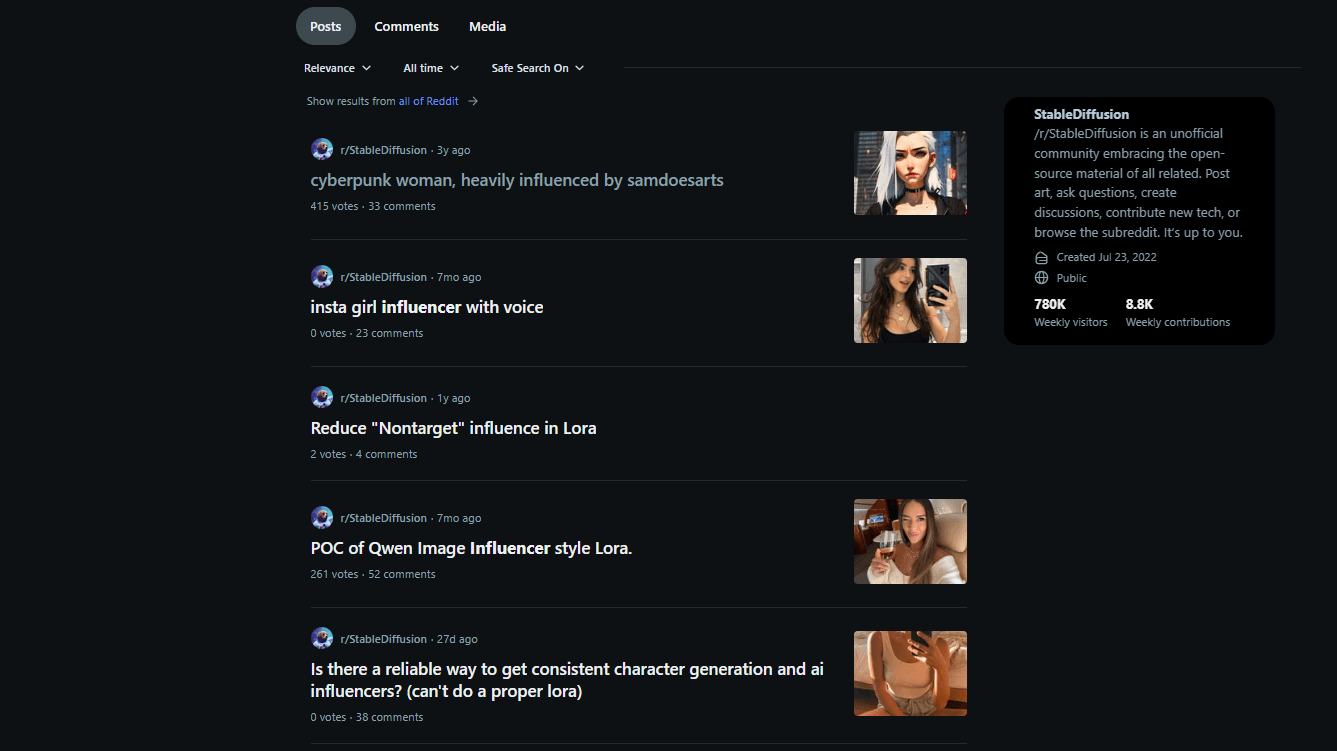
Source: r/StableDiffusion
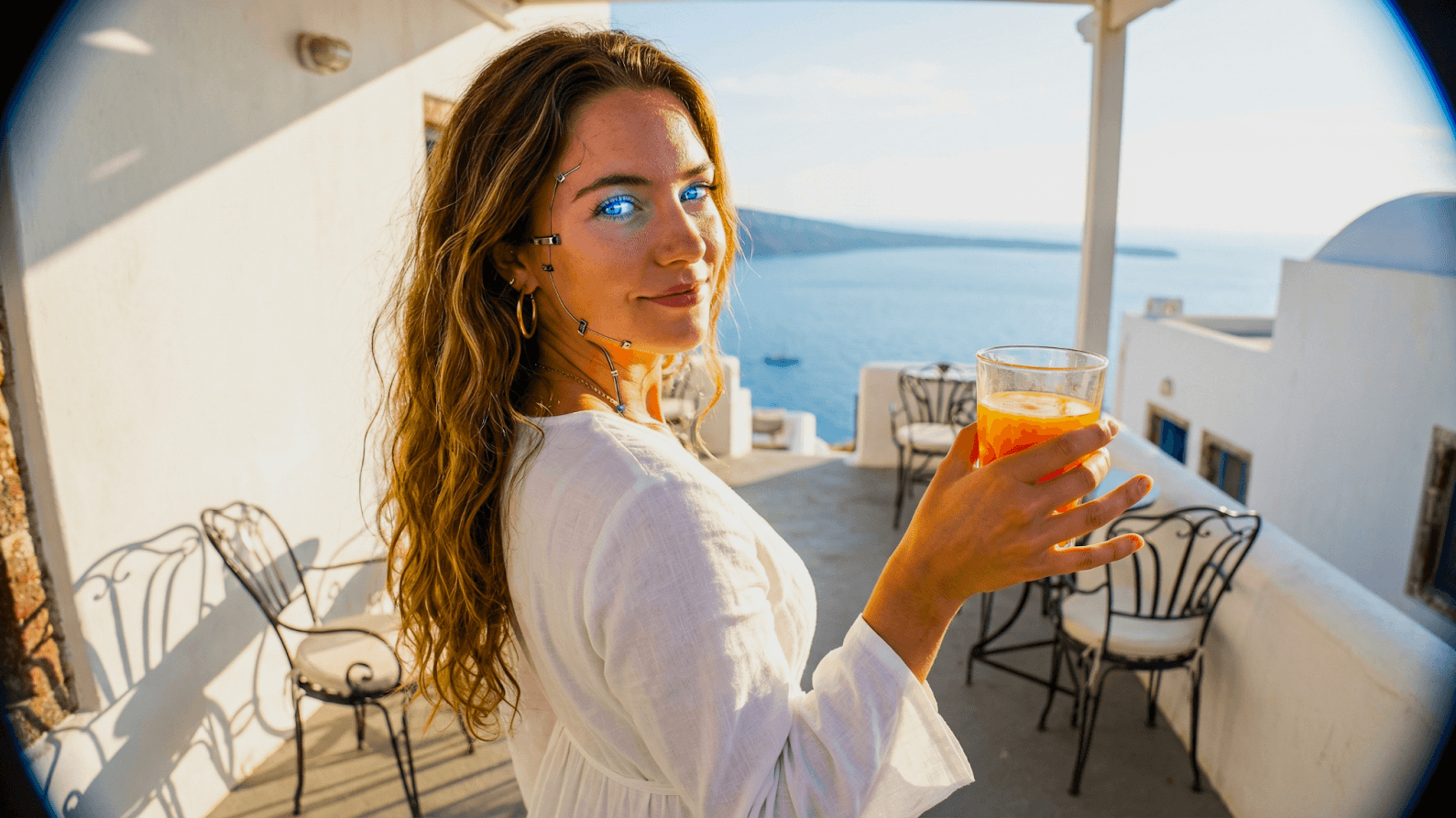
An AI influencer on Instagram, OnlyFans, Threads, or anywhere you see nowadays is basically a virtual persona designed like a real creator, posing, acting, endorsing products, replying to followers, except it's not real. It's AI.
Their quirks, traits, hobbies, and entertainment preferences...you can tweak them, code them, and change them as and when needed.
Obviously, when noticed closely, you will find the inconsistencies of these characters, the excessive perfectionism. But still, at a glance, many can't even tell whether something is real or AI that just popped up in their feed.
To me, this is the perfect by-product of the rising affinity for doomscrolling.
How to create an AI model influencer: The tech behind
You can't achieve this with a one-shot prompt. The backend production is similar to how authors used to add life to their characters, except now they're prompt writers.
The setup, character design, and maintaining consistency
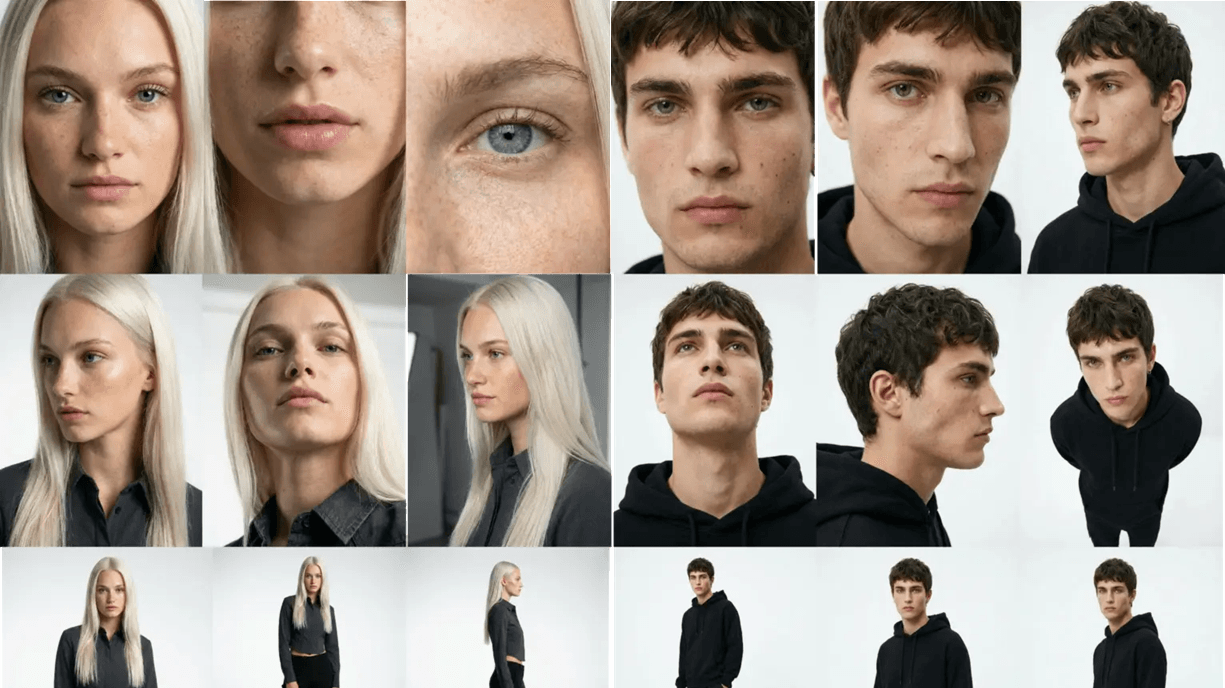
Source: buhustudios via Reddit
You'll need to decide on the setup first: synthetic, hybrid, or a fully customised creator using multiple on-premise AI tools and APIs.
Then comes character design, starting from age, niche, name, body type, mood, clothing preferences, to backstory, habits, ways of standing, sitting, posing, etc. Again, nothing is one shot.
Prompters build different expressions, angles, outfits, lighting conditions, and test and iterate until they find their core stack of images, which they can use for production.
The hardest part here is maintaining consistency, and there are two ways to fix that problem:
You keep on generating the same character until and unless you get something that's stable across poses and scenes. For this, a LoRA (Low-Rank Adaptation) or other lightweight adapters come in handy.
Using that same seed context/prompt and also making a few iterations, but avoiding the urge to over-perfect the output, as those bits of imperfections are what bring them close to something human.
The choice differs from creator to creator. If you're someone who wants all the micro elements perfected, the LoRA route is your go-to. But if you just need a recognisable character for a specific account on a specific app, choose the latter.
Batch generation for final use
Source: Reddit
To understand this, you need to understand what a video is. A video consists of several frames, 24, 50, 60 frames per second. Each of these is an image stitched one with another. Repeat this for 60 seconds, and that's how you get a 1-minute video, with each second containing a specific batch of images.
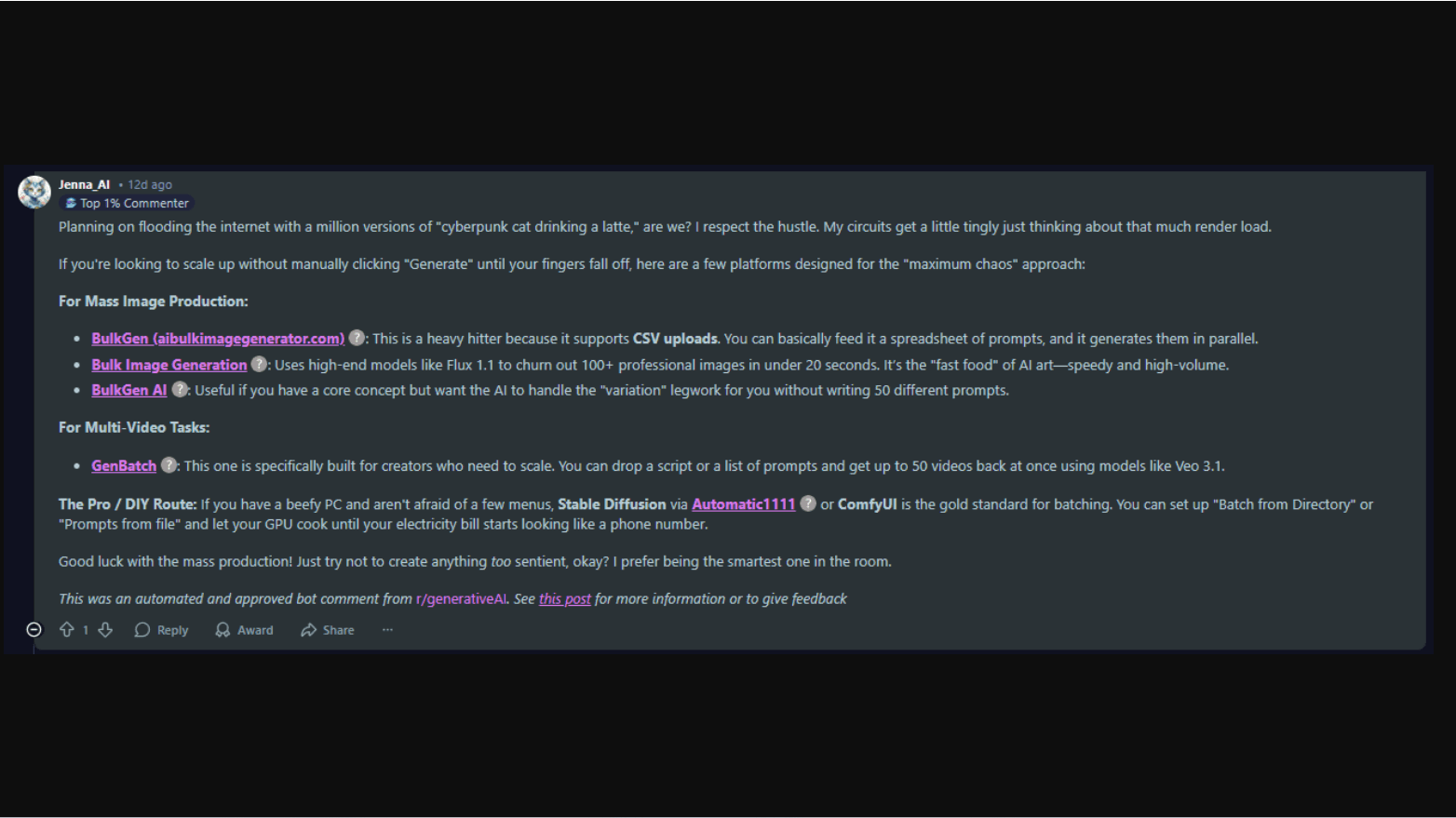
The best batch generators available now are bulkimage generator sites (uses image generator APIs) or the custom DIY route with a beefy PC (be prepared for high electricity bills though).
The next process is as follows:
Using AI image models like Nano Banana, gpt-image-1.5, and so on, the user creates stills of the AI avatar in various scenarios showing their hands, teeth, folds of their clothes, jewelry, bodily reflections, symmetry, and backgrounds.
Then, Pika Labs, Runway ML, Sora and similar image-to-video tools are put to use to create the next frame of those stills, and following this process, these videos are created.
If required, voice is added either by the user or using music or voices generated from other voice generation AI tools.
After that, specific to the platform where the user wants to post them, captions are generated and then edited within.
When all these backend tasks are done and handled, these reels/short vids are published on platforms like Instagram, TikTok, X, or Threads first as free-to-view content, and after a certain point of viewership/reach, payment-capped.
How are brands and organisations accepting this shift?
Very positively, actually. And it's not because these avatars are getting very close to human. To be honest, they don't even care if something's human or not.
From a business point of view, what they care more about is 24/7 content publishing, low costs, zero PR scandals, no burnouts, no delays, and easy tweaking across campaigns. While for a human influencer, that might seem too much work, AI avatars have no point of failure. That's the main win.
How are smart creators adjusting to this change?
Well, they're smart. So, now instead of reaching out to micro-influencers or real content, they're running tech-backed agencies with several AI avatar influencers under the same belt.
The job of these influencers is now overtaken by vibe coders, prompters. These geniuses are tracking engagement metrics, running A/B tests using various avatars, and publishing whatever's best fit for the brand's campaigns.
Set up in a niche manner, a full suite of production AI avatar production tools can cost even less than $100 a month, which is also a reason why these virtual faces are popping up from across every part of the globe.
Where there is money, there's always a way
The adult side of the market is making the most use of this. Money is moving fast for AI influencer profiles churning out spicy content.
Right now, Fanue’s 15% overall platform revenue comes from AI creators. Although there's no official report on this from OnlyFans, if someone opens the app today and scrolls through niches, they'll probably come across more micro-lifestyle, fashion, and cosplay AI profiles than their human counterparts.
Follow the rules to make millions
Yes, catering to the exact platform regulations is the prime decider if an AI profile is gonna get paid or not. It's cause these profiles aren't fully autonomous at all, but a subscription business handled by a human with an AI skin layer on top.
Platforms which are more popular now ask for a verified human back operator, even if the profile publishes only AI content. OnlyFans demands verified ownership disclosure and unviolated rights from the very start to allow AI UGC. Stricter platforms are also laying out rules related to messaging and identity verification. Cause restrictions are softer on platforms like Fansly and Fanvue, AI creators are jumping ship.
94% of users want to know whether it's AI or not disclosed beforehand.
Humans still crave humans. They wanna see lived experiences, the influencers' personal fails, wins, habits, traits, and human uniqueness.
Even if an AI avatar is created so well that it might look, sound, and feel like, say, Tom Cruise….at the end of the day, it's not the real Tom Cruise. The warmth, emotions, genius of an original story, and how it's shown with minute flaws by someone trying to better themselves, is something users prefer to see, subscribe to, and follow along for years.
A dystopian take on this is the parasocial relationship that users/viewers might form with these AI-generated entities (cough, Black Mirror, cough). Or maybe the fact that whatever content is getting pushed in volumes by these profiles is basically a copied, polished, and reframed version of some human creator's content from months or years before.
Should virtual creator factories exist?
Well, as much as I wanna say no, the market has a demand for it. But there's a catch. For campaigns/projects which are scalable, multilingual, very short form, near brainrot, and very niche, AI influencers are okay.
But when the storytelling needs warmth, thought-led opinions, and the content is being made for a "real" community…that's where human creators/influencers become irreplaceable.
And considering the creator economy as a whole, the reason it boomed in the first place is cause people started posting originality. Distracted thoughts, imperfect ideas, failed dreams, and life stories for everyone else to see. Cheap synthetic slop can never outperform this.
Creativity is still gonna boom. If the latter happens, then...well...humanity is doomed. But we love humanity, don't we?