AI Coins With Real Products: Render, ICP, Grass, and Others Beyond Pure Narrative
‘𝘞𝘩𝘢𝘵 𝘢𝘳𝘦 𝘵𝘩𝘦 𝘣𝘦𝘴𝘵 𝘈𝘐 𝘤𝘳𝘺𝘱𝘵𝘰 𝘤𝘰𝘪𝘯𝘴?’
If your answer includes tokens that survive on the AI hype cycle, THINK AGAIN. Branding isn’t a business model. Crypto market cycles have repeatedly shown that tokens launched on hype shed 80-95% of their initial gains as quickly as they gained. The AI hype is no different.
The demand-side equation for AI tokens continues to rise, with NVIDIA’s March 2026 keynote projecting $1 trillion in chip demand through 2027. AI giants, including Microsoft, Meta, and Google, have already committed hundreds of billions in capital expenditure, yet supply constraints persist.
Centralised models cannot outspend the supply problem, as the ‘problem’ was never capital. It is physical chip-fabrication capacity, energy availability, and the time required to commission new facilities.
Decentralised physical infrastructure projects, or DePINs, were built to fill in here. Projects like Render, Grass, etc., haven’t built new data centres from scratch. They aggregate idle GPUs and unused bandwidth that already exist, scattered across millions of devices worldwide.
This article looks past the marketing decks and asks whether AI coins actually work and whether an ordinary person can participate without buying a server farm.
The Three Core Layers of the On-Chain AI Stack
Most working AI crypto projects sit across three distinct layers of an emerging on-chain stack.
An AI Utility Token captures direct value from computing transactions or network actions. Every rendering job, dataset scrape, or query answered moves real economic activity through the chain.
An AI Narrative Token, by contrast, is a cosmetic wrapper. It might reference AI in its branding. But if the token is removed, the underlying project carries on exactly as before. There is no real product tying the token and utility together.
Suppose there’s a project without speculative token demand. Try to find answers to these questions:
𝑾𝒐𝒖𝒍𝒅 𝑮𝑷𝑼 𝒃𝒖𝒚𝒆𝒓𝒔 𝒔𝒕𝒊𝒍𝒍 𝒑𝒖𝒓𝒄𝒉𝒂𝒔𝒆 𝒄𝒐𝒎𝒑𝒖𝒕𝒆?
𝑾𝒐𝒖𝒍𝒅 𝑨𝑰 𝒍𝒂𝒃𝒔 𝒔𝒕𝒊𝒍𝒍 𝒑𝒂𝒚 𝒇𝒐𝒓 𝒕𝒉𝒆 𝒔𝒄𝒓𝒂𝒑𝒆𝒅 𝒅𝒂𝒕𝒂?
If the answer is no, the token is decorative.
The Decentralised Compute Layer
The compute layer is a network that connects idle hardware, turning it into rentable capacity. Render is a GPU marketplace that aggregates underutilised graphics cards owned by individual node operators to pool together processing power. This pooled resource is available on demand to AI developers and 3D artists.
The economics of a decentralised compute layer are impressive. A single NVIDIA H100 instance can cost 60-80% less on a decentralised marketplace than the equivalent reserved instance on AWS.
The Distributed Data Layer
Large language models are only as capable as the data they are trained on, and fresh, geographically diverse web data is becoming scarce for centralised scrapers operating from a single cloud region. Grass solves this by routing data collection through millions of residential internet connections rather than a handful of data centre IP ranges, avoiding the rate-limiting and geo-blocking that throttle conventional scraping infrastructure.
The Core Infrastructure and Index Layer
The final layer makes blockchain and web data usable by applications and AI agents. For instance, Internet Computer (ICP) runs entire web applications, frontend, backend, and storage, directly on-chain. The Graph indexes on-chain data into queryable APIs that thousands of decentralised applications depend on daily.
Case Studies: Live Software and Working Physical Hardware
Check how these protocols add to the working physical hardware:
Render Network (RENDER)
Render is the world’s first GPU rendering platform, i.e., it is a distributed network that connects GPU providers with idle capacity to offer processing power at a fraction of centralised cloud pricing. Render has at least 5,600 active node operators today.
Users who need 3D rendering and AI/machine learning computations can connect to the network and pay for these services in RENDER tokens. It uses the burn-and-mint equilibrium model to tie token supply directly to demand. Whenever a user pays, those tokens get burned. The node operators receive freshly minted RENDER as an incentive.
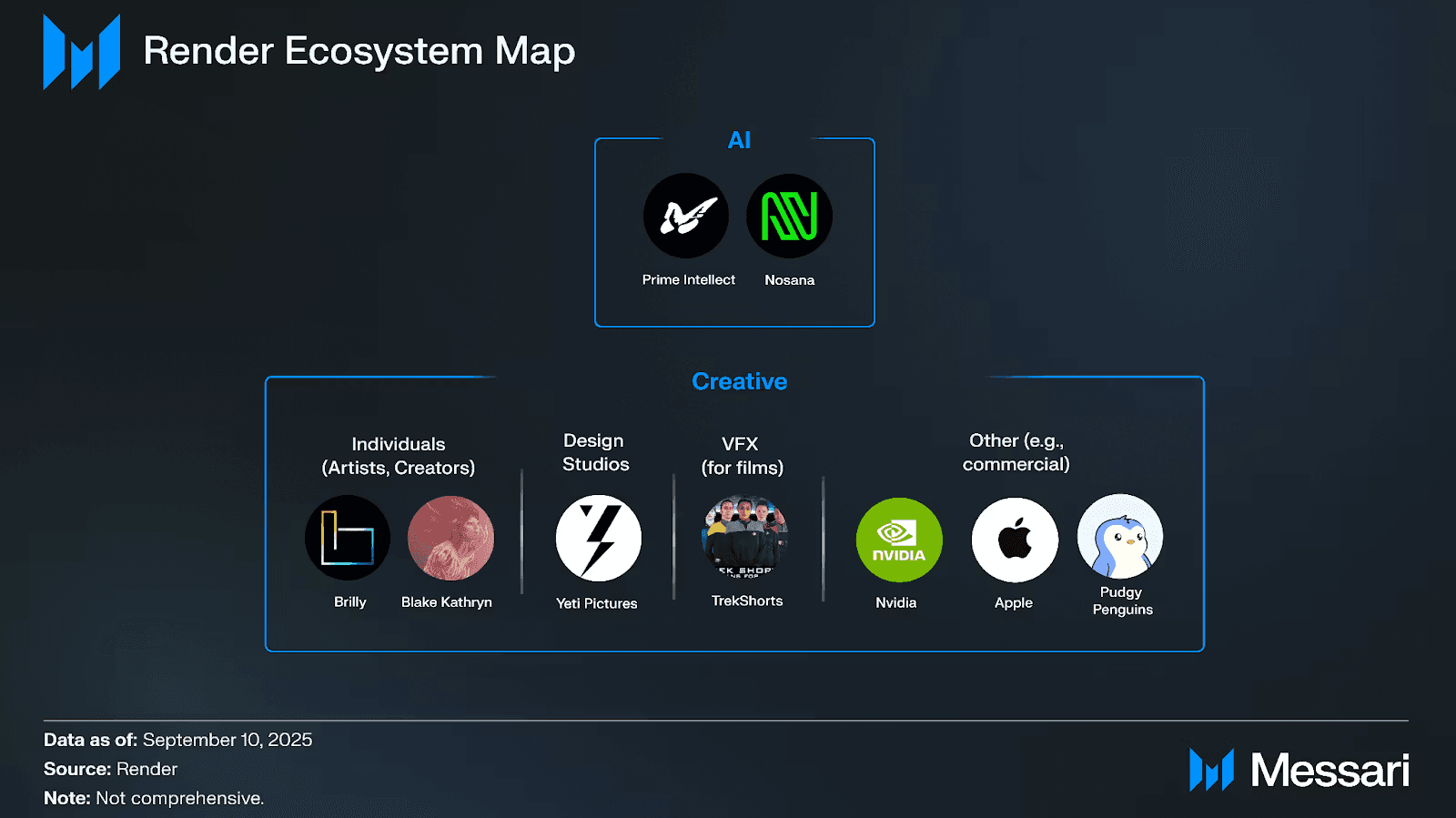
Source: Messari | Render ecosystem map
The network has now processed over 63 million cumulative frames, with token burns surging roughly 27% year-over-year between 2024 and 2025, according to Messari's analysis of the Render Network.
Render is expanding beyond its original general-purpose AI compute network role. The launch of Dispersed, a dedicated subnet for AI workloads, and the proposed Salad Network integration, which would add over 60,000 consumer-grade GPUs.
Internet Computer (ICP)
ICP stores and executes full-scale web software directly on-chain, inside containers called canisters. It does not rely on Web2 cloud dependencies such as AWS or Google Cloud for hosting. The network has processed over 287 billion transactions since its launch in 2021 and supports nearly 1,100,000 deployed canisters across 49 specialised subnets spread across 33 countries. ICP is secured by chain-key cryptography that delivers sub-second finality.
Internet Computer Network stats at a Glance
Network stats (2025–2026)
1B+ transactions in Q1 2026
~980,000 deployed canister smart contracts
1.24 million active wallets
2,044 GitHub commits in Q1 2026
Caffeine AI toolkit: cuts inference costs 20–40%
Mission70 roadmap: reduces annual inflation from 9.7% to 5.4%
Its Caffeine AI toolkit lets developers run large-language-model inference directly inside canisters. It can cut inference costs by an estimated 20-40% compared with relying on centralised API providers. Chain Fusion connects ICP trustlessly to Bitcoin, Ethereum, and Solana, helping it position itself as a genuinely decentralised alternative to the standard cloud-plus-API stack that most AI applications still depend on.
Grass allows users to monetise their spare internet bandwidth for companies to scrape, verify, and structure public web data for AI model training. A ZK Processor added in 2025 generates zero-knowledge proofs, which confirm that scraped content was not altered in transit. The ZK proof addition has upgraded the network from a simple bandwidth marketplace into a sovereign data rollup with its own validator and proof layer.
The network has scaled to 2.5 million registered nodes across 190 countries, generating an estimated tens of millions of dollars in annual revenue from selling scraped, structured data directly to AI laboratories, per DEXTools' 2026 breakdown of Grass. Grass also won a $10 million bridge round in October 2025, backed by Polychain Capital and Tribe Capital.
Alternative Networks to Watch: Bittensor, NEAR, and The Graph
Bittensor (TAO)
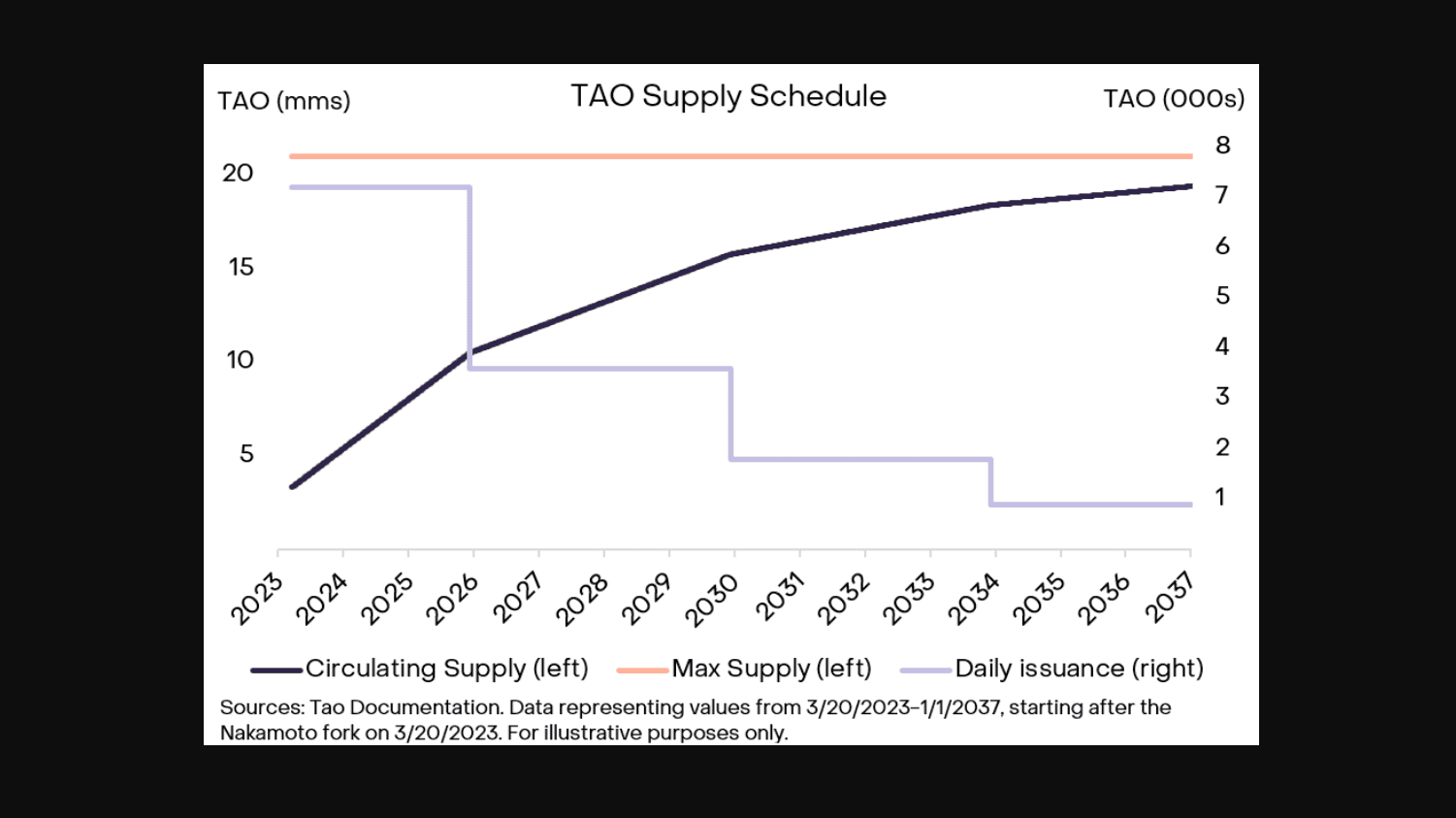
Bittensor (TAO) applies Bitcoin-style scarcity to AI intelligence supply. It has a hard cap of 21 million tokens. Contributors train and serve models across 128 specialised subnets. Each subnet has its own competitive micro-economy.
Subnet 64, known as Chutes, offers serverless AI compute with Trusted Execution Environment (TEE) protections. Chute delivers inference at costs up to 90% below centralised providers such as AWS. A December 2025 halving cut daily emissions in half, further tightening the scarcity model.
Near Protocol
NEAR Protocol gives autonomous AI agents a settlement layer fast enough to transact on a user's behalf. Its sharded architecture delivers roughly 1.2-second finality, and the NEAR Intents system abstracts away the wallet and bridge complexity that normally accompanies cross-chain activity.
The network counted around 50 million monthly active users by September 2025. Thoughits live mainnet throughput of around 63 transactions per second under typical load sits well below the headline million-TPS figures drawn from testnet benchmarks.
The Graph
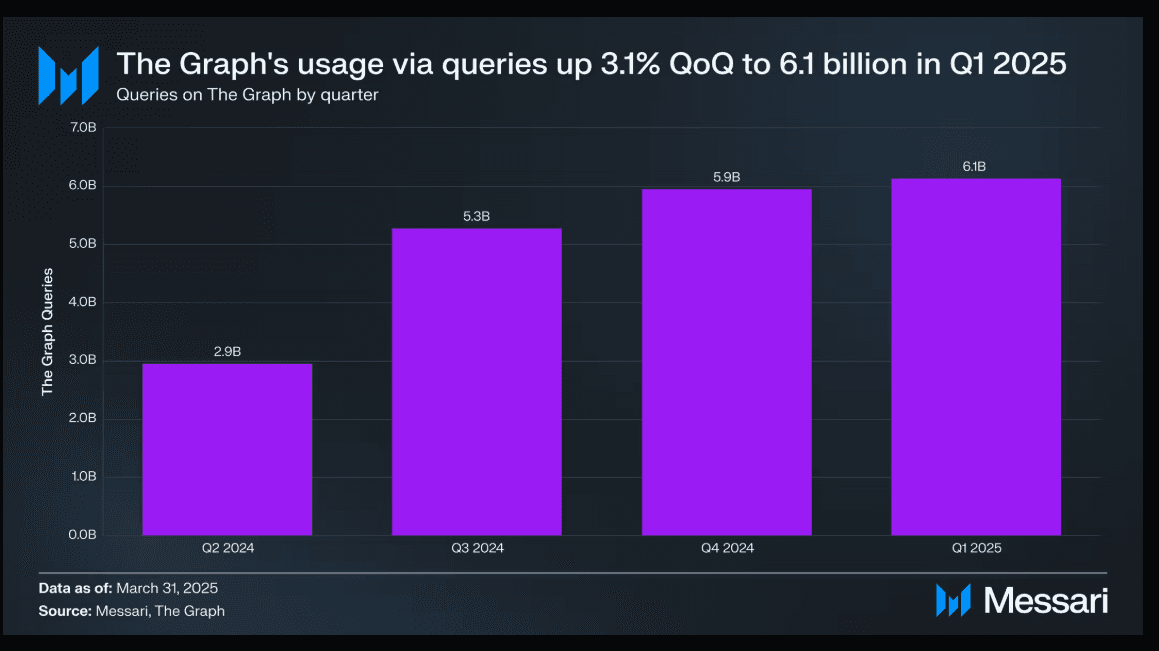
The Graph (GRT) provides the indexing layer that developers and AI agents can use to query blockchain data. Its subgraphs support over 1,100 projects spread across over 40 chains. The network processed more than 6.14 billion queries in Q1 of 2025, up 3.1% from the previous quarter.
Source: Messari | The Graph reached an all-time high of over 6.14 billion queries in Q1 of 2025
Its 2026 roadmap leans explicitly into agentic demand with the x402 protocol. This protocol allows AI agents to query the network autonomously and pay per request without setting up API keys in advance.
AI Infrastructure Tokens at a Glance
Token
Stack Layer
Live Activity
Token Mechanic
Retail Entry Point
RENDER
GPU compute
63M+ frames rendered
Burn-and-Mint Equilibrium
Bounty Platform; Salad nodes
ICP
Full-stack on-chain infra
1B txns Q1 2026
Cycles burn (deflationary)
Neuron staking via NNS
GRASS
Web data scraping
8.5M nodes, 190 countries
Epoch-based bandwidth rewards
Browser extension
TAO
AI model marketplace
128 active subnets
Hard-capped halving schedule
Subnet delegation
GRT
Data indexing
6.4B queries/quarter
Query fees + staking
Delegate to an Indexer
How exactly do retail users earn rewards from decentralised AI infrastructure?
Small and retail participants can earn rewards on these networks in four easy and accessible ways:
1. Small-Ticket Infrastructure Contribution
With a regular browser extension and a stable internet connection, you can become a contributor on platforms like Grass. Grass only uses the bandwidth that would otherwise sit idle on your GPU. Render's proposed Salad integration follows a similar logic for GPUs. Render also allows consumer-grade hardware to participate in the network without any specialist equipment.
2. Delegated Staking Frameworks
You can become a delegator on The Graph and stake GRT to an indexer to receive a proportional share of that Indexer's query fees, without running any indexing infrastructure. ICP holders lock tokens into governance ‘neurons.’ These are digital entities which get created when users lock ICP tokens within the Network Nervous System (NNS), ICP's on-chain autonomous governance system. The longer you lock tokens, the higher rewards you earn alongside voting rights in the NNS. 44.3% of ICP’s circulating supply is currently locked in neurons.
3. Data Monetisation and Tokenised Curation
You can also become a Curator on Graph if you have enough domain knowledge to signal which subgraphs are likely to generate high query volume. As a Curator, you can earn a 10% cut of the resulting query fees in return. Grass node operators can also earn proportional rewards based on the verified data volume their connection contributes to each epoch.
4. Ecosystem Execution Bounties
Render launched a Bounty Platform for its community in July 2025. The program opens community-led development contributions to direct token rewards. Individual Bittensor subnets issue their own micro-bounties tailored to specialised tasks, such as serverless deployment work on Subnet 64, accuracy-scored genomics work on smaller subnets, etc. Developers with niche skills can contribute to these tasks and earn TAO.
Risk Assessment: Technical and Structural Vulnerabilities
Though earning opportunities are many, none of these come without genuine friction. A fair assessment has to sit alongside the optimism.
Enterprise SLA Failures Versus Centralised Web2 Clouds
A centralised cloud provider offers contract-based service-level agreements, 24/7 support, and a single point of accountability. Decentralised networks still lack these assurances. These networks may face reliability issues from users owing to node churn, latency variance, and the geographic spread of capacity. AWS or Google Cloud never face such kind of risks.
Token Inflationary Pressures Versus Real Ecosystem Demand
Strong technology does not automatically translate into sound token economics. For instance, Grass's top 100 wallets control 96.7% of the total supply. That’s a persistent concentration risk. Add to that, Grass is planning a Season 2 airdrop of roughly 170 million tokens, expected in the second half of 2026. Airdrops and token unlocks have become notorious triggers for extreme selling pressure, leading tokens to lose most of their value. Though Grass’ airdrop is happening in phases, it could turn into a genuine sell-pressure event.
On the bright side, projects like ICP and Bittensor are prepping their tokenomics to tackle this issue. ICP's Mission70 roadmap directly targets this kind of dilution risk, cutting annual inflation from 9.7% down to 5.4%. Bittensor's December 2025 halving achieved something similar by cutting daily emissions in half outright.
Source: Grayscale | TAO has a four-year halving cycle and a maximum supply of 21 million tokens
Operational Fragmentation in Protocol Mergers
The Artificial Superintelligence (ASI) Alliance, formed from the 2024 merger of Fetch.ai, SingularityNET, and Ocean Protocol, show how consolidating heterogeneous platforms has its own complexities and risks. Under the ASI Alliance, three previously independent protocols now share a single token, but standardised, unified performance metrics across the merged network are still catching up to the marketing.
Multi-subnet architectures also face a related but opposite pressure. Bittensor replaced its lowest-performing subnets under its incentive structure. This arrangement helps keep quality high but can introduce short-term instability as weaker subnets cycle out.
AI Coins Are Still Catching On
The GPU crunch is an actual procurement problem, and the largest technology companies on Earth cannot solve it by just spending more money. The constraint sits in the physical chip supply and energy capacity. The AI coins we talked about in this article are tackling this problem head-on.
Render is rendering frames. Grass is scraping and verifying terabytes of data daily. ICP is executing a billion on-chain transactions a quarter. None of that guarantees that any single token will hold its value over a five-year horizon. Tokenomics, developer retention, and enterprise trust all remain open questions.
The platforms acknowledge the challenges they face and are continuously evolving to bypass them. Today, the infrastructure layer beneath the AI economy doesn’t just sit in ambitious white papers. They are working prototypes, real-world use cases, and successful ventures. What we need to watch is how these projects scale up in the coming times.